How to Fix Overspending: The 3 Leaks Your Budget Misses
Your budget isn’t failing because you’re “bad with money.” It’s failing because it’s missing three leaks that modern life is engineered to hide.
You can be a competent adult with a job, a 401(k), and a vegetable drawer you fully intend to use… and still wake up on the 28th like: “Where did my paycheck go?”
Also, you’re not alone. A CNBC report cited a survey showing 60% of Americans are living paycheck to paycheck, 70% feel stressed about finances, and only 45% say they have an emergency fund (with many under $5,000). It also reported 61% are in credit card debt with an average balance of $5,875. That’s not “personal failure.” That’s a system-level faceplant. (CNBC)
Here’s the part nobody talks about: overspending usually isn’t one big stupid decision. It’s three small leaks that never make it into your budget. Plug those, and your “willpower” suddenly looks amazing.
The overspending problem: your budget only sees what you planned
Meet “Jordan.” (Not your Jordan. A Jordan. Possibly you.) Jordan has a budget. Categories. Caps. Even a little “fun money.”
But Jordan’s budget is built on the fantasy version of Jordan: the one who cooks at home, never forgets annual renewals, and doesn’t treat DoorDash like an emotional support animal.
In real life, overspending shows up when actual cash flow quietly diverges from the story you told yourself at the beginning of the month.
To fix overspending, don’t “try harder.” Change what your budget is capable of seeing.
Here are the 3 leaks your budget misses.
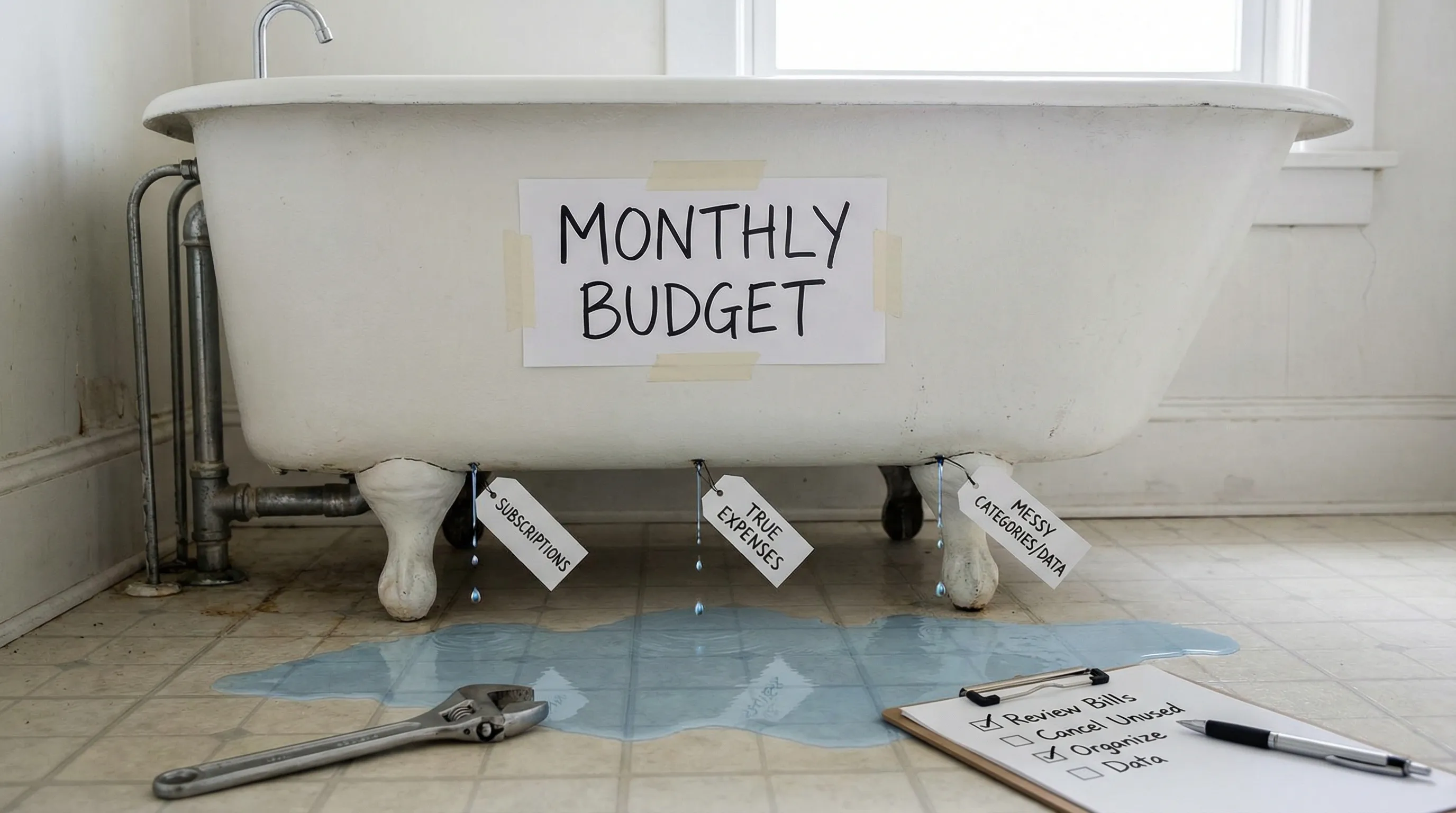
Leak #1: The silent auto-pay army (subscriptions + recurring charges)
Subscriptions are the gremlins of personal finance: feed them after midnight (free trial), and suddenly you’re supporting a small digital village.
The leak isn’t just Netflix. It’s the whole autopay ecosystem:
- Subscriptions you forgot
- Price hikes you didn’t notice
- Annual renewals you never planned for
- “Membership savings” that cost more than they save
The 20-minute recurring charge audit (no monk mode required)
Pick one rule: anything recurring must justify its existence. Not emotionally. Financially.
Do this:
- Pull the last 60 to 90 days of transactions.
- Filter for keywords like “monthly,” “annual,” “membership,” “renewal,” and the usual suspects (Apple, Google, Amazon).
- For each recurring charge, write a 1-line verdict:
- Keep: I use it weekly (or it saves me real money).
- Pause: I’m “meaning to use it.” (That’s not a plan.)
- Cancel: I didn’t know this existed.
Then set a cap: “Subscriptions cannot exceed $X/month.”
Quotable truth: If you can’t remember signing up, you definitely can’t afford it.Make it stick with one policy
Adopt the One In, One Out rule:
- Want a new subscription? Cool.
- Cancel one first.
This single rule stops subscription creep without forcing you into 2011-level deprivation.
How FIYR helps (lightly, not like a billboard)
If you want this to stop being a detective show, FIYR’s subscription tracking and transaction organization make recurring charges easier to spot, then contain. When you can see the recurring stack clearly, you can finally negotiate with it.
If you want the deeper subscription-cleanup workflow, FIYR already laid it out here: Best apps to manage subscription renewals.
Leak #2: “True expenses” that show up like jump scares (lumpy costs)
Most budgets are built for a world where bills are monthly and life is predictable.
We do not live in that world.
Your real life includes:
- Car repairs
- Medical bills
- Birthdays
- Travel
- Holidays
- Insurance premiums
- Annual fees
If these aren’t in the budget, you’ll overspend even if you’re “under budget” in groceries.
Why this fixes overspending: lumpy costs force you into last-minute funding, usually from your credit card, your savings, or your “well I guess we’re eating vibes for dinner” fund.The true-expense formula (simple enough to tattoo)
For each lumpy cost:
Monthly set-aside = (Annual cost ÷ 12)That’s it. That’s the whole religion.
The “Sinking Funds Starter Pack”
Create 4 to 6 true-expense buckets before you get fancy:
- Car maintenance
- Medical
- Gifts + holidays
- Travel
- Home maintenance
- Annual renewals (the “surprise, it’s $119” category)
If you need a full walkthrough, use this: Sinking funds guide.
The move that instantly reduces overspending
Stop budgeting monthly. Budget monthly-ized.
When true expenses are funded gradually, “random” costs stop hijacking your plan.
Quotable truth: Most overspending is just bad calendaring.FIYR tie-in
FIYR makes this cleaner because you can:
- Create custom categories for true expenses
- Use goal tracking so those buckets build over time
- Watch your safe-to-spend balance so you stop accidentally funding “future bills” with “current fun”
If you want a system built for real life, not a spreadsheet cosplay, start with: Flexible budgeting: build a system that bends.
Leak #3: Category lies (messy data that makes you feel “fine” until you’re broke)
This one is brutal because it’s invisible.
A “normal” budget breaks when:
- Amazon is 37 different life choices and you categorized it as “Shopping”
- Venmo is half dinner and half rent, but it all lands in one place
- Refunds and reimbursements smear the truth
- Credit card payments get counted as spending (or not counted at all)
- Everything you didn’t categorize becomes “Misc,” aka the budget witness protection program
If your categories are lying, you will not fix overspending because you’re not responding to reality. You’re responding to a spreadsheet fanfic.
Why this fixes overspending: bad data makes you confident at the exact moment you should be cautious. That’s how people end months with “I don’t know what happened” and a credit card balance that does.The clean-data fix: fewer categories, better rules
Aim for 8 to 12 decision categories you actually control.
Examples (keep it boring on purpose):
- Groceries
- Dining + delivery
- Transport
- Shopping
- Kids
- Health
- Subscriptions
- Travel
- Bills
- Savings / investing
Then add one honesty category:
- Needs review (temporary holding tank for anything messy)
Use labels for context, not categories for everything
A category answers: “What kind of spending is this?”
A label answers: “What was this for?”
So instead of making 30 categories like:
- “Wedding stuff”
- “Wedding travel”
- “Wedding outfits”
You keep normal categories and add a label like “Wedding 2026” across all of it.
This is how grown-ups track real life.
If you want a clean setup template, this helps: Budgeting categories list.
The automation play (because you’re busy, not broken)
Create transaction rules for your repeat offenders:
- Always categorize Starbucks as Dining
- Always split your paycheck correctly
- Always tag your gym as Subscriptions
This turns “I’ll remember” into “it happens automatically.”
More on the mechanics here: Spending rules automation.
Quotable truth: A budget without clean categories is like a scale that lies. You don’t need more discipline, you need a better instrument.The “Leak Check” scoreboard (steal this)
You don’t need 40 metrics. You need three that reveal the leaks.
| Leak | What to measure | What “bad” looks like | The fix |
|---|---|---|---|
| Recurring charges | Total subscriptions + memberships per month | You’re surprised by the number | Audit, cancel, cap, One In One Out |
| True expenses | How many lumpy costs hit your credit card | Every month has a “random” bill | Sinking funds, monthly-ize annual costs |
| Category lies | % of spending in Misc/Uncategorized/Needs review | You can’t explain where money went | Simplify categories, add labels, create rules |
Run this once a week for 5 minutes. Overspending hates surveillance.
The 7-day “Fix Overspending” sprint (practical, not performative)
If you’re tired of reading advice and want results, do this for one week.
Day 1: Build a reality baseline
Pull the last 30 days and answer one question: Where did my money actually go?
If you’re a former Mint user, this is the moment you realize Mint’s default categories were basically “vibes.” (FIYR users get more control here with custom categories and rules.)
Day 2: Kill one recurring charge
Not five. One.
Momentum beats perfection.
Day 3: Create 3 sinking funds
Start tiny if you need to. The point is to stop lumpy expenses from ambushing you.
Day 4: Add two transaction rules
Pick the two merchants that show up constantly and stop letting them sabotage your categories.
Day 5: Add one label for your current life event
Examples:
- “New baby 2026”
- “Kitchen reno”
- “NYC trip”
Now you can track the total cost without turning your categories into spaghetti.
Day 6: Set one cap that actually prevents overspending
Pick the category that blows up most months (dining, shopping, Amazon, convenience). Give it a cap.
If you want this to be less painful, use a dynamic approach: cap it weekly instead of monthly so you catch the problem earlier.
Day 7: Do a 12-minute closeout
Look at:
- Recurring total
- Needs review bucket
- One lumpy expense you forgot to plan for
Then adjust next week. That’s it.
Quotable truth: You don’t need a new personality. You need a weekly rhythm.Where FIYR fits (without the hard sell)
Any app can show you transactions. That’s table stakes.
What actually fixes overspending is when your system can:
- Track income and expenses cleanly
- Keep categories accurate (custom categories + rules)
- Expose recurring charges (subscription tracking)
- Show your progress (net worth, savings rate)
- Make tradeoffs obvious (safe-to-spend)
FIYR is built for that reality, and it’s especially useful if you’re a Mint refugee who wants more flexibility without turning budgeting into a second job.
If you want to tighten the whole system end-to-end, these two pair well with this article:
- How to prevent overspending: practical, real-world tips that work
- Why budgets fail (and how to fix yours in 2026)
The bottom line
If you’re trying to figure out how to fix overspending, stop fighting yourself and start fighting the leaks:
- Recurring charges that multiply in the dark
- True expenses you didn’t monthly-ize
- Messy categories that hide the truth
Plug those three, and your budget stops being a guilt machine and starts being a control panel.
Because you don’t have a spending problem.
You have a visibility problem.