 FIYR
FIYR Why Budgets Fail (And How to Fix Yours in 2026)
Most budgets do not explode because you are bad with money. They explode because you tried to fight trillion‑dollar checkout psychology with a pastel spreadsheet and pure willpower. In a world of one‑tap pay, buy‑now‑pay‑later, and free trials that regenerate like hydras, your February budget never had a chance.
Here is the candid playbook for why budgets fail and how to rebuild a system that survives 2026.

The uncomfortable truth
Budgets are predictions. Life is weather. You are not supposed to hit a perfect forecast. You are supposed to build a system that flexes when life does.
And the context is brutal. Recent surveys show the majority of Americans live with thin margins. One widely cited report found that about 60 percent live paycheck to paycheck, even among higher earners source. Many households report money stress near 70 percent, less than half say they have an emergency fund at all, and roughly three in five carry credit card balances with average debts in the mid‑$5,000s. If your budget feels fragile, the math around you is fragile too.
Here is the part nobody talks about. Most failed budgets are not math problems, they are design problems.
Why budgets fail in 2026
1) Psychological landmines (the human stuff)
- Present bias beats spreadsheets. Your brain values Friday night more than Future You. If your system relies on willpower at 8 p.m. with low blood sugar, you will lose.
- Optimism and planning fallacy. We assume next month will be different, then forget that soccer starts, insurance renews, and the dog needs vaccines.
- Decision fatigue. Hundreds of micro‑choices drain discipline. By dinner, “add to cart” feels inevitable.
- Mental accounting errors. Treating refunds as income, P2P transfers as spending, or ignoring BNPL payments makes categories lie to you.
- Identity mismatch. “I am a person who invests” beats “I am trying to save.” If your identity and goals are not linked, your budget becomes a temporary diet.
Quotable: Your budget is not a morality play, it is traffic control in a city with no stoplights.
2) Structural traps (the system stuff)
- No buffer, no chance. Without an emergency fund or even a one‑month cash cushion, one surprise bill nukes the plan. See our guide to building an emergency fund for a quick ramp.
- Annual and irregular costs ignored. If you do not monthly‑ize renewals, travel, maintenance, and gifts, you will keep “failing” every quarter. Sinking funds exist to prevent this.
- Too many categories. If you have 47 categories, you do not have a budget, you have categories. Fewer, more meaningful buckets create control.
- Irregular income with a regular‑income budget. Freelancers and sales pros need a cash‑flow system, not vibes. Start here: budgeting with irregular income.
- Transaction chaos. Mis‑tagged Amazon orders, double‑counted credit card payments, and scattered subscriptions poison your data. Here is how to build error‑proof categories.
- Two‑player game, one‑player plan. Couples without a shared rhythm or rules turn budgets into blame. Use a system both trust, not one person polices. See Budgeting for Couples.
Quotable: If your system cannot survive an annual Amazon renewal, it is not a budget, it is fan fiction.
3) Practical snags (the day‑to‑day stuff)
- No weekly review. Money flows weekly, not monthly. Without a 15‑minute touch‑base, small leaks become big floods.
- Frictionless spending everywhere. Stored cards, auto‑fill, social shopping, and BNPL split payments that hide real costs.
- Subscription creep. Tiny renewals stack up and hide in the tall grass. Do a recurring‑charge inventory. A 30‑minute audit often finds hundreds per year. Try this roundup of subscription renewal tools.
- Set‑and‑forget budgets. Categories that never adapt to seasonality, school calendars, or travel will fail on schedule.
Quotable: Your budget should not swing like a crypto chart every time soccer season starts.
The quick map: common failure and fix
| Failure pattern | What is really happening | Practical fix |
|---|---|---|
| Overspending late month | Present bias and decision fatigue | Add weekly allowances, activate a 24 to 72 hour delay rule, move fun money to a separate card |
| Annual bill blowups | You did not monthly‑ize renewals | Create sinking funds, contribute monthly, put renewals on a calendar |
| Irregular income whiplash | Wrong model for cash flow | Income hub plus buffer, pay yourself a steady transfer each month |
| Category spaghetti | Cognitive overload | Cap at 8 to 12 categories, use labels for detail |
| Transaction mess | Bad data in, bad plan out | Auto rules for P2P, refunds, transfers, Amazon splits |
| Couple conflict | No shared agreements | Weekly 15‑minute standup, Yours‑Mine‑Ours structure, clear dollar thresholds |
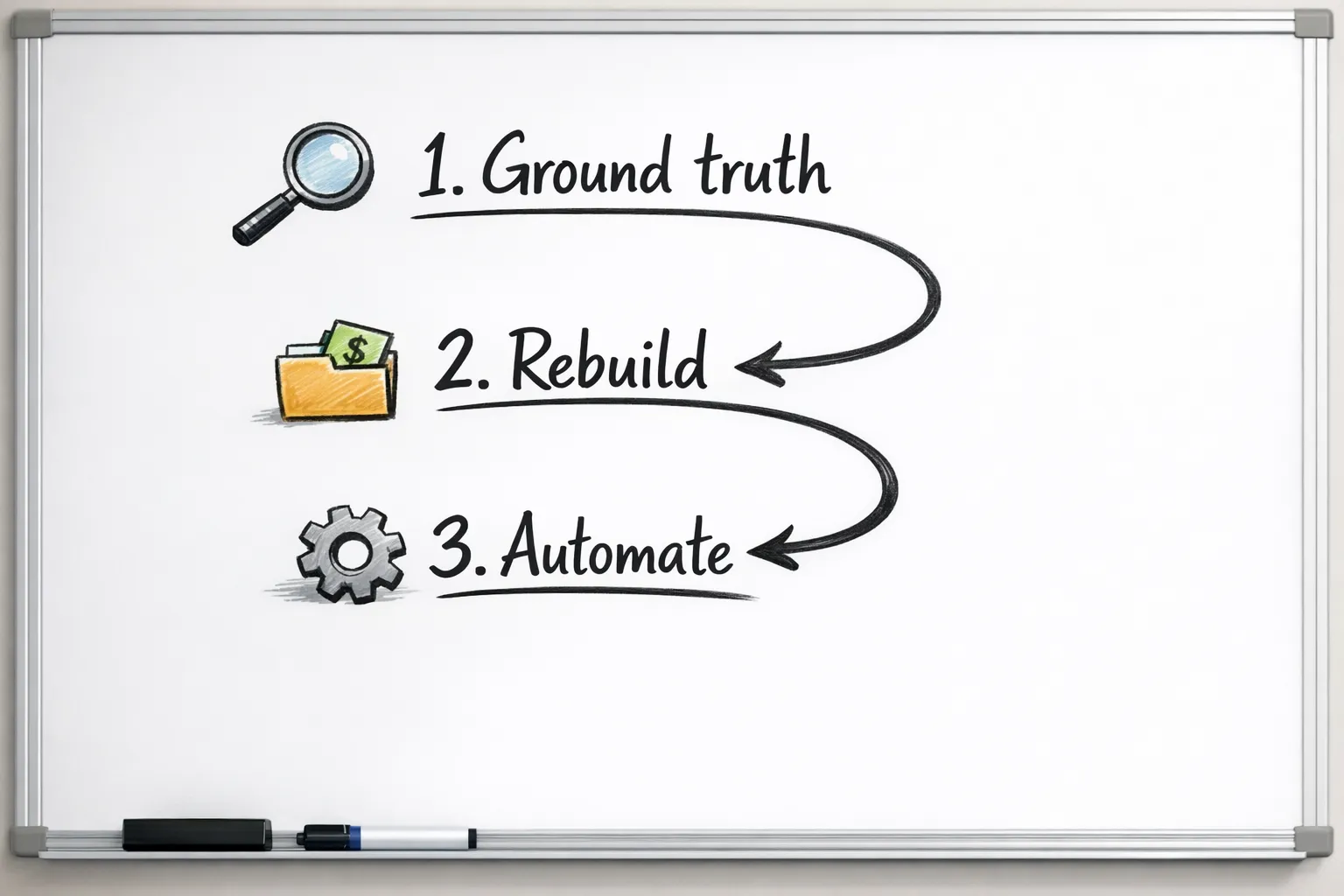
The 3‑step budget reset for 2026
No shame, just systems. Give this 30 days. It is built for real life, irregular income, and subscription‑heavy households.
Step 1, Days 1 to 7: Ground truth and clean the pipes
Start with reality, not hope. This is a no‑judgment diagnostic.
1) Pull 90 days of transactions. Tag only the top 10 merchants and anything over your personal threshold. Ignore the pennies for now.
2) Build a baseline. Add up your Big Four, housing, transportation, food, and subscriptions. These typically drive 60 to 80 percent of spend. Then list the top 10 variable categories by dollars.
3) Surface annuals. Scan for anything that hits 1 to 2 times per year, insurance, memberships, Prime, travel, car maintenance, school fees. Divide by 12 to get monthly contributions.
4) Reconcile the lies. Fix common errors, credit card payments are not expenses, refunds are not income, P2P to your spouse is not spending. Clean data is worth more than a fancier spreadsheet. If you need a walkthrough, see Common Budgeting Mistakes.
5) Snapshot your savings rate. Savings rate explains speed to FIRE. If the percentage embarrasses you, perfect, we have leverage. For context, read Boost Your Savings Rate.
Light FIYR tie‑in, FIYR lets you import transactions, auto‑tag merchants with rules, and track subscriptions as their own line. Labels give you deep cuts like “New York Trip 2025” so you can see the full cost across flights, food, and hotels.
Quotable: Before you fix your budget, fix the pipes the money flows through.
Step 2, Days 8 to 21: Rebuild for reality, not fantasy
Now we swap complexity for control.
1) Choose your 10‑category max. Use simple buckets, Must, Should, Fun, Future. For example, Housing, Transportation, Groceries, Dining and Coffee, Health and Insurance, Subscriptions, Kids and Pets, Household and Utilities, Fun and Travel, Future You. Extra detail goes in labels, not categories.
2) Monthly‑ize non‑monthly life. Create sinking funds for each annual or irregular cost and contribute monthly. Example, $600 car insurance every 6 months becomes $100 per month.
3) Set practical caps, not aspirational ones. Start with 90‑day averages and trim 10 to 15 percent if needed. A cap you hit beats a cap that hits you.
4) Add quarter‑turn friction to spending. Remove stored cards from browsers, turn off one‑click. Move online shopping to a single debit card with a low weekly limit. Institute a 24 hour delay for items under $100 and 72 hours for items over $100.
5) Create a weekly rhythm. Every Sunday, 15 minutes. Reconcile new transactions, glance at remaining category caps, and check your safe‑to‑spend. Adjust before the budget adjusts you. If you want a tested routine, try our overspending prevention habits.
6) Calendar the cash. Put paydays, big bills, and sinking fund transfers on an actual calendar. Budgets live on calendars, not just in apps.
Light FIYR tie‑in, FIYR shows a live safe‑to‑spend after your must‑pay bills and savings goals, supports dynamic budgets, and tracks goals alongside category caps. Add labels for trips, projects, and events, and the app will roll up the true, all‑in cost.
Quotable: You do not need a stricter budget, you need a budget with a spine.
Step 3, Days 22 to 30: Lock it in with automation and rules
This is where the system starts running itself.
1) Automate transfers. Pay yourself first into savings, investments, and sinking funds on payday. Treat them as bills.
2) Write transaction rules. Auto‑tag common merchants, fix P2P and refunds, and split Amazon orders by label. Your job is decisions, not data entry.
3) Install a subscription sentry. Keep subscriptions in one place, turn on alerts for price jumps, and set a quarterly review. Most people find 10 to 30 percent waste on the first pass. Here is a quick tool overview, managing renewals in 2025.
4) Do a monthly close. In 30 minutes, total spending, savings rate, category variance, and net worth delta. One page, no novel. Keep a running note of what to change next month by exactly one dial.
5) Build trigger rules. If Dining exceeds 75 percent by the 20th, freeze takeout. If travel sinking fund hits target, pause contributions and redirect to debt. If savings rate falls below your target, review the Big Four first.
Light FIYR tie‑in, FIYR’s rules clean up categories automatically, subscription tracking keeps recurring charges visible, and the savings rate plus FIRE date estimator make your monthly close feel like a scoreboard, not a guessing game.
Quotable: Automation is not sexy, consistency is. Consistency wins.
Special cases, quick fixes
Irregular income, freelancers and creators
Set up an Income Hub account, route every deposit there, skim 25 to 35 percent to a tax bucket, pay yourself a fixed salary monthly from the hub, build a one to two month buffer. Full walkthrough here, irregular income system.
Couples
Pick a model that matches reality, Fully Merged, Yours‑Mine‑Ours, or Separate with shared bills. Install a weekly 15‑minute standup and a monthly date‑night close. Agree on thresholds, for example, any purchase over $200 needs a heads‑up. Start here, budgeting for couples.
Debt pressure
If credit card APR is eating your lunch, prioritize an avalanche by rate or a snowball for momentum. Decide once, automate, and stop opening new tabs. Our comparison guide, debt payoff strategies.
Subscriptions
Centralize payment methods, track renewals, and calendar cancellations one week early. Most people reclaim a few hundred dollars per year. Tools and workflow here, manage subscription renewals.
Metrics that actually matter
Track fewer numbers, more consistently.
- Savings rate, the single clearest predictor of how fast you can retire. Use it to drive decisions. More here, boost your savings rate.
- Category variance, the gap between plan and reality by category. Fix the top two, ignore the noise.
- Subscription spend, total and by app. If it creeps up, prune.
- Net worth delta, simple directionality month over month is enough.
Quotable: When in doubt, track less but track it every month.
A quick mini‑story, because this is real life
Meet Jordan. January budget looked great, by March it was off by 42 percent. The culprits were not shocking, a Prime renewal, a surprise car repair, and six subscription trials that quietly graduated. Jordan did the 3‑step reset, capped categories at ten, monthly‑ized annuals, created a travel fund, and set a 15‑minute Sunday review. In 60 days, Dining was down 18 percent, subscriptions down 22 percent, savings rate up from 7 to 17 percent. The budget stopped being a guilt file and started acting like a dashboard.
Light FIYR tie‑in, the easy button
You can run this reset in a spreadsheet, but it is faster when your tool handles the boring parts. FIYR pulls in all your transactions, applies custom rules so categories stay clean, tracks subscriptions, sets category caps with a live safe‑to‑spend, rolls up labels like “NYC Trip 2025,” and shows your savings rate and projected FIRE date. It is built for people who want more than a budget, they want mastery.
If you are migrating from Mint or tired of rigid systems, here is a practical comparison, FIYR vs Mint, plus our rundown of common budgeting mistakes to bulletproof your setup.
The close
Your budget is not broken, your system was. In 2026, attention is the scarce resource and automation is the advantage. Ground truth your spend, rebuild for reality, and let rules carry the weight.
One month from now, your money can feel boring. Boring money is rich money.