 FIYR
FIYR Flexible Budgeting: Build a System That Bends
Most budgets fail for the same reason most diets fail: they assume you’re a robot with perfect impulse control, stable income, and no friends who invite you to “just grab a quick drink.”
You’re not a robot. You’re a human with a nervous system, a group chat, and at least one subscription you forgot you had.
And the data agrees that we’re collectively not crushing it. According to a CNBC report, about 60% of Americans are still living paycheck to paycheck, and financial stress is basically the national hobby (CNBC). When your life has volatility, your budget needs flexibility. Otherwise it snaps, and you “take a break” that suspiciously lasts 14 months.
Flexible budgeting is the antidote to brittle budgeting. It’s not “spend whatever.” It’s a system that bends without breaking, so you can keep moving toward goals like debt freedom, a real emergency fund, and eventually FIRE.
Here’s the part nobody talks about: a budget isn’t a math problem, it’s a design problem.
What “flexible budgeting” actually means (and what it doesn’t)
Flexible budgeting means you plan for reality.
- Some months your car acts like a car.
- Other months your car acts like a haunted Victorian doll.
A flexible budget anticipates variability and gives you rules for how to respond.
Flexible budgeting is not “no budget”
No budget is vibes. Flexible budgeting is guardrails.
The goal is simple: you stay in control even when your month gets weird.
Rigid vs flexible, in one table
| Budget style | What it optimizes for | What breaks it | Who it works best for |
|---|---|---|---|
| Rigid (fixed caps everywhere) | Predictability, strict control | Irregular income, unexpected expenses, human behavior | People with very stable pay and stable spending |
| Flexible (ranges + rules) | Consistency over time, resilience | Poor tracking, unclear priorities, no review rhythm | Most humans, especially families, freelancers, FIRE planners |
A rigid budget says, “Dining out is $200, don’t mess it up.”
A flexible budget says, “Dining out is $200 to $350, and if you hit $350, here’s exactly what you do next.”
That second one survives reality.
The “Bend Budget” framework: Floor, Flex, Future
Meet the simplest flexible budgeting model that works for normal people with normal chaos.
1) Floor: your non-negotiables
These are the expenses that keep your life from collapsing.
Think rent or mortgage, insurance, minimum debt payments, utilities, childcare, basic groceries.
The Floor is boring. Boring is good. Boring is how you get rich.
2) Flex: the categories that naturally swing
This is where most budgets go to die.
Groceries, dining, gas, Amazon, activities with kids, personal spending, gifts, travel, health stuff that pops up, all of it.
Instead of one brittle number, you use ranges.
Example: groceries might be $650 to $850, depending on whether you’re cooking like an influencer or surviving on rotisserie chicken and vibes.
3) Future: goals that deserve first-class seating
This is debt payoff, emergency fund, sinking funds (annual expenses), investing, and FIRE contributions.
Your Future categories are the whole point. Otherwise you’re just tracking spending like it’s a hobby.
And here’s the twist: Flexible budgeting doesn’t mean your goals are flexible. It means your method is flexible so your goals can stay steady.
A flexible budget protects the future version of you from the current version of you.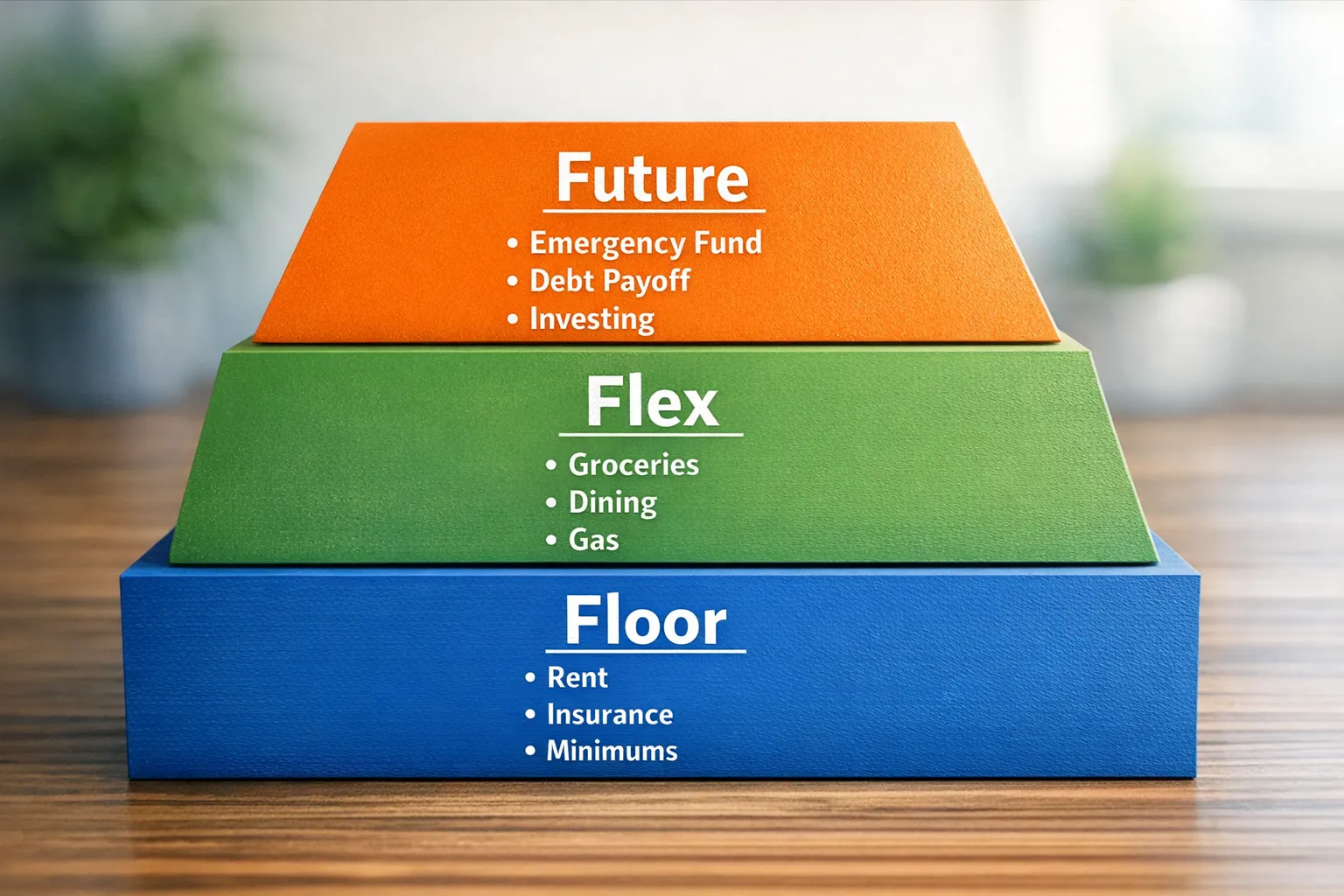
Step 1: Build your “Reality Baseline” in 20 minutes
Most people don’t have a budgeting problem. They have a “my numbers are fictional” problem.
Before you set ranges, you need your baseline.
Use the last 60 to 90 days of spending and grab these for each Flex category:
- Median month (your typical)
- High month (your chaotic)
If you want to be extra competent, include a “low month” too, but let’s not cosplay as perfect.
Quick range formula (steal this)
- Typical = median of last 2 to 3 months
- Range = typical plus 10% to 25% (depending on volatility)
So if your typical groceries are $700:
- Groceries range: $700 to $850 (about +20%)
This stops you from doing the classic move where you budget $400 for groceries because you once ate a salad in 2019.
If your transactions are messy (hello, misc category), fix the data first. A clean budget is built on clean categorization, not wishful thinking. If you want a tactical guide for that, start with Error-Proof Budgeting: How FIYR Keeps Spending Categories Clean.
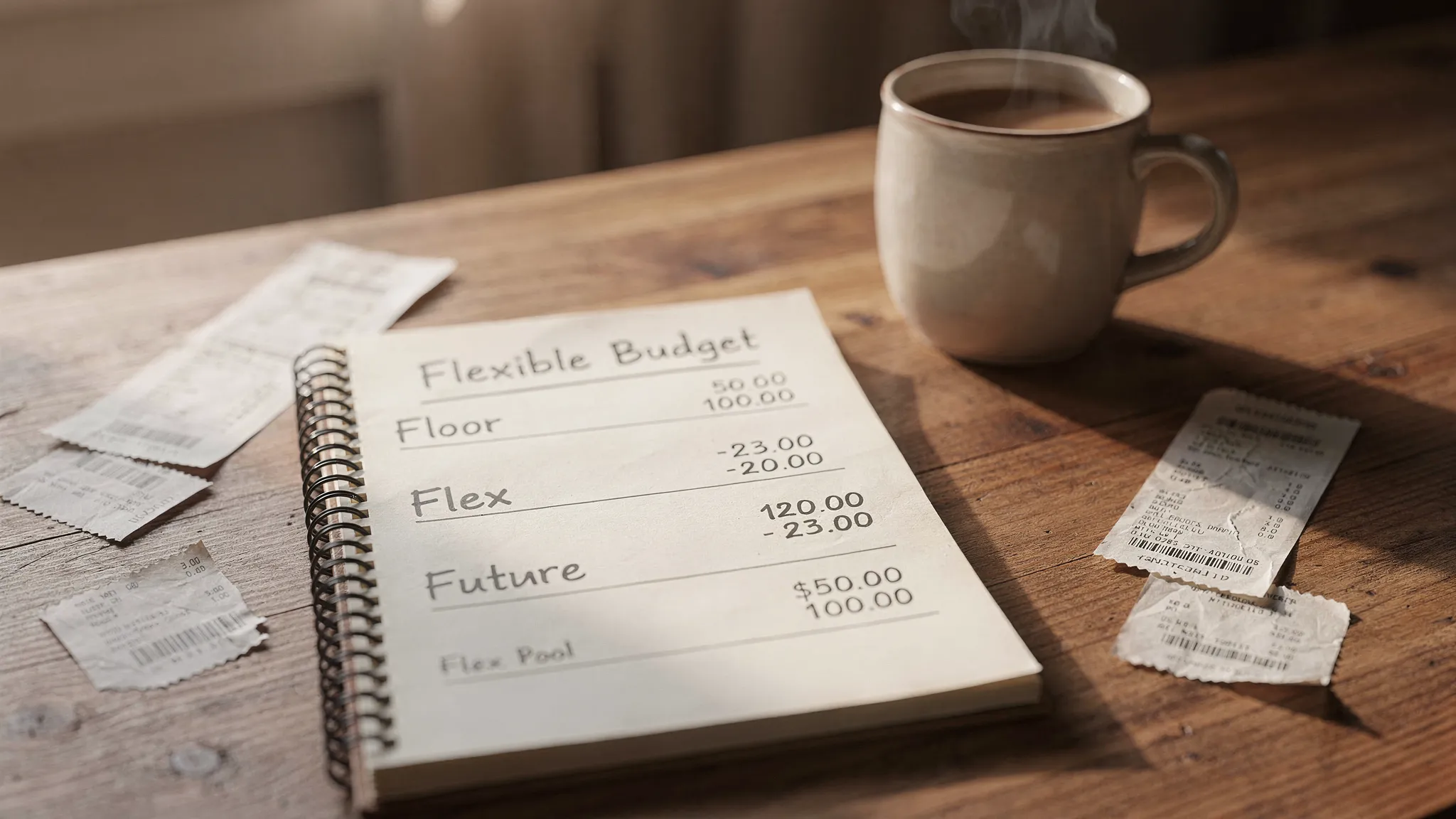
Step 2: Create one “Flex Pool” category (your shock absorber)
This is the single most underrated trick in flexible budgeting.
A Flex Pool is a small bucket of money designed to absorb monthly randomness, without forcing you to blow up your entire plan.
It covers things like:
- The birthday gift you forgot
- The co-pay you didn’t plan
- The “we’re out of everything” Target run
How big should your Flex Pool be?
Start with 1% to 3% of take-home pay, or a flat amount you can live with (like $100 to $300).
If you’re paycheck-to-paycheck, make it smaller, but still have one. Even $50 changes the psychology because you stop feeling like one random expense equals “I failed.”
Your budget shouldn’t be fragile. Your ego shouldn’t be either.Step 3: Turn annual bills into monthly “True Expense” sinking funds
This is where the grown-ups separate from the spreadsheets.
Annual and semi-annual expenses aren’t surprises. They’re appointments your money forgot to calendar.
Examples:
- Car insurance paid every 6 months
- Holiday spending
- Property taxes
- Subscriptions that renew annually
- School fees
- Medical deductibles you hit every year like clockwork
The simple formula
Monthly sinking fund = annual cost ÷ 12
So if you spend $1,200 per year on car insurance:
- Set aside $100 per month
This makes your budget feel magically “easier,” because you stop getting ambushed by predictable expenses.
If subscription creep is your personal villain origin story, you’re not alone. One widely cited consumer survey found people often underestimate what they spend on subscriptions (C+R Research, State of Subscriptions). The fix is visibility and a plan.
Step 4: Write your “Bending Rules” (so you don’t negotiate with yourself)
Flexible budgeting fails when your flexibility becomes a courtroom drama.
You need pre-decisions.
Here are three bending rules that work in real life:
Rule A: Ranges are normal, not failure
If groceries land at $830 and your range ends at $850, you didn’t “overspend.” You lived.
Rule B: If a category breaks the range, you follow a script
This is the whole game.
Use this decision table.
| Situation | What you do | Why it works |
|---|---|---|
| A Flex category is over range by less than your Flex Pool | Cover it with Flex Pool, move on | Prevents drama for small stuff |
| Flex Pool is empty but the month isn’t over | Freeze 1 or 2 optional categories (fun money, dining out, shopping) for 7 days | Creates immediate friction without “punishment” |
| You’re overspending in the same category 2+ months in a row | Raise the range or fix the root cause (pricing, habits, planning) | A budget should reflect reality, then shape it |
| A true emergency hits | Use emergency fund, not Flex Pool, not credit cards | Keeps your buffer from becoming a lie |
Rule C: Savings is a line item, not what’s “left”
If you’re aiming for FIRE, “save whatever’s left” is adorable. It’s also how you stay employed forever.
Make savings and investing a Future category that gets funded automatically.
If you want the motivation punch, read Boost Your Savings Rate: A Shortcut to FIRE. Savings rate is the closest thing personal finance has to a cheat code.
Step 5: Add a weekly rhythm (because monthly budgeting is too slow)
A monthly budget with no weekly check-in is like going to the gym once, then staring at your biceps until they grow.
You need a rhythm.
The 10-minute Weekly Money Reset
Do this once a week:
- Check your Safe-to-Spend (or your checking balance if that’s your current chaos level)
- Scan the 3 categories you most often blow up (for most people: dining, groceries, shopping)
- Flag anything weird (refund missing, duplicate charge, surprise subscription)
- Decide one move for the next 7 days (freeze a category, swap a plan, move $50, cancel something)
If you want a deeper system, the Weekly Money Check-In habit is worth stealing.
Budgets don’t fail in month three. They fail in week two.Step 6: Make it easier with automation (because willpower is expensive)
If you’re doing flexible budgeting in a spreadsheet and manually categorizing transactions at 11:48 pm, you’re basically doing CrossFit with your money.
Respect. But also, no.
Automation is how flexible budgeting becomes sustainable:
What to automate
- Recurring bills and subscriptions (so they stop jump-scaring you)
- Transaction categorization (so your data stays clean)
- Rules for merchants you see constantly (grocery stores, gas stations, your favorite “little treat” locations)
If you want the full playbook, Automated Budgeting: How Rules Save Time and Keep Your Spending Accurate is the practical version.
Where FIYR fits naturally
Flexible budgeting is dramatically easier when your app supports it instead of fighting you.
FIYR is built for this style:
- Flexible budgeting with dynamic budgets, so categories can bend without breaking the whole plan
- Custom categories and category groups, because your life is not a default template
- Automatic transaction rules, so your data stays consistent without manual cleanup
- Subscription tracking, so recurring charges stop hiding in plain sight
- Goal tracking and Safe-to-Spend, so you know what’s actually available
- Savings rate + FIRE date projections, so your daily decisions connect to your long-term timeline
Not as a “buy this” moment, more as a “stop making this harder than it needs to be” moment.
A quick story: how flexible budgeting saves a “normal” month
Meet Maya.
Maya’s not reckless. She’s just living in 2026, where everything costs more and every app wants $9.99 a month for the privilege of existing.
She sets:
- Floor expenses
- Flex ranges for groceries, dining, and gas
- A $200 Flex Pool
- Monthly sinking funds for car insurance and holidays
Mid-month, her kid needs a last-minute school thing, $85. Then her car battery dies, $210.
Old budget Maya would panic, blow up the plan, and “start fresh next month.”
Flexible budget Maya covers the $85 from Flex Pool, then freezes dining out for 7 days to refill the pool. She pushes one non-urgent goal contribution by $50, and keeps everything else intact.
No shame spiral. No “budget is broken.” Just a plan that bends.
The goal isn’t perfection. The goal is continuity.Flexible budgeting templates (steal these ranges)
Here are starter ranges you can adapt, based on volatility.
| Category type | Examples | Recommended approach |
|---|---|---|
| Low volatility (mostly fixed) | Rent, insurance, debt minimums | Fixed amount (Floor) |
| Medium volatility | Groceries, gas, utilities | Range of +10% to +20% |
| High volatility | Dining out, shopping, travel, gifts | Range of +20% to +40% plus Flex Pool |
| True expenses | Holidays, annual renewals, car maintenance | Sinking funds (annual ÷ 12) |
| Future goals | Emergency fund, investing, extra debt payoff | Fixed contribution, automated if possible |
If you have irregular income, flexible budgeting is not optional, it’s oxygen. Start with Budgeting With Irregular Income: A Practical System That Actually Works.
Common mistakes that make “flexible” turn into “messy”
Flexible budgeting is powerful. It’s also easy to misuse.
Mistake 1: Ranges with no rules
If you don’t define what happens when you exceed the range, you’re not flexible. You’re just vague.
Mistake 2: No true expenses
If you don’t monthlyize annual costs, every “surprise” becomes a crisis, and every crisis becomes debt.
Mistake 3: Tracking spending but not tracking progress
If you’re not tracking net worth, savings rate, and debt payoff, you’re watching the scoreboard without knowing the rules.
If you want a clean net worth system, start here: How to Calculate Net Worth: A Simple Guide With Examples.
Frequently Asked Questions
What is flexible budgeting? Flexible budgeting is a budgeting approach that uses ranges, buffers, and pre-decided rules so your plan can adapt to real-life variability (like fluctuating spending or irregular income) without falling apart. Is flexible budgeting the same as zero-based budgeting? Not exactly. Zero-based budgeting assigns every dollar a job, often with tighter category targets. Flexible budgeting can still be zero-based, but it typically uses ranges and buffers so you don’t have to “rebudget” your entire life every time groceries spike. How do I choose budget ranges without overcomplicating it? Use your last 60 to 90 days as a baseline. Set the low end near your typical month and the high end about 10% to 25% higher for medium-volatility categories, and 20% to 40% for high-volatility categories. What’s the point of a Flex Pool category? It absorbs small, unpredictable costs so you don’t wreck your plan (or your motivation) over minor overspends. It’s basically suspension for your budget, because potholes exist. Can flexible budgeting still help me reach FIRE? Yes. Flexible budgeting is often better for FIRE because it makes your savings system more sustainable. Consistency beats intensity, especially over a decade.Build a budget that survives your actual life
If your budget only works in months where nothing goes wrong, it’s not a budget, it’s fan fiction.
Flexible budgeting gives you a system: ranges, buffers, sinking funds, and rules that keep you moving even when life gets loud.
And if you want to run that system without spreadsheet gymnastics, FIYR is designed for it. Track income and spending, set dynamic budgets, automate transaction rules, monitor subscriptions, and tie it all back to savings rate, net worth, and your FIRE timeline.
Start by exploring more frameworks on the FIYR blog, then build a system that bends, because life won’t stop body-checking your plans.