Increase Savings Rate by 10 Percent: The 30-Day Playbook
You don’t need to “be better with money.” You need to win back 10 percent of your income from the swamp of modern life: subscriptions, convenience fees, lifestyle creep, and that one “quick Target run” that somehow costs $173.
And no, this isn’t a “stop buying lattes” sermon. Lattes aren’t the villain. Invisible systems are.
Also, for context: a CNBC report notes roughly 60% of Americans are living paycheck to paycheck. So if your savings rate feels like it’s being held hostage, congratulations, you are extremely normal. The goal is to become extremely dangerous.
This is the 30-day playbook to increase savings rate by 10 percent (meaning 10 percentage points, like 10% to 20%, not “10% more than your current 10%”). It’s aggressive, realistic, and built around one idea:
Savings rate is not a vibe. It’s a number you can engineer.First, the math that keeps you honest
Your savings rate (simple version) is:
Savings Rate = (Income − Spending) ÷ IncomeExample: You bring home $6,000/month, you spend $5,100.
- Savings = $900
- Savings rate = $900 ÷ $6,000 = 15%
Here’s the twist: most people “calculate” savings rate using whatever their bank balance felt like it was doing. That’s how you end up like my old coworker Dan, who swore he saved 25%… while financing a Peloton he used as a towel rack.
What “10 percent” actually means in dollars
A 10 percentage point bump is big, and that’s why it works.
| Monthly take-home pay | +10 percentage points | Extra saved per month | Extra saved per year |
|---|---|---|---|
| $3,500 | +10% | $350 | $4,200 |
| $5,000 | +10% | $500 | $6,000 |
| $7,500 | +10% | $750 | $9,000 |
| $10,000 | +10% | $1,000 | $12,000 |
That’s not “skip brunch.” That’s “change your timeline” money.
And if you’re FIRE-minded, this number punches above its weight because it hits both sides of the equation: more invested and often lower spending to fund.
(If you want the bigger timeline math, see How to Retire 15 Years Earlier: The Simple Math No One Tells You.)
The 30-day rule: you’re not allowed to guess
If your data is messy, your plan is fiction.
Meet “Sarah” (composite, but painfully real): she thought she spent about $4,200/month. When she finally tracked everything, it was $5,050.
What changed?
- Amazon was not “shopping.” It was groceries, home supplies, and dopamine.
- Credit card payments were being counted wrong, creating phantom savings.
- Subscriptions were multiplying like gremlins after midnight.
Her problem wasn’t discipline. It was a lack of a reliable scoreboard.
This is exactly why modern trackers beat spreadsheet heroics. If you’re coming from Mint, or debating Monarch, Copilot, Rocket Money, or Quicken, the differentiator isn’t prettier charts. It’s whether you can keep your categories clean, spot leaks fast, and track savings rate without doing manual forensic accounting.
If you need help setting up clean tracking once (and then letting automation do the boring work), start with Automatic Expense Tracking: Set It Up Once, Benefit Forever.
Quotable truth: You can’t out-hustle bad visibility.
The 30-day playbook (what you do each week)
This playbook is designed to produce a real, measurable bump fast, then lock it in so it doesn’t evaporate by day 45.
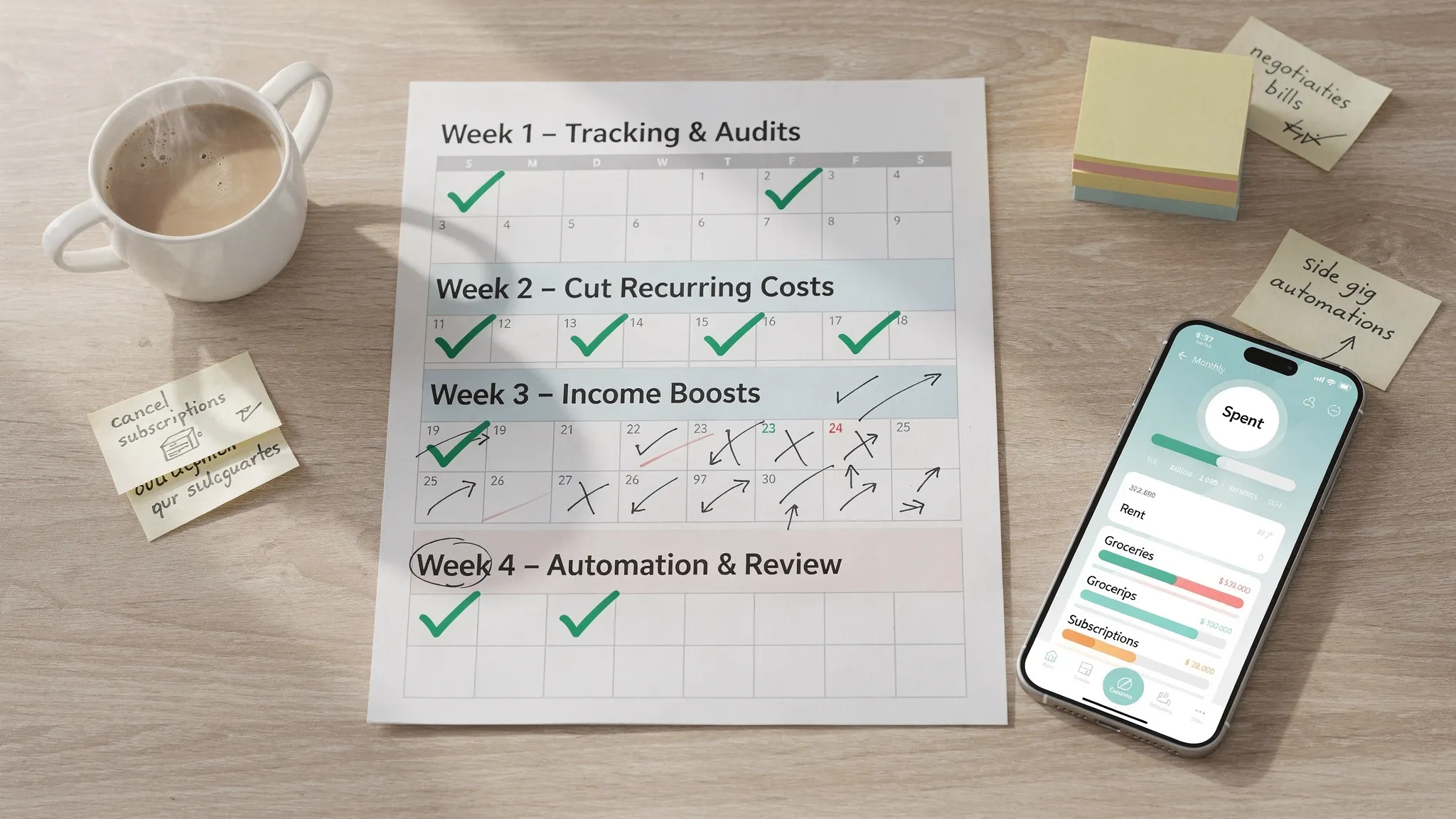
Week 1 (Days 1 to 7): Build the scoreboard, expose the leaks
Your only job this week is to stop lying to yourself by accident.
Day 1: Define the win condition.Pick one:
- Increase savings rate by 10 percentage points in 30 days.
- Or increase savings rate by $X/month (same thing, less math drama).
Then convert it into a monthly dollar target.
Day 2: Establish a baseline using real transactions.Use the last 30 to 90 days of spending, not your memory.
If you use FIYR, this is where customizable categories and transaction rules matter. “Shopping” is where truth goes to die. Split it into categories that map to decisions (like “Convenience Food,” “Amazon Needs,” “Amazon Wants,” “Fees”).
For a clean category structure, steal a system from Budgeting Categories List: A Clean Setup That Works.
Day 3: Run the Subscription Gladiator.Subscriptions are the tax you pay for not checking.
Do a quick audit and put each recurring charge into one bucket:
- Keep
- Pause
- Replace
- Cancel
(If you want the full sprint, see Reduce Subscriptions in 2026: A 30-Minute Cleanup Plan.)
Day 4: Create one “truth-serum” category.Call it “Oops,” “Chaos,” “Convenience Tax,” whatever makes you slightly uncomfortable. The point is to catch spending you’d otherwise rationalize away.
Day 5: Install a “Needs Review” inbox.This prevents your data from rotting. Every uncategorized or weird transaction goes there until you decide what it really is.
Day 6: Find the top 3 leaks.Most budgets fail because people fight 47 tiny battles instead of 3 big ones.
Your top 3 leaks usually live here:
- Food (delivery, convenience, “work lunch that turned into cocktails”)
- Transport (car payments, insurance, rideshare creep)
- Recurring lifestyle (subscriptions, memberships, kid stuff, “monthly boxes”)
Example:
- Cap: “Convenience Food” = $200/week.
- Rule: “If we hit the cap, we eat what we have. Yes, even the sad freezer vegetables.”
Quotable truth: A budget without rules is just fan fiction.
Week 2 (Days 8 to 14): Cut recurring costs (the compounding villains)
This is where you get the “10 percent” without feeling like you moved into a monastery.
Your targets this week: recurring bills, fees, and autopilot spending.#### The “$50 x 6” approach
If you can’t find one giant cut, find six $50/month cuts. That is $300/month right there.
Look for:
- Subscription downgrades (ad-tier plans, family plan cleanup)
- Insurance shopping (car and renters/home)
- Phone plan reality check
- Bank fees and “membership” nonsense
- Interest charges (credit card interest is literally negative investing)
If you’re carrying high-APR debt, prioritize it. Paying off a 25% APR card is a guaranteed return that makes your index funds look like they’re napping.
If you want a clean debt strategy, see Debt Payoff Smackdown: Snowball vs. Avalanche.
#### Two scripts that save real money
Script 1: The subscription cancel script“Hey, I’m reviewing recurring expenses for the month. Can you help me cancel (or downgrade) immediately and confirm the cancellation date?”
Polite. Direct. No hostage negotiation.
Script 2: The partner script (for shared spending)“I’m trying to raise our savings rate by 10 points for 30 days. What’s one thing you’d cut that wouldn’t make you miserable?”
This makes it a team sport, not a courtroom.
Quotable truth: Recurring expenses are just decisions you forgot you made.
Week 3 (Days 15 to 21): Increase income (without becoming a hustle goblin)
Cutting costs has a floor. Income has fewer ceilings.
And before you roll your eyes: this week is not “start a dropshipping empire.” It’s tactical.
Pick one lane:
#### Lane A: Get paid more at your job
Your goal is to create a single, specific ask.
- Pull 3 proof points (results, metrics, shipped work)
- Find salary range data (industry, location)
- Ask for a comp conversation
Even a modest raise, when captured properly, can jump your savings rate quickly.
(And if you struggle with lifestyle creep after raises, you are not broken, you’re human. See How to Avoid Lifestyle Creep in 2026 (And Start Saving More).)
#### Lane B: Sell the “unused optimism” in your house
Your home is full of stuff you bought for your fantasy self.
- The guitar you were totally going to learn
- The espresso machine you used twice
- The running shoes that saw zero running
Sell 5 items this week. Route the money to your goal immediately.
#### Lane C: Add a small, boring income stream
Not “build a brand.” Just add cash flow.
Examples: freelancing one client, picking up one weekend shift, consulting, tutoring, dog sitting.
If your income is irregular, the goal is not perfection. The goal is predictability. Start with Variable Income Budgeting: A System for Feast-or-Famine Paychecks.
Quotable truth: Your savings rate improves fastest when you stop treating income like weather.
Week 4 (Days 22 to 30): Lock it in with automation and a repeatable rhythm
Most people can do a heroic month. The question is whether you can do a boring year.
This week turns your progress into defaults.
#### Day 22: Set up “pay yourself first” as a system
Make saving automatic and spending manual.
You want money to move like this:
Income hits -> savings/investing moves out -> bills covered -> the rest is safe-to-spend
This is where FIYR-style goal tracking and a safe-to-spend view are clutch, because you stop doing mental math every time you open DoorDash.
#### Day 23: Add 3 transaction rules that prevent backsliding
Examples:
- Anything from “UBER” goes to Rideshare
- Any “APPLE.COM/BILL” goes to Subscriptions
- Any “AMZN” goes to “Amazon Needs” unless you label it “Amazon Wants”
Rules are how you keep accuracy without spending your life categorizing.
If you want the deeper system, see Spending Rules Automation: Categorize Faster and Never Miss a Transaction.
#### Day 24: Start one sinking fund (because life is lumpy)
True expenses are the bills that show up once or twice a year and ruin your month.
Pick one:
- Car repairs
- Medical
- Gifts
- Travel
Then monthly-ize it.
If you need a full walkthrough, see Sinking Funds Guide: Stop Getting Blindsided by Bills.
#### Day 25: Track savings rate weekly (not monthly)
Monthly reviews are too slow. By the time you notice, the money is already gone and your spending is already in a new relationship with “treat yourself.”
A weekly check-in is the difference between a small correction and a full financial crime scene.
#### Days 26 to 29: Run the “10-minute close”
Do a mini close to make sure your savings rate is real:
- Confirm income posted correctly
- Make sure transfers are not counted as spending
- Catch any miscategorizations
- Verify subscription list is clean
If you want a ritual, see Why You’re Overspending (And the One Habit That Could Save You $50,000).
#### Day 30: Measure the result and decide what stays
Two questions:
- Did you increase savings rate by 10 percentage points?
- If not, what got in the way: fixed costs, income, debt, or chaos spending?
Here’s the part nobody talks about: even if you only got halfway, you just built a machine. Machines improve.
Quotable truth: Progress you can measure is progress you can repeat.
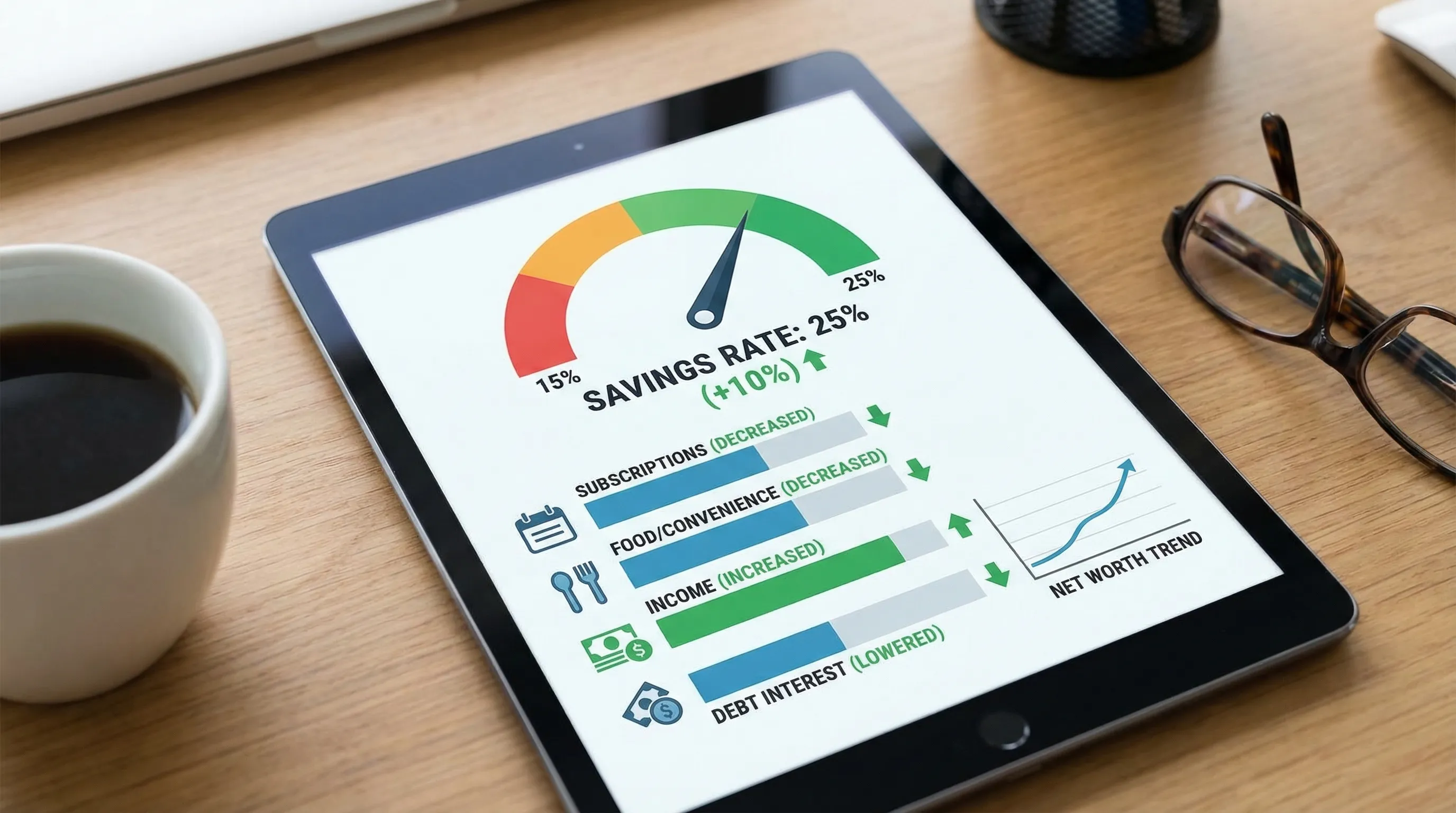
A simple “10% savings rate jump” scorecard
Use this to diagnose why your savings rate won’t move.
| Lever | What it changes | Fastest way to pull it in 30 days | Common trap |
|---|---|---|---|
| Recurring costs | Spending baseline | Subscription audit, plan downgrades, fee removal | “It’s only $12.99” repeated 14 times |
| Convenience spending | Variable spend | Caps + friction (remove saved cards, meal plan basics) | Relying on willpower |
| Fixed costs | Biggest line items | Shop insurance, negotiate, refinance research | Trying to solve housing in 2 weeks |
| Income | Denominator and numerator | Raise ask, extra shifts, sell items | Lifestyle creep immediately eats it |
| Debt interest | Negative savings | Avalanche high APR, stop new debt | “Minimum payments are fine” delusion |
Where FIYR fits (without the hard sell)
If you’re trying to increase savings rate by 10 percent in 30 days, your real enemy is not math. It’s friction and messy data.
A modern tracker like FIYR helps because it’s built for the stuff that actually breaks budgets:
- Savings rate tracking that updates as your real transactions come in
- Custom categories so “Shopping” stops hiding the truth
- Transaction rules so your tracking stays accurate without busywork
- Subscription tracking so recurring charges don’t become permanent residents
- Net worth tracking so you see the bigger story, not just this month’s drama
- FIRE projections so you understand what a higher savings rate buys you
If you’re coming from Mint (or considering Monarch, Copilot, Rocket Money, or Quicken), start with Best Mint Alternative 2026: The Tools Worth Switching To.
Frequently Asked Questions
Is “increase savings rate by 10 percent” realistic in 30 days? Yes, if you treat it like a sprint and focus on high-leverage moves (subscriptions, recurring bills, caps on the biggest variable categories, and capturing any income upside). If your fixed costs are extreme or you’re dealing with high-interest debt, 30 days can still produce meaningful progress, even if it’s not the full 10 points. Do you mean 10 percent or 10 percentage points? This playbook targets 10 percentage points (example: 12% to 22%). That’s the kind of jump that actually changes outcomes. A 10% relative increase (12% to 13.2%) is fine too, it’s just smaller. Should I save more or pay off debt first? If you have high-interest debt (especially credit cards), prioritize paying that down while keeping a small emergency buffer. Interest is a guaranteed drag on your savings rate and your future. What’s the fastest expense to cut without feeling deprived? Recurring expenses you don’t value: unused subscriptions, overpriced phone plans, bank fees, and convenience spending that doesn’t actually make your life better. How do I keep the savings rate increase after the 30 days? Automation and rhythm. Set automatic transfers, keep categories clean with rules, run a weekly 10 to 15 minute check-in, and do a monthly close so your tracking stays honest.Your move: turn this into a system (not a motivational poster)
If you do nothing else, do this: track your real savings rate weekly for the next 30 days and force every recurring charge to justify its existence. That alone will make your money behave.
And if you want the “less work, more control” version of this sprint, use a tracker that’s built for it. FIYR is designed to make savings rate, subscriptions, net worth, and FIRE projections easy to see and harder to ignore.
Take the next step with:
- FIYR Budgeting Tutorial: Your First Week Setup, Step by Step
- Savings Rate Calculator: The One Metric That Matters
Because the best time to raise your savings rate was five years ago. The second best time is… today. Annoying, but true.