 FIYR
FIYR How to Avoid Lifestyle Creep in 2026 (And Start Saving More)
If your spending grows faster than your salary, you did not get a raise, you just hired a more expensive version of yourself. That line stings because it is true. About 60 percent of Americans still live paycheck to paycheck, even as incomes climbed in recent years, according to CNBC. The U.S. personal saving rate has hovered around a sleepy 3 to 5 percent in recent years per the BEA. Meanwhile, 61 percent of people carry credit card debt, averaging roughly $5,875, says NerdWallet’s 2023 study. Translation, lifestyle creep is eating raises for breakfast.
Here is the part nobody talks about. Avoiding lifestyle creep in 2026 does not require monk-level discipline or living in the dark. It requires three moves, delay raises, hold spending caps, automate savings. Add one dead-simple weekly reset and you will start saving more without feeling broke.
What lifestyle creep actually is
Lifestyle creep is the quiet upgrade of your baseline. A salary bump becomes a nicer apartment, craft cocktails replace happy-hour specials, the gym becomes a spa. It is not inflation, it is normalization. Your brain adapts to a fancier default, so yesterday’s treat becomes today’s minimum. Psychologists call this hedonic adaptation. Pair that with present bias, see Investopedia, and you get a powerful one-two punch, I want it now and I get used to it fast.
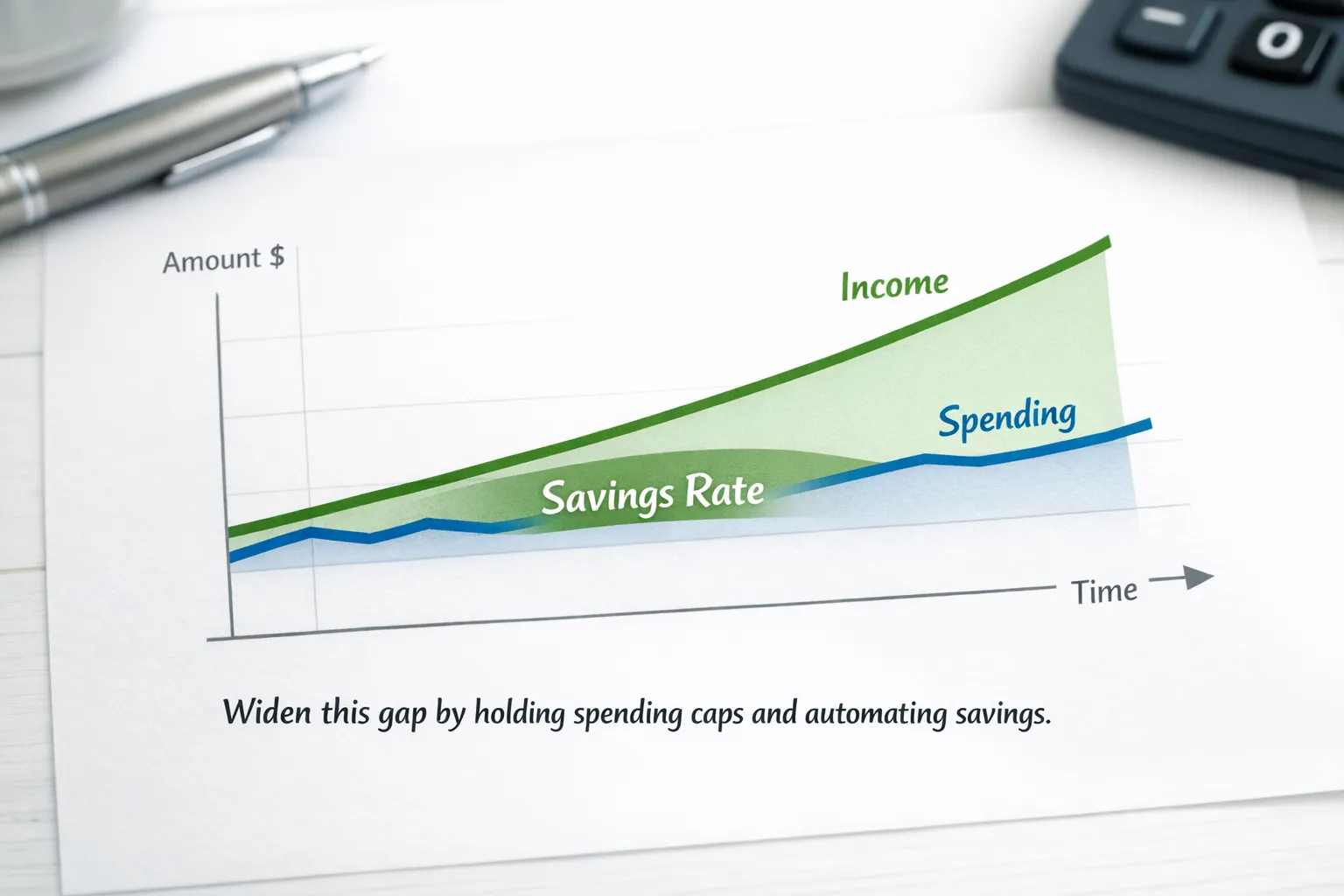
Meet Maya. She got an 8 percent raise and celebrated with a new phone, premium gym, upgraded streaming bundle, and a couple of weekend trips. Ninety days later her checking account looked the same. Savings rate flat. Stress up. The math was not complicated, her spending grew with her income, so the gap that funds freedom never widened. Lifestyle creep does not announce itself. It shows up as a bunch of tiny yeses.
Quotable takeaway, you do not beat lifestyle creep with willpower, you beat it with defaults.
Common triggers and the psychology behind them
- New job or raise, anchoring to a bigger number resets what feels reasonable.
- Moving, new space invites new stuff, and neighbors set new comparison points.
- Credit limit increases and 0 percent promos, mental accounting turns borrowed money into free money.
- New life chapters, baby, partner, pet, new identity equals new baseline.
- Annual renewals and bundles, default settings renew silently while you are busy.
The outcome is predictable, if you do not set caps and automate the good, the algorithm of modern life will automate the expensive.
The Anti Creep System for 2026, delay, cap, automate
1) Delay your raise on purpose
Create a raise quarantine. For the first two pay cycles after any raise, do nothing new. No new recurring bills. No upgrades. This lag is the antidote to impulse-based baselining.
A simple split that works, the 70, 20, 10 raise rule.
- 70 percent of the raise goes to investing or savings.
- 20 percent goes to debt or future big goals, sinking funds.
- 10 percent is guilt-free lifestyle, yes, enjoy it on purpose.
Example, salary goes from 90,000 to 96,000, a 6,000 raise. After tax that is roughly 4,200 per year, about 350 per month. Apply the 70, 20, 10 rule, invest 245 per month, put 70 per month toward debt or a future trip, keep 35 per month for upgraded life. Invest that 245 monthly at a market-like 7 percent long term and you are adding around 40,000 in a decade. Results vary, markets move, but directionally, this is how you buy time back.
FIYR assist, label the raise. Create a label called Raise 2026 and tag any allocation moves so you can track where the bump went. Then bump your savings-rate target in FIYR by the same percentage and let the FIRE date calculator show the new timeline.
Memorable line, raises you do not see are the ones that make you rich.
2) Hold spending caps while your income grows
If income jumps 8 percent, your lifestyle does not have to. Freeze category caps for 12 months unless there is a true need. If inflation forces an increase, tie it to CPI, not vibes. The BLS CPI is a better boss than lifestyle FOMO.
A simple formula for category caps,
Cap for this year equals average of the last 6 months, round down, adjust by inflation only if required.
Focus on the big three, housing, transportation, food. These three categories do most of the damage.
- Housing, aim for 25 to 30 percent of take home pay. If you move, run the numbers before the tour. If the new rent squeezes savings, the math says no.
- Transport, keep total car cost under 10 percent of take home pay, including insurance, gas, repairs. If you can, push the next car 12 months.
- Food, keep restaurants and delivery separate from groceries. Cap restaurants first. Cook twice, eat thrice, leftovers are inflation proof.
FIYR assist, set dynamic budgets with category caps and use safe to spend as your guardrail. When the green turns yellow, your wallet is telling you something. Add transaction rules for common creep vendors to keep categories clean, Amazon is not a category.
Quotable takeaway, caps keep you from negotiating with yourself.
3) Automate savings so creep never gets a vote
Pay yourself first, then live on the rest. Direct deposit into two places before you see it, tax advantaged accounts where eligible, 401k, HSA, IRA, and a brokerage or high yield savings for near-term goals. Increase contributions by 1 percent every quarter until it pinches, then stop. You will be shocked how quickly you adapt to the new normal, see also hedonic adaptation working for good.
Windfall rule for 2026, 80, 10, 10.
- 80 percent to savings and investments.
- 10 percent to debt or future expenses.
- 10 percent to fun now, yes, carry on.
FIYR assist, turn on savings rate tracking and schedule an auto review. FIYR plots the savings rate over time so you can see whether your raise translated into freedom or frills. Goals with safe to spend show how much slack you really have.
One liner, automation is discipline that runs even when you are tired.
Quick table, spot the creep and kill it fast
| Trigger | Psychology at work | Countermove | FIYR feature that helps |
|---|---|---|---|
| New job or raise | Hedonic adaptation, new anchor | 60 day raise freeze, 70, 20, 10 split, auto increase retirement by 1 to 2 percent | Savings rate tracker, FIRE date calculator, labels like Raise 2026 |
| Move or bigger place | Social comparison, identity upgrade | Keep housing at 25 to 30 percent of take home, one in one out for furniture | Category caps for Housing, safe to spend |
| Credit limit bump, 0 percent offer | Present bias, mental accounting | Treat promos as debt, set payoff date before promo ends | Custom liabilities, debt category tracking, labels for payoff date |
| New subscription bundle or free trial | Default effect, vendor set and forget | Set cancel dates at signup, run quarterly subscription audit | Subscription tracking with renewal dates and vendor rules |
| New baby, partner, pet | Identity spending, new baseline | Pre build sinking funds for gear and care, add only must haves | Goal tracking and category groups, custom categories |
One simple weekly reset, 20 minutes on First Friday
You do not need a life overhaul. You need a loop. Try this once a week or at least monthly. Set a 20 minute timer. No vibes, just facts.
- Reconcile transactions and label outliers, Was that Whole Foods run groceries or half your date night budget.
- Run a subscription scan, any new trials, upcoming renewals in the next 30 days. Decide today, keep or cancel.
- Check three numbers, savings rate, month to date safe to spend, net worth trend. If the savings rate is down, take five minutes to move a percentage point from dining to savings.
- Fix one leak, choose a single category and reduce next week’s cap by 10 percent. Friction beats intention.
- Reward on purpose, schedule one small treat inside the fun budget. Deprivation is not a strategy, it is a relapse plan.
Memorable line, routines beat resolutions every time.
A quick mini case study, the raise that did not creep
Mateo’s salary goes from 100,000 to 108,000. After tax that is roughly 5,600 per year, about 467 per month. He applies the system.
- Delay, no new recurring bills for 60 days.
- Cap, all category caps held flat, only groceries allowed a small inflation nudge after checking real receipts.
- Automate, 70, 20, 10 split of the raise, 327 to investments, 93 to a travel sinking fund, 47 to fun.
Inside FIYR he adds a label Raise 2026 and a goal called Summer Europe 2026. He sets a dynamic budget cap for Restaurants and turns on safe to spend. In three months, his savings rate climbs by 4 percentage points. His FI date pulls forward on the FIRE calculator. The only thing he misses is an extra streaming bundle that his subscription audit kills in week two.
Punchline, he kept the raise and the life upgrades, because he bought them in the right order.
Make this easier with FIYR, and keep it light
- Track income, expenses, and a real savings rate, not a vibe.
- Use custom categories and transaction rules to prevent messy budgets from lying to you.
- Set dynamic budget caps and trust safe to spend to call you out before it hurts.
- Turn on subscription tracking so free trials cannot sneak into your future.
- Label life events, Raise 2026, New City Move, New Baby Starter Kit, so you can see what actually changed the numbers.
- Pressure test the impact on your timeline using the FIRE date calculator.
If you want a deeper dive on why savings rate is the master lever, read Boost Your Savings Rate. If your safety net is thin, build it with The Emergency Fund Guide. And if overspending is your kryptonite, the system in How to Prevent Overspending plugs the leaks fast.
Final thought for 2026
Avoid lifestyle creep and your future self will send a thank you note. Raises are raw material. Automation turns them into freedom. Caps keep the gains from evaporating. Delay keeps your brain from moving the goalpost. Do this for one year and 2026 will be the year your lifestyle stayed gorgeous and your savings rate finally looked grown up.