 FIYR
FIYR Budgeting for Couples: Build a System You Both Can Trust
Most couples do not argue about math, they argue about meaning. A $120 dinner is really a debate about fairness, freedom, and whether the future is on schedule. The good news is that you do not need a perfect budget to fix that. You need a system you both trust.
Survey data backs up the pain. Money remains a top stressor for Americans, and many households still feel fragile. Nearly 60 percent of Americans live paycheck to paycheck, according to reporting from CNBC, which raises the stakes of every spending decision. The American Psychological Association’s Stress in America surveys consistently rank money as a leading source of stress. And Bankrate’s research shows less than half of adults can cover a $1,000 emergency solely with savings. When the margins are tight, small misunderstandings feel big.
Why couples budgeting breaks down
Three friction points show up again and again.
- Transparency. Not secrecy, usually, but avoidance. One partner quietly manages the bills, the other quietly hopes it is fine. Purchases get explained after the fact, subscriptions renew in silence, and every monthly review turns into a surprise party no one asked for.
- Expectations. One sees restaurants as joy, the other sees them as lost compound interest. You both want the same outcome, but your mental models for getting there do not match.
- Unequal incomes. A 50-50 split can feel fair on paper and unfair in real life. If one partner makes twice as much, a flat split can quietly punish the lower earner’s ability to save or breathe.
Here is the part nobody talks about. A budget does not create trust. Agreements, structure, and rhythm create trust. The budget is just the scoreboard.
A simple framework: agreements, structure, rhythm
- Agreements. What are we optimizing for this year, and what are our non-negotiables? Put words around values and guardrails.
- Structure. How the money flows in and out. You will choose one of three models below and automate it.
- Rhythm. Regular money meetings where you make small adjustments before small problems become big ones.
The three models that actually work
There is no “right” model. There is only the one that matches your personalities, paychecks, and goals.
1) Fully merged
All income goes into one joint account. All bills are paid from it. Each partner gets an equal personal allowance for discretionary spending.
- Best for couples who value simplicity and a shared identity for money.
- Pros: One pot, no math. Strong alignment to joint goals. Easy to track savings rate and timelines.
- Tradeoffs: Less privacy. Can feel like surveillance if you skip expectation-setting.
- Setup tips: Agree on a personal allowance amount and a purchase-approval threshold. Automate all bills from the joint account.
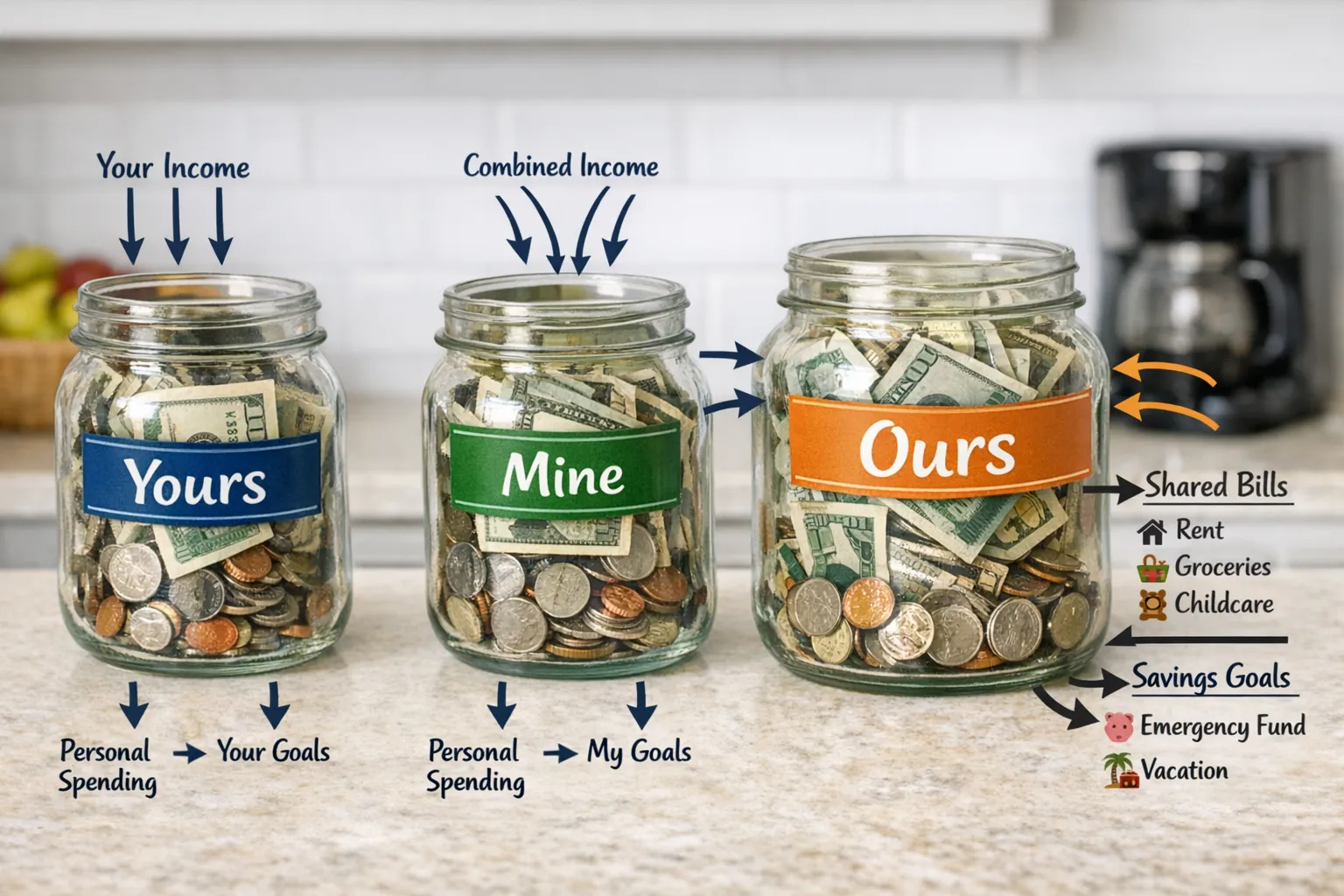
2) Partially shared, also called Yours-Mine-Ours
Each partner keeps a personal account. You also maintain a joint account for shared expenses. You fund the joint account proportionally by income, then keep the rest for personal goals or spending.
- Best for unequal incomes or when autonomy matters.
- Pros: Fairness without resentment, privacy without secrecy, easy to scale goals together.
- Tradeoffs: Slightly more moving parts. Requires clarity on what counts as “shared.”
- Setup tips: Decide your split formula. Funnel shared bills, groceries, daycare, housing, and shared sinking funds from the joint account.
3) Fully separate with a shared ledger
You keep finances separate. Each partner pays specific bills or transfers a fixed share to the other for particular expenses. You track joint goals in a common dashboard.
- Best for couples with similar incomes who value autonomy and already communicate well.
- Pros: Strong independence. Minimal account changes.
- Tradeoffs: Easy to lose sight of shared goals. Requires discipline to review together.
- Setup tips: Assign bills clearly, agree on annual goals, and schedule quarterly check-ins to rebalance who pays what.
Quick comparison
| Model | Simplicity | Privacy | Fairness with unequal incomes | Goal alignment |
|---|---|---|---|---|
| Fully merged | High | Low | Good, if allowances are equal | Excellent |
| Partially shared | Medium | Medium | Excellent | Very good |
| Fully separate | High | High | Weak, unless adjusted often | Medium |
How to make unequal incomes feel fair
Pick one of these contribution methods. The right answer is the one you can both live with for a year.
- 50-50 split. Easy, but stressful for the lower earner if shared costs are high.
- Proportional split by take-home pay. Each partner funds the joint account in proportion to their net income. This is the default for many couples.
- Pool-and-allowance. Pool income, pay all bills from joint, then give equal personal allowances. Balances fairness and autonomy even when income is very different.
Proportional formula: Your shared contribution equals Total shared expenses multiplied by Your take-home income divided by Combined take-home income.
Example. Partner A take-home 6,000, Partner B 3,500, combined 9,500. Shared expenses 4,750.
- A contributes 4,750 × (6,000 ÷ 9,500) = 3,000.
- B contributes 1,750.
Both keep the remainder for personal savings or spending. No quiet resentment, no phantom guilt.
Define what is shared vs personal
Decide this once, write it down, and stop renegotiating every weekend.
Shared typically includes: rent or mortgage, property tax, utilities, internet, groceries, household supplies, childcare, kids’ activities, pet care, shared transportation, insurance premiums, streaming shared accounts, vacations you take together, shared sinking funds like home maintenance and car replacement.
Personal typically includes: personal shopping, solo travel, individual subscriptions, hobbies, gifts for each other, personal lunch, and any pre-relationship debt unless you explicitly choose to tackle it together.
When in doubt, ask: does this benefit both of us most of the time? If yes, it is shared. If not, it is personal.
The money meeting templates
Skip the three-hour summit. You need short, repeatable meetings that prevent drift.
Weekly 15-minute standup
- Check the calendar. Any unusual expenses coming this week?
- Review spending since the last check-in. Any surprises over the threshold?
- Adjust category caps if needed. Move money before a category goes red.
- Confirm bill payments. Nothing should depend on memory.
- Quick micro-win. Pick one tiny improvement, like canceling an unused subscription.
Suggested script: “Here is what posted, here is what is coming, here is what we will change. Anything bugging you?”
Monthly 45-minute close and plan
- Close last month. Income, shared expenses, personal expenses, and total savings rate.
- Look at patterns. Which three categories consistently drift? What can you change upstream?
- Agree on next month’s caps. Add or remove sinking funds for predictable future costs.
- Review goals. Emergency fund status, debt payoff progress, and any upcoming big purchases.
- Decide one lifestyle upgrade and one cut. Trade consciously.
Quarterly 60-minute strategy session
- Update net worth and investment contributions.
- Revisit your 12 to 24 month plan. Housing, career moves, kids, travel, education, or caregiving.
- Run a “what if” scenario. What if we increase the savings rate by 5 points? What if childcare drops next year? Adjust targets.
Keep these meetings judgment-free. Numbers are information, not identity.
Conversation tools that reduce friction
- The threshold rule. No surprise purchases over a mutually agreed amount, for example 200, without a quick text. The default answer is yes unless cash flow is tight.
- The cooling-off rule. For wants over the threshold, wait 24 to 72 hours. If you still want it and it fits caps, proceed.
- The restart policy. When one of you overspends a category, agree on a specific next step. For example, “I overspent dining by 85. I will pause personal fun for a week and we will move 85 from my personal account to dining.”
- The values interview. Ask each other: what does a good life look like at this stage? What are our top three spending joys? What are our top three non-negotiable savings priorities? What will we gladly spend more on, and what can go?
A real-world mini-case
Meet Maya and Chris. Two incomes, one calendar, and recurring arguments about groceries that somehow included candles and outdoor gear.
- Problem. Unequal incomes, flat 50-50 split, and vague rules about what counted as shared. Result: the lower earner felt squeezed, the higher earner felt policed.
- Fix. Switched to Yours-Mine-Ours with a proportional split. They defined shared vs personal on one page, set a 200 threshold, and started a weekly 15-minute standup.
- Outcome in 90 days. Fewer surprises, a clear vacation fund labeled for their anniversary trip, and 240 saved by canceling three forgotten subscriptions. More importantly, fewer budget postmortems and more intentional tradeoffs.
Build your couples system in 7 steps
- Choose your model. Merged, partially shared, or fully separate. Pick the one that feels sustainable for the next 12 months.
- Map shared expenses. List housing, utilities, groceries, childcare, insurance, transportation, and predictable annual costs like car tags or birthdays. Total it.
- Pick the split method. 50-50, proportional, or pool-and-allowance. Write the formula you will use.
- Set up accounts and automation. Open or designate the joint account if using one. Route payroll or schedule transfers to hit the joint account two days before major bills.
- Create category caps. Define caps for shared categories and personal allowances. Add sinking funds for the next 12 months of known irregulars.
- Set your guardrails. Threshold rule, cooling-off rule, and a list of what counts as shared vs personal. Put it in one shared note.
- Start the meetings. Weekly 15-minute standup, monthly close and plan, quarterly strategy. Short and consistent beats long and rare.
How to handle subscriptions and invisible drift
Subscription creep is real. Many couples discover they are paying for the same service twice under different emails, or for channels they forgot existed. Do a 30-minute sweep quarterly. List all recurring charges, cancel duplicates, and reassign each as shared or personal.
Turn off auto-renew on anything that has not been used in the last 60 days. If you miss it, you will know.
Special cases
- Irregular income. Use a base-and-bonus approach. Each partner contributes a fixed base to shared expenses that covers essentials. Anything above the base contributes proportionally to goals and shared luxuries.
- Existing debt. Decide if pre-relationship debt is personal or shared. If personal, earmark personal allowances or extra income to accelerate payoff. If shared, treat it like any other shared bill with clear ownership and visibility.
- Caregiving and unpaid labor. If one partner contributes more time at home, that is economic value. A proportional split or pool-and-allowance can balance that reality without turning home into payroll.
Data check, for confidence
- Nearly 60 percent of Americans still live paycheck to paycheck, according to CNBC’s coverage of recent surveys. That fragility amplifies couple stress when there is no system.
- Money remains a leading source of stress in APA’s Stress in America surveys. Stress drops when uncertainty drops, which is what automation and short meetings solve.
- Less than half of Americans can cover a modest emergency with savings, per Bankrate’s reporting. A shared emergency fund is not optional, it is the foundation.
Sources: CNBC, American Psychological Association, Bankrate.
Light tools to make this easier
If you want less spreadsheet and more signal, a clean money tracker helps. FIYR was built for this kind of system-level approach.
- Track income, expenses, and category caps without the clutter.
- Use custom categories and labels, like “Anniversary Trip 2026,” to see the full cost and avoid double counting.
- Set automatic transaction rules so recurring bills and subscriptions land in the right buckets. Clean data reduces arguments.
- See a safe-to-spend balance that respects your caps, so you can say yes or not yet without guesswork.
- Track savings rate, net worth, and a projected FIRE date together, so tradeoffs make sense in context.
It is the same weekly rhythm, just with fewer manual steps.
Common mistakes to avoid
- One person becomes CFO for life. You both need visibility, even if one enjoys the details more.
- No emergency fund. Without a buffer, every surprise becomes a crisis and every crisis becomes a fight.
- Treating reimbursements and transfers as income. Keep the categories clean or the numbers will lie.
- Letting Amazon be a category. Split purchases into what they actually are so you can manage what matters.
- Negotiating everything in the moment. Decide rules once, then follow them. Change the system quarterly, not weekly.
The quiet goal
Couples budgeting is not about perfection. It is about predictability and trust. Predictability is a byproduct of automation. Trust is a byproduct of seeing the same numbers, hearing the same story, and making the next decision together.
Pick a model. Write down the rules. Meet briefly, often. Then let the math do its job while you get back to building the life the math is funding.