How to Build Financial Habits That Survive Real Life
Your financial plan doesn’t fail because you’re “bad with money.” It fails because it assumes you’ll behave like a calm, rational robot… in an economy designed to keep you slightly panicked and one-click away from buying a $38 water bottle.
Also, reality.
According to CNBC, about 60% of Americans are living paycheck to paycheck, 70% are stressed about finances, and only 45% have an emergency fund (with many under $5,000). That’s not “a few people being irresponsible.” That’s a national lifestyle. (Source: CNBC)
So if your budget only works on perfect weeks, it’s not a budget. It’s fan fiction.
Here’s how to build financial habits that survive real life, meaning the weeks where your kid gets sick, your car makes a noise that sounds like bankruptcy, and your friends suddenly decide every hangout must involve “small plates.”
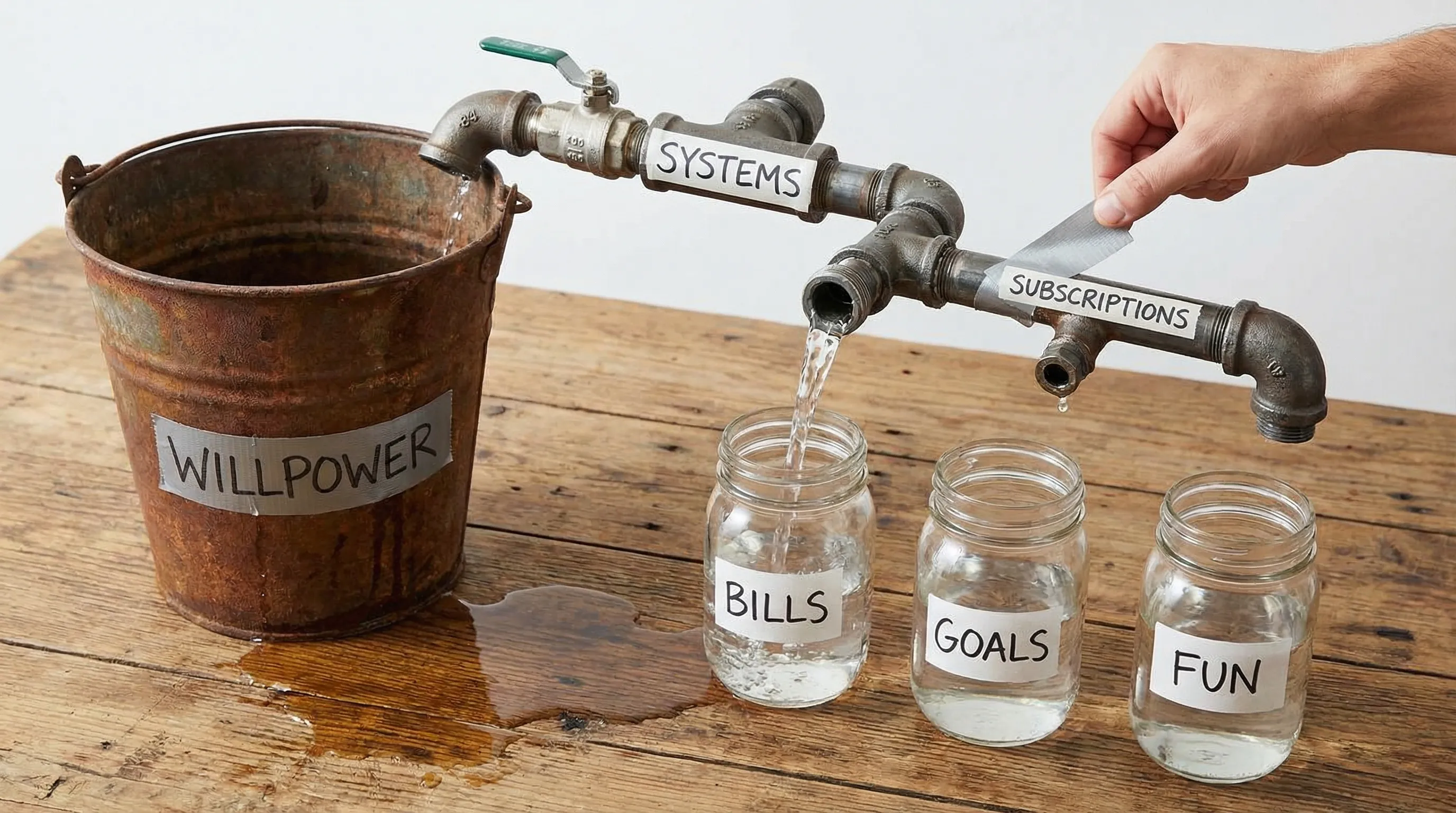
The uncomfortable truth: “discipline” is not a strategy
Meet Sarah.
Sarah starts January strong. New year, new spreadsheet, new “I’m finally the kind of person who meal preps” energy. By February, she’s back to vibes-based spending because:
- Work got chaotic.
- Her rent went up.
- She discovered she’d been paying for a meditation app she forgot existed.
Sarah didn’t fail. Her system failed under load.
Most money advice is built for people with:
- Stable schedules
- Stable income
- Stable emotions
Cool. Now let’s build habits for everyone else.
The goal isn’t perfection. It’s durability. If your financial habits can survive your worst weeks, your best weeks become rocket fuel.The Habit Survival Rule: design for your worst week
If you want habits that stick, stop asking, “What should I do when I’m motivated?”
Ask: “What can I still do when I’m tired, busy, and mildly annoyed at the world?”
That’s your baseline.
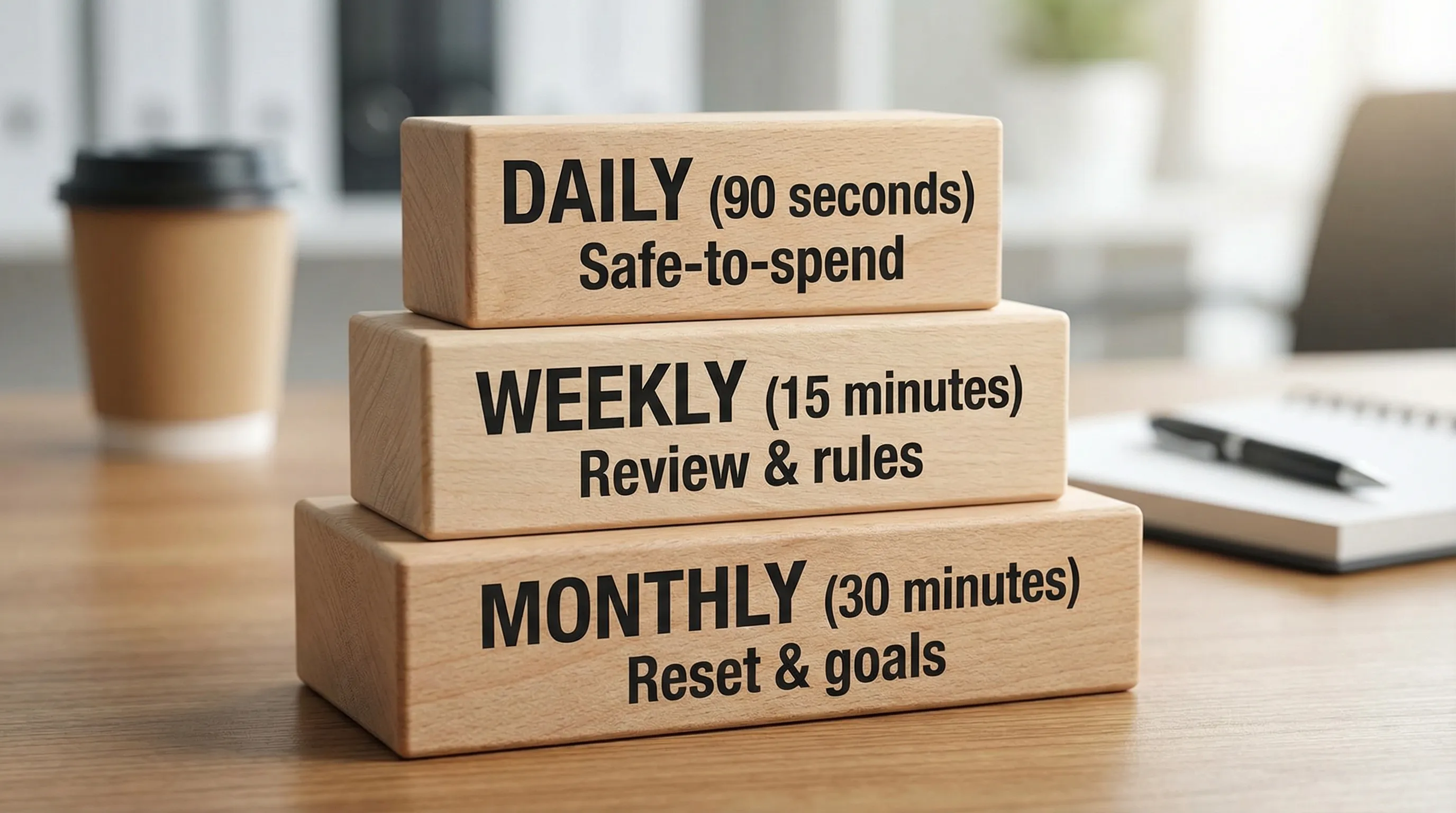
I call it the Minimum Viable Money Routine. It’s small, repeatable, and makes future-you noticeably harder to ruin.
Here’s the structure:
- Tiny daily habit (60 to 90 seconds): glance at one number
- Short weekly habit (10 to 15 minutes): correct course before you crash
- Simple monthly habit (20 to 30 minutes): lock in learnings, adjust targets
Not glamorous. Highly effective. Like brushing your teeth, but for your net worth.
Now let’s turn that rhythm into habits that don’t die the moment life does a surprise backflip.
Habit 1: Know your “safe-to-spend” number (and stop negotiating with your checking account)
Your checking account balance is a liar.
It includes money that belongs to:
- Rent/mortgage
- Insurance
- Utilities
- Debt payments
- Your future self’s goals
What you actually need is safe-to-spend, the amount you can spend today without creating a problem for next week.
A simple version:
Safe-to-spend = current cash minus upcoming bills minus minimum debt payments minus planned savingsMake this your daily 90-second habit: check safe-to-spend, then live your life.
This one habit reduces the two most expensive phrases in personal finance:
- “I thought I had more.”
- “It’s fine, I’ll figure it out later.”
If you want this to survive real life, you need it to be automatic and visible. FIYR’s goal tracking and safe-to-spend balance is built for exactly that, so you’re not doing mental math in a grocery aisle like a contestant on a game show.
Quotable truth: Your money doesn’t need a TED Talk. It needs a scoreboard.
Habit 2: Automate the boring, audit the sneaky
Real life doesn’t break your finances with one big event.
It bleeds you out with:
- subscriptions
- fees
- “little treats”
- convenience spending
So you do two things:
Automate what you already decided
If you’ve already decided rent gets paid and savings should happen, don’t rely on your mood.
Automate:
- bill payments (where appropriate)
- transfers to savings
- recurring contributions to investing
Automation is not laziness. It’s leadership.
Audit what you didn’t decide
Once a month, scan for:
- subscriptions you forgot
- price increases
- duplicate services (three streaming apps, zero time)
If subscriptions are your personal kryptonite, start with this guide: Best Apps to Manage Subscription Renewals.
FIYR makes this easier by combining subscription tracking with your budget and actual transaction data, so it’s not just “cancel stuff” energy. It’s “cancel stuff and watch your savings rate improve” energy.
One-liner to remember: If you can’t remember buying it, you definitely shouldn’t be paying for it.
Habit 3: Build “true expense buffers” so the calendar stops mugging you
Most people think they’re bad at budgeting.
They’re not. They’re just running a monthly budget in a world full of annual bills.
Car insurance every 6 months. Holiday spending every December. Medical copays whenever your body decides to cosplay as a 19th-century factory machine.
The fix is boring but elite: sinking funds (a.k.a. “I refuse to be surprised by predictable expenses”).
If you want the full playbook, use: Sinking Funds Guide: Stop Getting Blindsided by Bills.
To make this practical, here’s a starter table you can copy.
| True expense | How it hits | Simple monthly set-aside idea (example) | Why it saves your sanity |
|---|---|---|---|
| Car maintenance | random-ish | $50 to $150 | Prevents “new tires” becoming new debt |
| Insurance (auto/home/renters) | semi-annual/annual | bill ÷ months until due | Stops the calendar from jump-scaring you |
| Gifts + holidays | seasonal | $25 to $200 | Keeps December from becoming January regret |
| Medical | unpredictable | $25 to $150 | Reduces credit card “emergencies” |
| Travel | lumpy | trip cost ÷ months | Makes vacations feel earned, not financed |
(Amounts vary by life stage and location, the point is the mechanism.)
In FIYR, you can turn these into goal buckets and track contributions without turning your banking setup into a Rube Goldberg machine.
Memorable takeaway: Surprise bills aren’t surprises, they’re just neglected math.
Habit 4: Use guardrails, not guilt
Guilt is a terrible financial coach. It screams, it shames, it rage-quits.
Guardrails are calmer. Guardrails say, “You can still have fun, just don’t drive off the cliff.”
Instead of 27 hyper-specific categories, aim for:
- a small set of meaningful categories
- clear caps for the “chaos” zones (food delivery, shopping, fun)
- a buffer category (Flex Pool) for real-life randomness
If you want a clean setup that won’t rot in two weeks, start here: Budgeting Categories List: A Clean Setup That Works.
And here’s the part nobody talks about: your guardrails must be adjustable.
Because “groceries” in a calm month is one number.
“Groceries” during:
- a growth spurt
- a new baby
- a stressful project
…is a completely different animal.
FIYR’s dynamic budgeting options and custom categories help you set caps that bend instead of snap. That’s the whole game.
Quotable one-liner: A budget that can’t bend is just a future panic attack with formatting.
Habit 5: Clean your data so your habits don’t drift into fantasyland
Most people don’t need more advice.
They need cleaner inputs.
If your transactions are miscategorized, your budget becomes a magic trick. Fun, but not useful.
Once a week (or at least every couple of weeks), do a quick cleanup:
- review uncategorized or weird transactions
- fix the biggest mislabels
- add or adjust automation rules
FIYR supports automatic transaction rules, so your system gets smarter over time instead of relying on you to remember that “AMZN MKTP” is either groceries or a waffle maker you bought at 1:00 a.m.
If you want to go deep on keeping categories clean, this is worth it: Error-Proof Budgeting: How FIYR Keeps Spending Categories Clean.
Memorable takeaway: You can’t build financial habits on dirty data. That’s just vibes with extra steps.
The “real life” stress test: what to do when you fall off
You will fall off. Everyone does.
The question is whether you spiral, or you reset.
Here’s a simple reset protocol that doesn’t require a monastery.
The 24-hour reset (after an overspend)
- Label the spending (literally name it): “Work Stress Week” or “We Deserved It”
- Make one compensating move: pause one non-essential purchase this week
- Add one friction rule for next time
Friction rule examples:
- “If it’s over $50, I wait 24 hours.”
- “No shopping apps on my phone.”
- “Delivery only on Fridays.”
This is not punishment. It’s systems design.
The 48-hour “Oh no” reset (after a real hit)
If you lose income, get a big medical bill, or life decides to audition for a disaster movie, switch to emergency mode fast.
Use this guide: Emergency Budgeting: The “Oh No” Plan You Need.
The short version:
- pause non-essentials
- calculate runway
- focus on cash flow, not perfection
One-liner: In a crisis, your job is not optimization. Your job is survival with receipts.
Make it stick: one table to rule your habit stack
If you want habits that survive, they need a trigger, a time cost, and a payoff you can feel.
| Habit | Trigger | Time cost | What you get | How FIYR helps |
|---|---|---|---|---|
| Check safe-to-spend | Morning coffee, lunch break | 90 seconds | Fewer “oops” purchases | Safe-to-spend + goals |
| Review spending hotspots | Same day each week | 10 to 15 minutes | Early course correction | Spending charts + categories |
| Clean categories and rules | End of week | 10 minutes | Better data, less work later | Transaction rules + custom categories |
| Subscription scan | First weekend of month | 10 minutes | Instant savings wins | Subscription tracking |
| Net worth and savings rate glance | Month-end | 10 minutes | Motivation that’s real | Net worth + savings rate tracking |
Notice what’s missing: willpower.
That’s not an accident.
Where FIYR fits (without the cheesy hard sell)
A lot of “money habits” advice quietly assumes you have unlimited time, perfect attention, and a spreadsheet fetish.
Most people have:
- a job
- a family
- 11,000 browser tabs
- a brain that just wants a break
FIYR is built for that reality: track spending, income, subscriptions, net worth, and savings rate in one place, with custom categories, automatic transaction rules, and FIRE-focused insights like a FIRE date calculator.
Translation: you spend less time “doing budgeting,” and more time making decisions that move you toward financial independence.
If you’re coming from Mint (RIP), FIYR is also designed as a modern alternative to Mint, Monarch Money, Copilot, Rocket Money, and Quicken, without the legacy baggage or the “why is this category called ‘Other’?” nonsense.
The punchline (and the point)
Financial habits that survive real life aren’t heroic.
They’re small. They’re automatic. They’re honest.
Build a system that works when you’re tired, busy, and slightly feral, and you’ll be unstoppable when you’re on your game.
Because the goal isn’t to be perfect.
The goal is to be unbreakable.