Why You’re Overspending (And the One Habit That Could Save You $50,000)
Most budgets do not fail because you cannot do math. They fail because your brain meets one‑tap checkout. Emotional spending triggers plus frictionless purchases is a rigged game, and it quietly drains the price of a small car over a decade.
Here is the uncomfortable part. The average American is not short on income, they are short on guardrails. Sixty percent of Americans still live paycheck to paycheck, according to CNBC. That is not a moral failing, it is a design problem in a world where your thumb can move more money in three seconds than your grandparents moved in three days.
A quick story
Meet Alex. Decides Sunday night is the rebirth of discipline, sets a clean food budget, promises to cook at home. Monday, rough day. Doorbell rings, delivery number one. Tuesday, doomscrolling, sees a micro‑trend hoodie, taps Buy Now, thinks, it is only 39 bucks. Wednesday is friends, rideshare both ways, surge pricing did not mention it would surge his blood pressure. Friday, the cart he left open checks out his willpower. He does not remember choosing most of it, he just remembers the taps.
Here is the part nobody talks about. Overspending is rarely a single big decision, it is a series of small, emotional decisions that feel harmless in the moment and expensive in hindsight.
What the data is telling you
- Sixty percent of Americans are living paycheck to paycheck. Source: CNBC.
- Many households juggle revolving credit card balances and subscription creep while reporting high money stress in annual surveys.
Put simply, the path of least resistance is not financially neutral. It is financially negative.
The insight
Overspending is not a math problem, it is a timing problem. Two minutes of emotion plus a checkout that feels like a video game can erase a month of good intentions. The fix is not 47 rules, it is one habit that makes all the other rules optional.
The one habit that saves real money
A 15‑minute Weekly Money Check‑In. Same time, same place, every week. If you only do one thing for your finances this year, do this.
Here is the playbook, no fluff:
- Open your tracker on Sunday and look at two numbers, month‑to‑date spend and safe‑to‑spend for the week ahead. If the weekly number is tight, choose exactly one category to throttle.
- Scan the last seven days and tag emotional spending triggers. Late‑night buys, stress snacks, payday splurges, social FOMO, bored scrolling. Name them so you can see them next week.
- Set one micro rule for the next seven days. Examples, 24‑hour hold on any purchase over 50 dollars, no food delivery on weekdays, no discretionary spending after 11 pm, category cap with a hard stop on eating out.
- Add one friction speed bump where you leaked cash. Remove saved cards from the worst app, turn off one‑tap, move the app to your last screen, turn on notifications that tell you your weekly cap is 90 percent used.
- Move the money you plan to save, now. Set a 50 to 300 dollars transfer to investments or debt for next payday, then forget it. Savings you do not move is just hope wearing deodorant.
Quotable version, What you do for 15 minutes on Sunday decides what you can afford in 15 years.
And then things get interesting.
Back‑of‑napkin math, where does 50,000 dollars come from?
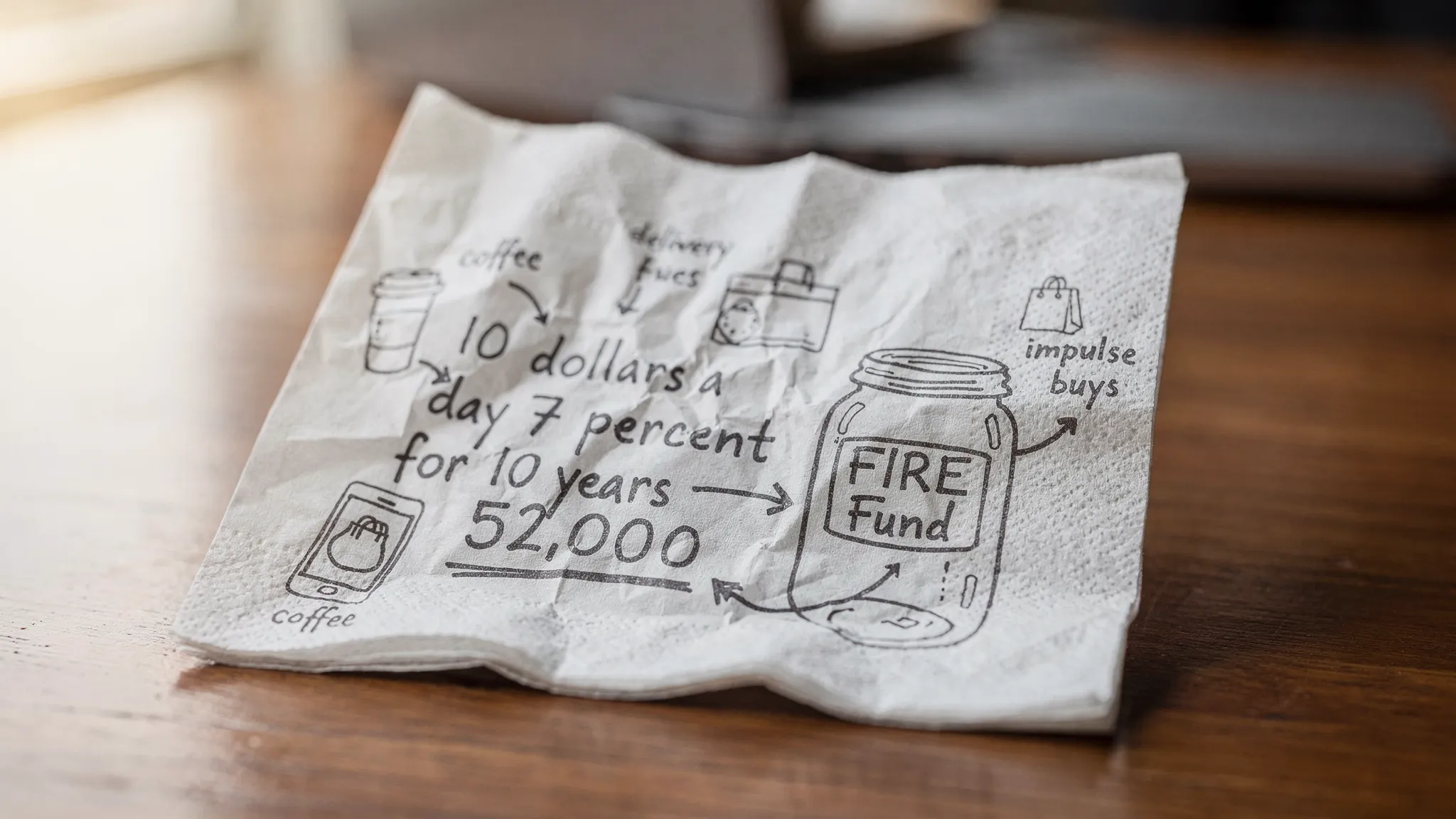
Compounding turns small weekly tweaks into real money. At a 7 percent annual return, investing 10 dollars per day for 10 years is roughly 52,000 dollars. Yes, ten bucks. Your daily delivery fees and impulse buys are auditioning for the role of future freedom.
Another way to see it:
| Tiny change | Monthly saved | 10‑year invested at 7 percent, approx |
|---|---|---|
| Cancel three zombie subscriptions | 35 dollars | 6,000 dollars |
| Swap two weekly deliveries for pickup | 60 dollars | 10,300 dollars |
| 24‑hour rule kills one 25 dollar impulse each week | 100 dollars | 17,200 dollars |
| Any combo that hits 300 dollars per month | 300 dollars | 51,700 dollars |
Assumes consistent monthly investing and long‑term average returns. Markets vary. Your habits matter more.
Spot your emotional spending triggers
Most people do not overspend everywhere. They overspend in the same three situations, again and again. Find the pattern, fix the pattern.
- Late‑night boredom scrolling, one‑tap Amazon therapy. Translation, fatigue plus convenience.
- Post‑meeting stress, I earned this, food delivery and rideshare. Translation, cortisol plus comfort.
- Social FOMO, a friend’s link in the group chat. Translation, identity plus belonging.
Label the trigger, then create a speed bump.
| Trigger | Easy speed bump | Tool to make it automatic |
|---|---|---|
| Late‑night scroll buys | No discretionary purchases after 11 pm, 24‑hour hold on carts | Use a weekly reminder and turn off one‑tap checkout on shopping apps |
| Stress spending after work | Pre‑budget a 20 dollar Treats category, no delivery Mon to Thu | Category cap with a hard stop and a calendar reminder |
| Social FOMO purchases | Make an Experiences sinking fund, buy only from that fund | Separate category with a monthly target and safe‑to‑spend view |
| Payday splurges | Pay yourself first, automate transfers on payday morning | Scheduled transfer to investments before you see the money |
| BNPL temptations | Debit‑only rule for discretionary for one week | Remove cards from BNPL apps and require a physical card |
Here is the punchline, triggers lose power when you see them coming.
Make the habit stick
- Put a 15‑minute calendar invite every Sunday called Money Check‑In, non‑negotiable.
- Keep a one‑line scoreboard, last week’s savings moved, this week’s cap, next week’s micro rule.
- Use a friction buddy, text a friend your 24‑hour holds so you cannot impulse alone.
The lighter, smarter tie‑in with FIYR
If you want the habit to run on rails, FIYR makes it fast without turning your life into a spreadsheet.
- Labels and rules, tag patterns like Late Night, Payday Splurge, or Travel FOMO, then auto‑apply rules so your triggers show up in one tap.
- Category caps with a safe‑to‑spend balance, see exactly how much runway you have this week and set hard stops where you leak.
- Subscription tracking, identify duplicate or dead subscriptions before they renew.
- Savings rate and FIRE date projections, watch 100 to 300 dollars of monthly cuts move your retirement timeline in real time.
Oh, and if you want deeper tactics, our guides on how to prevent overspending, the psychology of saving, and managing subscription renewals pair perfectly with a weekly check‑in.

Fast scripts you can steal this week
- The 24‑hour hold, If it costs more than 50 dollars, it waits 24 hours. If I still want it tomorrow, I probably want it. If I forget, it was a craving, not a need.
- The No‑buy window, No discretionary spending after 11 pm. Nothing good for my budget happens after 11.
- The Treats budget, I get 20 dollars each week to spend emotionally, guilt free. When it is gone, I am done.
If you want more structure behind these scripts, check the three‑fund play in our index fund guide so saved dollars actually grow.
Common pushbacks, answered quickly
- I do not have time for a weekly check‑in. You have time to lose hours to scrolling. Trade 15 of them for a habit that gives you money back.
- I tried budgeting, it never sticks. That is because you built rules you could not feel. This habit builds rules around the exact moments you overspend.
- Cutting 300 dollars a month sounds painful. Cutting the 300 dollars that does not improve your life is the opposite of painful. It feels like control.
The closer
Your money does not need more spreadsheets, it needs a rhythm. Do a 15‑minute Weekly Money Check‑In, add one new speed bump each week, and move the savings before you forget. Keep that up for a decade and those boring minutes will buy you something exciting, time.
Rich is not the absence of coffee, it is the presence of systems. Set the system, watch the savings rate climb, and let compounding do the loud part.