Why People Overspend: The Real Culprits in 2026
If you feel like you’re “bad with money” in 2026, congrats, you fell for the oldest trick in the modern economy: making you blame yourself for a system designed to drain you quietly.
Your problem isn’t that you can’t do math. It’s that your spending environment is basically a casino with two-day shipping.
Meet Alex.
Alex is normal. Good job, decent income, tries to “be responsible.” Then one month hits:
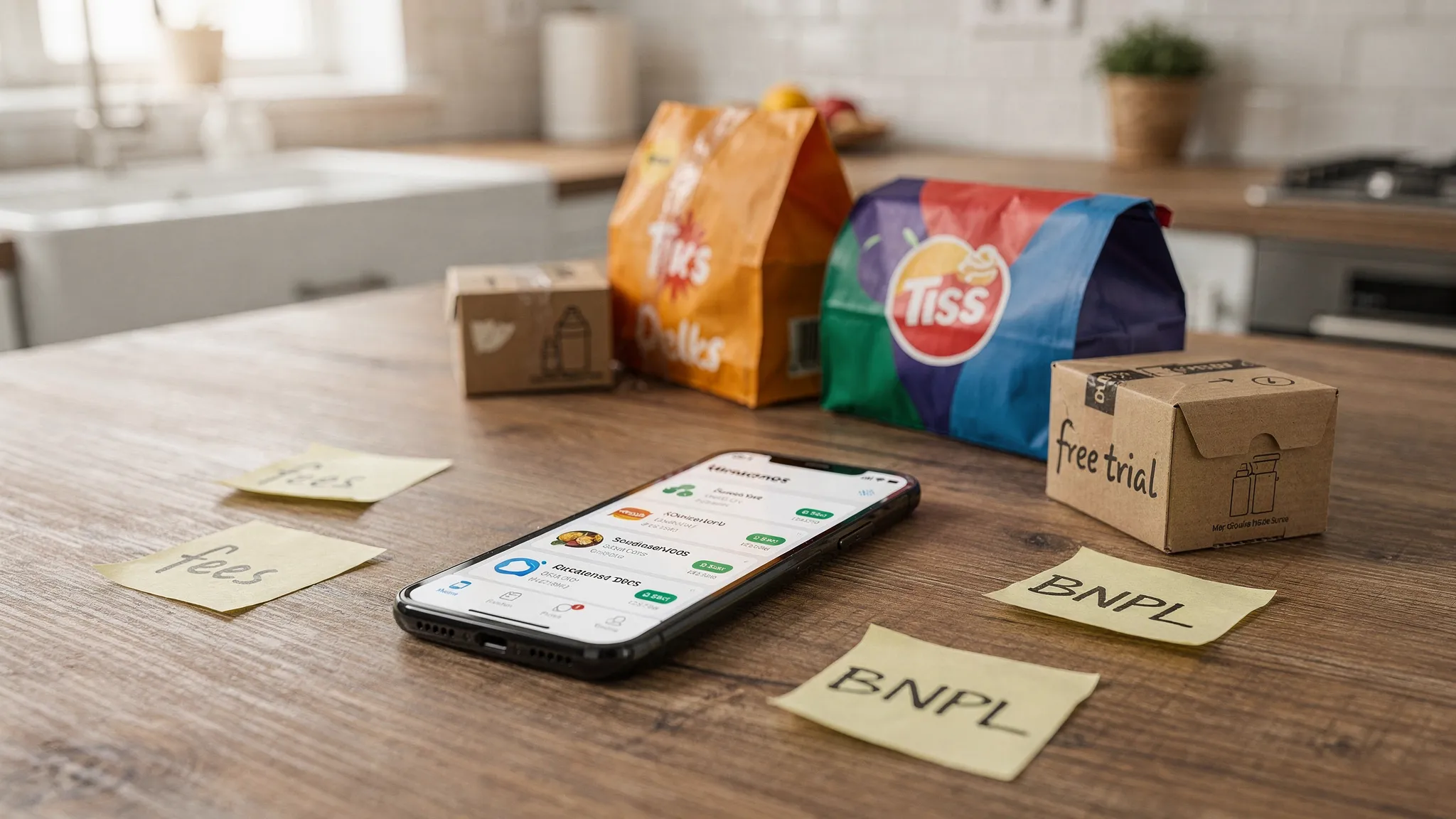
- A “free trial” becomes an annual renewal.
- A delivery app turns Tuesday dinner into a $38 “little treat.”
- A Buy Now, Pay Later plan makes a $240 hoodie feel like “four payments of nothing.”
- Tips, fees, and “service charges” spawn like gremlins after midnight.
Alex checks the bank app and gets that familiar sensation: How am I broke again?
Here’s the part nobody talks about: overspending in 2026 isn’t a character flaw. It’s a product feature.
The data says you’re not alone (and you’re not crazy)
A lot of people are white-knuckling their finances right now.
According to a CNBC report, around 60% of Americans are living paycheck to paycheck, about 70% are stressed about money, and only 45% say they have an emergency fund. The same report notes 3 in 5 (61%) are in credit card debt, owing $5,875 on average.
That’s not “a few irresponsible people.” That’s the mainstream.
The uncomfortable truth: when most people are struggling, the system isn’t “fine.” It’s just profitable.
Why people overspend in 2026: the real culprits
This isn’t about “stop buying lattes.” That advice is the financial equivalent of telling someone to “just calm down” during a panic attack.
Let’s talk about what’s actually happening.
Culprit #1: Frictionless spending (biometrics turned your wallet into a reflex)
We used to buy things with cash, which meant you physically watched money leave your hands. Then we used cards, which at least required a swipe. Now it’s face scan, thumbprint, one-tap, saved card, autofill address, and a dopamine confetti animation.
Your brain interprets “easy” as “safe.”
So when you overspend, it’s not because you’re weak. It’s because your purchasing process has the same resistance as scrolling.
Counterpunch: Put friction back where it counts.- Remove saved payment methods from the apps that get you.
- Turn off “one-click” wherever possible.
- Create a rule: “If it’s not in the plan, it waits 24 hours.”
Yes, you can still buy it tomorrow. If you still want it tomorrow.
Culprit #2: Algorithms that know your triggers better than you do
In 2026, you’re not shopping. You’re being shopped.
Your feeds are a personalized temptation buffet. A creator you like raves about a “must-have.” A platform drops a limited-time deal. Your brain hears: scarcity + social proof + instant gratification.
It’s not a coincidence you want new running shoes right after watching three “that girl” morning routines.
Counterpunch: Label the context, not just the category.Instead of only tracking “Shopping,” track why it happened:
- “Shopping (Bored Scroll)”
- “Shopping (Stress Day)”
- “Shopping (TikTok Made Me Do It)”
When you can name the pattern, you can break the spell.
And yes, this is where a flexible tracker matters. FIYR lets you use custom categories and labels so your data tells the truth, not a sanitized fairy tale.
Culprit #3: Subscription creep (death by 19 small charges)
Subscriptions used to be Netflix. Now it’s:
- Streaming bundles
- AI tools
- fitness apps
- “premium” email
- cloud storage
- kid apps
- random add-ons you forgot existed
Subscriptions are sneaky because they don’t feel like spending. They feel like background noise. Then your monthly budget is getting tackled in the parking lot by charges you barely recognize.
Counterpunch: Move subscriptions from “background” to “board meeting.”Do a monthly subscription review and ask:
- Would I buy this again today at this price?
- What did I use exactly three times and then emotionally abandon?
If you want a deeper cleanup playbook, use the workflow in Best Apps to Manage Subscription Renewals.
FIYR helps here by combining subscription tracking with the rest of your money system, so it’s not a separate “subscription project” you forget by next week.
Culprit #4: Buy Now, Pay Later (BNPL) and the great “not-real-money” illusion
BNPL is not evil. It’s just… incredibly good at its job.
It splits pain into installments, which makes your brain treat the purchase as smaller than it is. The mental math becomes: “It’s only $35 today.”
But life doesn’t happen in installments. Your cash flow does.
Counterpunch: Track BNPL like the liability it is.Two rules that keep this from getting spicy:
- If you can’t afford it in full today, it’s not “on sale.” It’s financed.
- Create a dedicated category or label for BNPL so it cannot hide inside “Shopping.”
If you want to get more precise with tracking what you owe (and what it’s doing to your net worth), read How to Track Liabilities Accurately Without Missing Details.
Culprit #5: The fee economy (your total bill is now a surprise ending)
In 2026, the price is rarely the price.
Food delivery, ticketing, travel, services, even coffee shops, all add layers:
- service fees
- delivery fees
- platform fees
- tip expectations
- “small order” fees
The psychology is brutal: you anchor on the menu price, then rationalize the final total because you’re already committed.
Counterpunch: Budget on all-in pricing.A simple mental model: if a purchase category usually includes fees (delivery, rideshare, events), assume a markup.
- Delivery: add 20% to the menu total as your “reality tax.”
- Tickets: expect fees and budget off the final cart.
Your budget should be a mirror, not a mood board.
Culprit #6: Identity spending (you’re not buying stuff, you’re buying a version of yourself)
This one’s the boss battle.
People overspend because spending is social now. It signals:
- taste
- status
- belonging
- competence
- self-care
Sometimes it’s not even about flexing. Sometimes it’s “I work hard, I deserve it.”
And you do deserve nice things. The question is: Do you deserve them more than future-you deserves freedom?
Counterpunch: Choose “rules of identity,” not rules of deprivation.Instead of “I can’t spend,” try:
- “I’m the kind of person who buys quality, but not impulsively.”
- “I do treats, but I plan them.”
- “I don’t finance vibes.”
Your spending will always obey your identity. So pick one that makes you richer.
The Overspending Defense System (simple, repeatable, not vibes-based)
Willpower is cute. Systems are undefeated.
Here’s a practical framework you can run every month.
Step 1: Build a “Truth Week”
Pick one week where you track everything like a detective, not a judge.
- No shame.
- No “I’ll fix it later.”
- Just accurate labels.
This is where most budgets fail because the data is messy. If you want to see how messy categories sabotage progress (and how to clean them up), read Why Budgets Fail (And How to Fix Yours in 2026).
Step 2: Turn spending into intelligence (labels, rules, and a clean scoreboard)
A normal budget asks, “Where did the money go?”
A great budget asks, “Why did it go there, and can I prevent the next one?”
Use:
- Custom categories for what matters to you (not what a generic app thinks matters).
- Labels for context (trip, stress week, baby supplies, work travel).
- Transaction rules to auto-clean the boring stuff, so your brain can focus on decisions.
This is the difference between “tracking” and “controlling.”
Step 3: Install guardrails (caps + safe-to-spend)
People don’t overspend because they love chaos. They overspend because they don’t have a live boundary.
Guardrails that work:
- A cap on your top 2 problem categories (restaurants and shopping are frequent offenders).
- A separate bucket for “planned fun” so you can spend without guilt.
- A safe-to-spend number you trust, so you stop negotiating with yourself in Target.
FIYR is built for this style of control: dynamic budgets, category caps, and a safe-to-spend balance that keeps you from “accidentally” funding your lifestyle with your future.
The 3 numbers that predict overspending (before it happens)
Most people look at money like a rearview mirror. Let’s make it a dashboard.
| Metric | What it tells you | Simple way to calculate it | What “good” looks like (for most people) |
|---|---|---|---|
| Unplanned Spend Rate | How much of your month is impulse and drift | Unplanned purchases ÷ total spending | Trending down month over month |
| Subscription Load | How much of your budget is locked in | Subscription total ÷ take-home pay | Low enough that one cancellation makes a difference |
| Debt Drift | Whether you’re financing lifestyle | Credit card balance this month minus last month | At or below zero (not growing) |
These aren’t moral grades. They’re early-warning signals.
If your Subscription Load is high, you don’t need motivation. You need cancellations.
If your Debt Drift is positive, you don’t need a new budget template. You need fewer “payments.”
And if your Unplanned Spend Rate is climbing, your environment is winning.
The FIRE gut-punch: overspending steals years, not dollars
Here’s a clean piece of math that should make you sit up straight.
If you increase your spending by $100/month, that’s $1,200/year.
Using the classic Rule of 25 logic (spending × 25), that $1,200/year adds about $30,000 to your FI number.
That’s the real cost of “it’s only a hundred bucks.”
If you’re FIRE-minded, tracking your savings rate and FI timeline makes this painfully real. FIYR’s savings rate tracking and FIRE projection tools are basically a lie detector for lifestyle creep.
For more on why savings rate is the wealth accelerant, see Savings Rate Calculator: The One Metric That Matters.
A 30-minute reset you can do this weekend
If you want momentum fast, do this in one sitting:
- Identify your top 3 merchants by total spend (the “usual suspects”).
- Create one new label for context (examples: “Bored Scroll,” “Convenience Tax,” “Work Survival”).
- Set one cap on your biggest leak category.
- Review recurring charges and cancel one subscription you would not re-buy today.
- Decide one friction rule (24-hour delay, no saved cards, or no delivery on weekdays).
Then repeat next month. Consistency beats intensity. Every time.
Where this gets interesting (and hopeful)
Overspending feels personal, but it’s mostly structural. Which is good news, because structural problems have structural fixes.
You don’t need to become a monk.
You need a clearer picture, cleaner categories, and guardrails that work on your worst day, not your best day.
Because the goal isn’t to “spend less.”
The goal is to spend on purpose and keep your freedom.