 FIYR
FIYR How to Save More Money Without Hating Your Life
You don’t need to live on rice and regret to save more money.
You need a system that stops the silent financial pickpockets: convenience fees, subscription creep, lifestyle drift, and the little “treat yourself” purchases that have somehow become a daily wellness program.
Meet Jordan. Smart. Employed. Not reckless.
Jordan also had:
- Three streaming services
- Two “free trials” that turned into paid plans
- A premium gym membership used twice (once to sign up, once to cancel but “the app was down”)
- DoorDash showing up like an uninvited relative
Jordan wasn’t “bad with money.” Jordan was paying the Modern Life Tax.
And it’s everywhere.
According to a CNBC breakdown of recent surveys, about 60% of Americans are still living paycheck to paycheck, 70% are stressed about money, and 61% carry credit card debt (with an average balance around $5,875). Only 45% report having an emergency fund, and many of those have under $5,000 saved (CNBC).
So no, you’re not “behind.” You’re in a very crowded line.
Here’s the good news: saving more doesn’t require misery. It requires better math, better defaults, and fewer money leaks.
Why most saving advice makes you hate your life
Traditional personal finance advice is basically:
- Stop buying coffee
- Never have fun again
- Retire at 94 with a large pile of unused money
It fails because it attacks the wrong thing.
Most overspending isn’t one giant mistake. It’s a thousand tiny decisions made on autopilot, in an economy engineered for frictionless swipes and one-tap “Buy Now.”
So if you’re trying to save using willpower alone, you’re bringing a squirt gun to a house fire.
The goal is not “spend less.” The goal is spend on purpose.
Memorable truth: You don’t need more discipline, you need fewer decisions.
The “Save More, Hate Life Less” framework
If you want to save more money without turning into a monk with a spreadsheet, you need to separate spending into three buckets:
- Joy spending: genuinely improves your life
- Leak spending: costs money, adds stress, barely adds happiness
- Future-you spending: saving, investing, debt payoff, emergency fund
Your job is not to delete joy spending. Your job is to migrate leak spending into future-you spending, while protecting the joy.
Here’s a simple way to classify expenses (and yes, it works even if you have chaotic, irregular income).
| Spending type | Quick test | What to do with it |
|---|---|---|
| Joy spending | “I’d buy this again next month, happily.” | Keep it, just cap it |
| Leak spending | “I forget I bought this, or I feel gross after.” | Cut it, replace it, or add friction |
| Future-you spending | “This reduces stress later.” | Automate it first |
This is how to save more money in real life: not by becoming cheap, but by becoming selective.
Step 1: Find your money leaks (the ones you barely notice)
The easiest savings are the ones that don’t feel like sacrifice.
Do a “Leak Sweep” using the last 30 days of transactions. You’re hunting for:
- Recurring charges you forgot about
- Convenience purchases you don’t even remember
- “Small” transactions that happen constantly
- Fees (late fees, interest, ATM fees, random account charges)
The 3-question Value Audit
For each suspicious category (food delivery, shopping, subscriptions, bars, rideshare), ask:
- Did this meaningfully improve my day?
- Would I pay for it again at the same price?
- If I removed this, what would I do instead?
That last question matters because your brain hates a vacuum. If you don’t replace the habit, it will boomerang back with a new credit card.
Quotable line: If you can’t remember buying it, you didn’t “treat yourself”, you got mugged by your own habits.
Make it easier with FIYR (because memory is a liar)
This is where a modern tracker earns its keep.
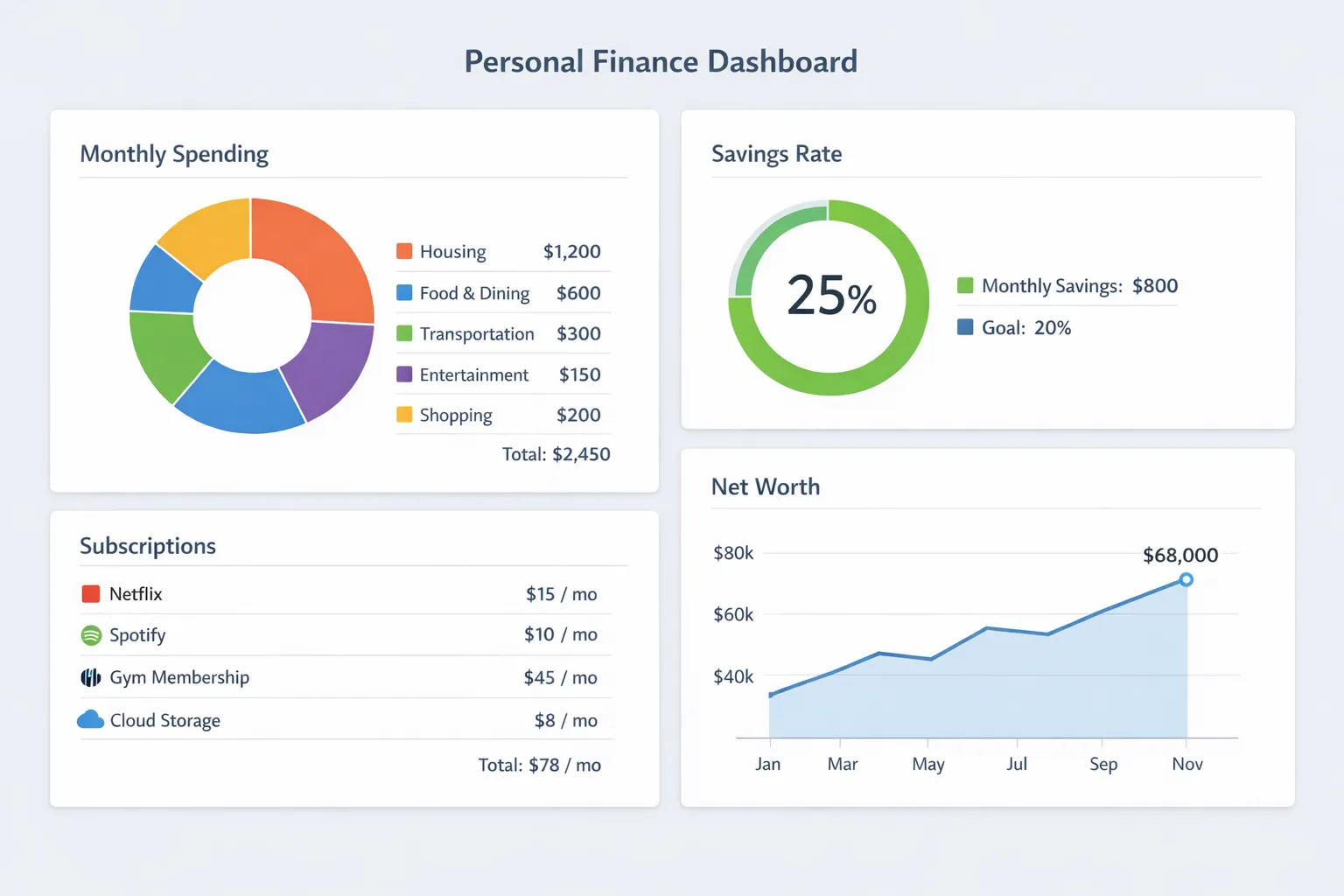
In FIYR, you can track income, spending, subscriptions, and net worth in one place, then:
- Create custom categories that match your actual life (not a 2009 bank spreadsheet)
- Use transaction rules to auto-clean messy merchants (hello, “AMZN MKTP US”)
- Add labels like “NYC Trip 2025” to see the true cost of a thing without guessing
If you’re coming from Mint, Monarch Money, Copilot, Rocket Money, or Quicken, this is the difference between “budgeting theater” and “I know what’s happening.”
Step 2: Stop trying to win with $3 cuts (go after the Big 3)
Yes, canceling a subscription helps.
But if your housing, transportation, and food costs are drifting upward unchecked, you’re basically bailing out the Titanic with a teaspoon.
Housing: the “silent boss fight” of your budget
Housing is usually the biggest lever. You don’t need to move into a van (unless you’re into that aesthetic).
Options that save real money without ruining your life:
- Negotiate at renewal: landlords expect it, especially if you’re low-maintenance and pay on time.
- Downshift slightly: same neighborhood, smaller unit, fewer “luxury” amenities you don’t use.
- House hack: roommate, rental of a spare room, short-term sublet when traveling (if allowed).
Best mindset: Lowering your housing cost is like getting a raise that isn’t taxed.
Transportation: the car payment is the new smoking
If you have a big car payment, you’re not “bad with money.” You’re just funding a rolling subscription with leather seats.
Levers that don’t require selling your car tomorrow:
- Re-shop insurance (yes, again)
- Reduce unnecessary driving (bundle errands, stop paying for chaos miles)
- If you’re replacing a car soon, decide with math, not vibes
Quotable line: A fancy car is just a monthly payment dressed up as a personality.
Food: keep the joy, delete the chaos
Food spending explodes when:
- You don’t plan even a little
- Your fridge is a museum of “aspirational groceries”
- You’re hungry and your phone knows it
A realistic fix:
- Pick two default meals you can cook half-asleep
- Keep “emergency food” stocked (frozen meals, pantry staples)
- Give yourself a fun budget for restaurants so you stop oscillating between restriction and rebellion
The goal is consistency, not culinary perfection.
Step 3: Kill subscription creep (politely, but aggressively)
Subscriptions are sneaky because they feel small. Then you add enough “small” and suddenly you’re paying $247/month to rent your own entertainment.
Run a subscription audit once a month:
- List every recurring charge
- Mark each as Keep, Pause, Cancel, or Downgrade
- Cancel the bottom 20% first (the ones you’d barely miss)
If you want a deeper playbook, FIYR has a dedicated guide on subscription renewals you can steal tactics from: Best Apps to Manage Subscription Renewals.
The “One In, One Out” rule
This rule is stupidly effective:
- If you add a new subscription, you cancel one within 24 hours.
It forces tradeoffs, and tradeoffs are where savings lives.
Memorable truth: Subscriptions aren’t evil, unreviewed subscriptions are.
Step 4: Make saving automatic (so you don’t need motivation)
Motivation is a fair-weather friend. Automation is a machine that shows up on time.
The Pay-Yourself-First split
On payday (or whenever income hits), route money in this order:
- Future you: emergency fund, retirement, debt payoff, investments
- Bills: fixed essentials
- Life: variable spending with guardrails
If you’ve ever wondered how to save more money consistently, this is it. You stop saving “what’s left,” and you start spending what’s left.
The “raise capture” move (so lifestyle creep doesn’t eat your future)
Any time your income goes up, decide the split in advance.
A simple default:
- Put most of the raise toward goals (saving/investing/debt)
- Allow a smaller slice to improve your life
Not because fun is bad, but because raises have a habit of evaporating into nicer versions of the same chaos.
For a deeper dive on this, you’ll like: How to Avoid Lifestyle Creep in 2026 (And Start Saving More).
How FIYR helps you actually stick to it
FIYR is built for the reality that people need a system, not financial shame.
You can:
- Track your savings rate (the number that quietly controls your FIRE timeline)
- Use goal tracking with a safe-to-spend balance, so you don’t “accidentally” spend your vacation fund on tacos
- Set category caps with dynamic budgeting so your plan reflects real cash flow
Quotable line: Willpower is a terrible financial plan. Defaults are undefeated.
Step 5: Use “friction” as a weapon (not a punishment)
Saving works when spending becomes slightly annoying.
Friction ideas that don’t ruin your quality of life:
- Remove saved cards from the worst temptation apps
- Add a 24-hour delay rule for nonessential purchases
- Create a separate “spending” account with a weekly transfer
The best friction isn’t dramatic. It’s subtle. It creates a pause long enough for your prefrontal cortex to wake up and stop your inner raccoon from ordering gadgets at 1 a.m.
Here’s the part nobody talks about: friction is how rich people stay rich. They just call it “policies.”
Step 6: Save time, save money (especially if you’re self-employed)
If you’re a freelancer, creator, or small business owner, your budget doesn’t just leak money, it leaks time.
And time leaks become money leaks. Missed invoices, delayed onboarding, messy permissions, endless back-and-forth, it all turns into “why is cash flow tight again?”
If you run an agency or service business, tightening onboarding can be a real financial lever. Tools like client onboarding software can reduce admin chaos by getting clients set up through one secure link, which means you spend less time herding cats and more time doing billable work (or, you know, living).
Memorable truth: You can’t out-budget a broken process.
The 45-minute “Save More” sprint (do this once, then repeat monthly)
This is the practical reset that doesn’t require a finance degree or a personality transplant.
Minute 0 to 15: Ground truth
- Look at the last 30 days of spending
- Identify your top 3 categories
- Identify your most annoying category (the one that makes you say, “Wait, what?”)
Minute 15 to 30: Pick 3 moves
Choose:
- One cut (cancel, downgrade, pause)
- One replace (swap a habit for a cheaper version)
- One automate (transfer to savings, extra debt payment)
Minute 30 to 45: Lock it in
- Add a rule, cap, or reminder so it persists
- Set a calendar event for next month
If you want a weekly rhythm that pairs perfectly with this, the FIYR blog has a strong companion habit: Why You’re Overspending (And the One Habit That Could Save You $50,000).
Quotable line: The point of budgeting is not control, it’s confidence.
Common mistakes that make saving feel awful
Mistake 1: You cut joy first
People slash the one dinner out they actually love, then keep the five random purchases they don’t even remember. Backwards.
Cut leaks first. Protect the stuff that makes life feel like life.
Mistake 2: You try to change everything in one month
That’s not a budget, that’s a personality makeover.
Change 2 to 3 things per month. Let them stick.
Mistake 3: You don’t measure the one number that matters
That number is your savings rate. It quietly determines whether FIRE is a dream, a plan, or a screenshot you doom-scroll past.
(If you want the motivation punch plus the math, this one is worth it: Boost Your Savings Rate: A Shortcut to FIRE.)
Frequently Asked Questions
How can I save more money without giving up everything fun? Keep your “joy spending,” cap it, and cut “leak spending” first (subscriptions you don’t use, convenience spending you don’t enjoy, fees, and impulse buys). You save more with less misery when you protect what you actually value. What’s the fastest way to start saving if I live paycheck to paycheck? Start with a tiny automatic transfer on payday (even $10 to $25), then do a leak sweep to free up cash (cancel one subscription, reduce one recurring bill, or add friction to one impulse category). Small wins create breathing room. Should I focus on cutting expenses or increasing income? Both work, but start with the easiest wins. Cutting leaks is immediate. Increasing income is powerful long-term. The sweet spot is doing one of each every month. How do I stop subscription creep? Use a monthly audit and a simple rule like “one in, one out.” If a new subscription enters your life, an old one leaves within 24 hours. What should I track if I’m serious about saving more? Track spending by category, subscriptions, and your savings rate. If you’re FIRE-minded, also track net worth and your projected timeline. Is a budgeting app worth it if I already have a spreadsheet? If your spreadsheet is accurate, consistent, and you actually update it, great. Most people don’t. A good app makes tracking automatic, categorization cleaner, and reviews easier, which is usually what turns “good intentions” into real savings.Ready to save more money with less suffering?
If you’re trying to cobble together clarity from three bank apps, a notes file, and vibes, you’re doing personal finance the hard way.
FIYR is built for people who want the full picture, spending, income, subscriptions, net worth, savings rate, and a FIRE-focused path forward, without the legacy clunk of older tools. It’s a modern alternative to Mint, Monarch Money, Copilot, Rocket Money, and Quicken, designed for customization and real life.
If you want a next step that isn’t “be perfect forever,” start here: track one month, label your leaks, set a couple rules, and watch your savings rate climb.
Your money should be a tool, not a horror movie. And the plot twist is you’re one good system away from winning.