Holiday Budgeting Tips: Celebrate Without Going Broke
If your holiday “budget” is basically vibes plus a credit card, congrats, you’re running the most popular financial system in America.
And it’s not just you. According to a CNBC report, 60% of Americans are living paycheck to paycheck, 70% are stressed about money, and 61% are in credit card debt (average balance $5,875). Holiday season doesn’t create the problem. It just turns the volume up.
So let’s do the thing nobody wants to do (but everybody needs): celebrate like a functional adult without waking up in January like, “Who authorized this gingerbread-flavored bankruptcy?”
The real reason people go broke during the holidays
Meet Alex. Alex is a good person. Alex tips well, buys thoughtful gifts, and hosts “casual” dinners that somehow require three trips to Target.
Alex also does one fatal thing: Alex decides holiday spending one purchase at a time.
That’s how it gets you.
- $38 here for “just a few stocking stuffers”
- $92 there for shipping because “it won’t arrive otherwise”
- $140 for a party outfit you’ll wear once and later “donate” to the back of your closet
Holiday overspending isn’t a math problem. It’s a decision architecture problem. Your wallet gets death-by-a-thousand “small” yeses.
Here’s the part nobody talks about: if you don’t set a number in advance, the number gets set by your impulses. And your impulses have a marketing budget.
Holiday budgeting tips that actually work (because they’re systems, not wishes)
The goal isn’t to “spend less.” The goal is to spend on purpose.
Step 1: Pick one number (yes, one)
Your holiday budget is a single all-in cap for the season. Not a loose guideline. A cap.
Use this simple formula:
Holiday Budget = Cash you can spend without debt or savings sabotageTo find it fast, ask:
- If I spend this amount, will I still pay all bills on time?
- Will I still hit my minimum savings goal this month?
- Will I avoid carrying a balance on my credit card?
If any answer is “lol no,” your number is too high.
Your holiday budget should be a plan, not a plot twist.
Step 2: Split the budget into five buckets (so it can’t hide)
Most people “budget for gifts” and then get ambushed by travel, food, and shipping like it’s a surprise DLC.
Use five buckets:
- Gifts
- Travel
- Hosting + food
- Decor + outfits
- Giving (charity, tips, donations)
Here’s a realistic starting split (adjust to your life):
| Bucket | What it covers | Typical share |
|---|---|---|
| Gifts | Presents, gift cards, kids’ stuff | 45% |
| Travel | Flights, gas, lodging, ride shares | 25% |
| Hosting + food | Groceries, alcohol, potluck contributions | 15% |
| Decor + outfits | Tree, lights, holiday fits, photos | 10% |
| Giving | Charity, service workers, family help | 5% |
This is the anti-ambush framework. If you don’t give every dollar a job, it will audition for the role of “miscellaneous.”
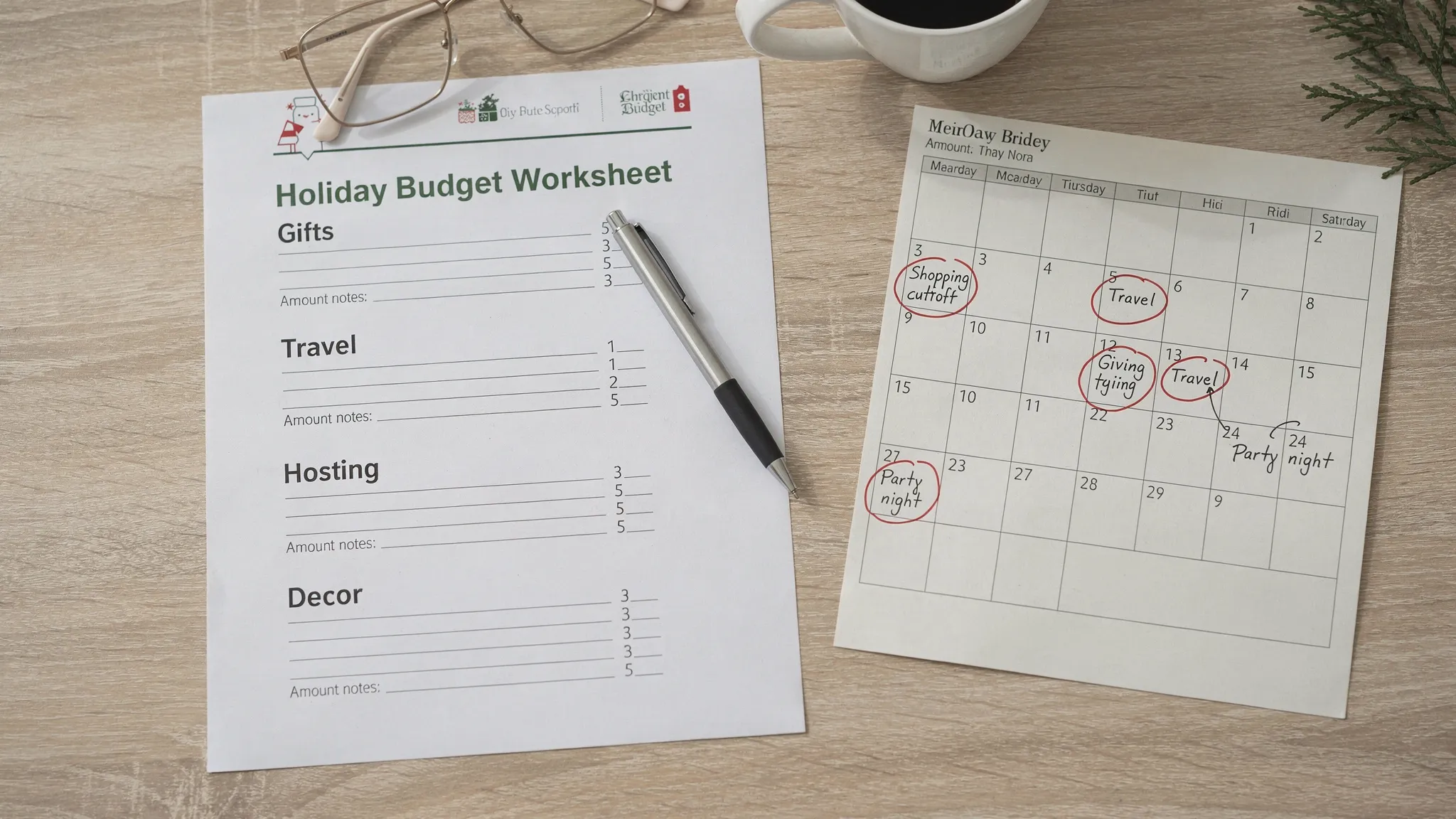
Step 3: Make it calendar-based (because holidays are a schedule, not a surprise)
You know what’s predictable?
- Shipping deadlines
- Office parties
- Family travel
- That one friend who organizes a gift exchange like it’s the Met Gala
Add the key dates to a calendar and assign each one a budget amount.
Example:
- Thanksgiving travel: $400
- Gift exchange: $25
- Hosting dinner: $180
- Final shipping rush: $40
Now you’re not “budgeting.” You’re project managing your spending.
The holidays are not an emergency. They’re an annual subscription.
The “Good Enough Gift List” (so you don’t buy 27 panic presents)
The easiest way to overspend is to shop with an empty plan and a full internet connection.
Create a gift list with three columns:
- Person
- Gift idea (one sentence)
- Max spend
Then add one rule:
One person, one primary gift.If you want to add a small extra, fine. But stop turning gift-giving into a scavenger hunt for your self-worth.
Scripts that save money (and relationships)
Use these verbatim. They work because they’re clear.
- “We’re keeping gifts at $X per adult this year so December doesn’t wreck January.”
- “Let’s do kids only and do a potluck for the adults.”
- “I’d rather do one nice experience than lots of stuff. Coffee date on me in January?”
People rarely get mad at a boundary. They get mad at ambiguity.
Stop paying the “convenience tax”
Holiday spending has a secret villain: last-minute convenience.
When you’re tired, busy, and overstimulated, you pay extra for:
- expedited shipping
- overpriced airport food
- “quick” Target runs that somehow cost $97
- delivery fees that multiply like rabbits
Two rules that fix this fast:
- 72-hour rule for non-urgent buys: If it’s not time-sensitive, wait three days.
- One-store rule for essentials: Choose one place for decor/hosting staples and stop “just browsing” everywhere else.
Convenience is great. It’s just not free.
Budgeting with credit cards: do it clean or don’t do it at all
Credit cards aren’t evil. They’re just honest about one thing: they make spending feel fake.
If you use cards for holiday spending, your system needs two guardrails:
- Autopay the full statement balance (minimum payments are how January becomes a sequel)
- Track spending by purchase, not by payment
If you want the clean version, use the same approach we recommend in this guide: treat credit card payments as transfers, and track purchases where they happen. Here’s a deeper breakdown: Smarter budgeting with credit cards.
The “Holiday Label” trick: track the season without destroying your categories
Here’s how holiday budgets quietly die: you shove everything into “Shopping” or “Misc” and then pretend it’s insight.
A better move is to keep your normal categories (Groceries, Travel, Gifts) and add a single label for the season.
Example label:
- Holidays 2026
Now you can see the true total across all categories without losing the detail.
This is where FIYR fits naturally: you can track spending with custom categories and category groups, then use labels to roll up holiday-specific costs for a clean, all-in view. It’s like Mint, Monarch Money, Copilot, Rocket Money, and Quicken, but built for people who want flexibility and clarity instead of mystery meat charts.
And if certain merchants are always holiday-related (looking at you, “AMZN Mktp US”), FIYR’s automatic transaction rules can tag them consistently so your data doesn’t turn into a crime scene.
If your data is messy, your budget is fiction.
Hosting without hemorrhaging money
Hosting is where budgets go to die with dignity.
The fix is not “don’t host.” The fix is cap the variables.
Try this:
- Pick one “centerpiece flex” item (nice dessert, great bottle of wine, fancy roast)
- Everything else is baseline
A simple hosting cap rule:
Hosting Budget = (People x $Y per person) + one flex itemIf you host 10 people and choose $8 per person, that’s $80, plus one flex item. Not $300 of chaotic appetizer innovation.
You’re hosting friends and family, not catering the Oscars.
Travel: the silent budget assassin
Travel costs don’t arrive all at once. They drip.
- luggage fees
- airport parking
- ride shares
- snacks
- “we should get coffee”
A quick travel control system:
- Set a daily travel cap (food, transit, activities)
- Pull it out as its own number
Example:
- 4 days x $55/day = $220 travel daily spend cap
This doesn’t eliminate fun. It eliminates the “how did we spend $900 on vibes?” moment.
If you’re traveling with a partner, use one shared rule: anything over $X requires a quick 2-minute yes from both people. It’s not control. It’s teamwork.
For a fuller couple system, this article helps: Budgeting for couples.
The post-holiday clean-up (the part that separates adults from financial archaeologists)
January is where progress happens because reality returns.
Do a 20-minute “holiday close”:
- Total up holiday spending (all-in)
- Note the top 3 surprises (shipping, decor, “little gifts”)
- Pick one fix for next year (start a sinking fund, buy earlier, set a lower cap)
If you’re FIRE-minded, here’s the fun twist: holiday overspending doesn’t just cost money. It costs time.
Every $500 that becomes revolving credit card debt can turn into months of drag depending on your APR and payments. Meanwhile, improving your savings rate can compress your timeline to freedom. If you want the bigger-picture scoreboard, read: What is a good savings rate?.
The holidays are one month. The interest can last all year.
A quick “No-Regret Holiday Budget” checklist
Use this as your annual pre-season ritual:
- Set one all-in holiday cap
- Split into five buckets (gifts, travel, hosting, decor, giving)
- Put key spend dates on a calendar
- Make a gift list with per-person max
- Set one hosting “flex” item and cap the rest
- Use one label for holiday tracking so totals don’t hide
- Schedule a 20-minute January close
That’s it. Not sexy. Very effective.
Frequently Asked Questions
How much should I budget for holiday spending? Start with what you can spend without creating debt or skipping core savings. If your finances are tight, a smaller budget with clear caps beats a bigger budget funded by future regret. What if I’m already in credit card debt? Then holiday spending needs a hard ceiling and simpler expectations. Prioritize low-cost traditions, cap gifts, and avoid adding new revolving debt. The “perfect holiday” is not worth 22% APR. How do I budget for holiday travel without nickel-and-diming myself? Use one travel all-in cap plus a daily spend cap for food and local transit. Travel costs leak through small purchases, so daily caps stop the drip. What are the best holiday budgeting tips for couples? Agree on the all-in number, define what counts as “holiday spending,” and set a quick approval threshold for larger purchases. Clarity prevents fights and overdrafts. What’s the easiest way to track holiday spending without wrecking my normal budget categories? Use normal categories, then add a single holiday label (like “Holidays 2026”) so you can see the full total across gifts, travel, and food without losing detail.Celebrate like you have a plan (because you do)
You don’t need to be a budgeting monk to win the holidays. You just need a system that makes spending visible before it becomes a problem.
If you want an easier way to track the season, FIYR helps you see your spending, budgets, subscriptions, savings rate, and net worth in one place, with the flexibility to label holiday costs, automate categorization, and keep a clean view of what’s safe to spend.
Build the plan once. Then enjoy the season without the January hangover. Check out FIYR and make your holiday budget the boss, not the victim.