Financial Goals for 2026: A No-Fluff Blueprint
Most “financial goals” are just vibes wearing a spreadsheet costume.
Meet Sarah. Smart, motivated, has a Notes app full of promises:
- “Save more.”
- “Invest.”
- “Stop ordering DoorDash like it’s a medical necessity.”
By March, life happens. The goals don’t die in a dramatic blaze, they slowly ghost her. Because the plan was never a plan. It was a wish.
Here’s the uncomfortable truth: your goals aren’t too ambitious, they’re too fuzzy.
And that fuzz is expensive. If you feel like you’re doing “fine” but somehow never getting ahead, you’re in very good company. A CNBC report found 60% of Americans were still living paycheck to paycheck. Not because they are bad people, but because modern money is frictionless and chaotic by design. (CNBC)
So let’s do this properly.
This is a no-fluff blueprint for financial goals for 2026 that actually survives real life, surprise expenses, bad moods, and the fact that your bank balance does not care about your vision board.
The 2026 reality check (aka why “try harder” is not a strategy)
Money in 2026 has three big problems:
- Spending is invisible (tap, swipe, autopay, done).
- Subscriptions multiply like gremlins after midnight.
- Budgeting apps often show you pretty charts instead of telling you the truth.
Your fix is not “more discipline.” Your fix is a system that makes progress the default.
Here’s the part nobody talks about: your goals are only as real as your tracking. If the numbers are messy, your goals become cosplay.
The Goal Stack: 5 levels of financial goals for 2026
Most people set goals like they are ordering at a drive-thru: “Yeah, I’ll take a Roth IRA and also retire early, thanks.”
Instead, build goals in a stack. Bottom first. Always.
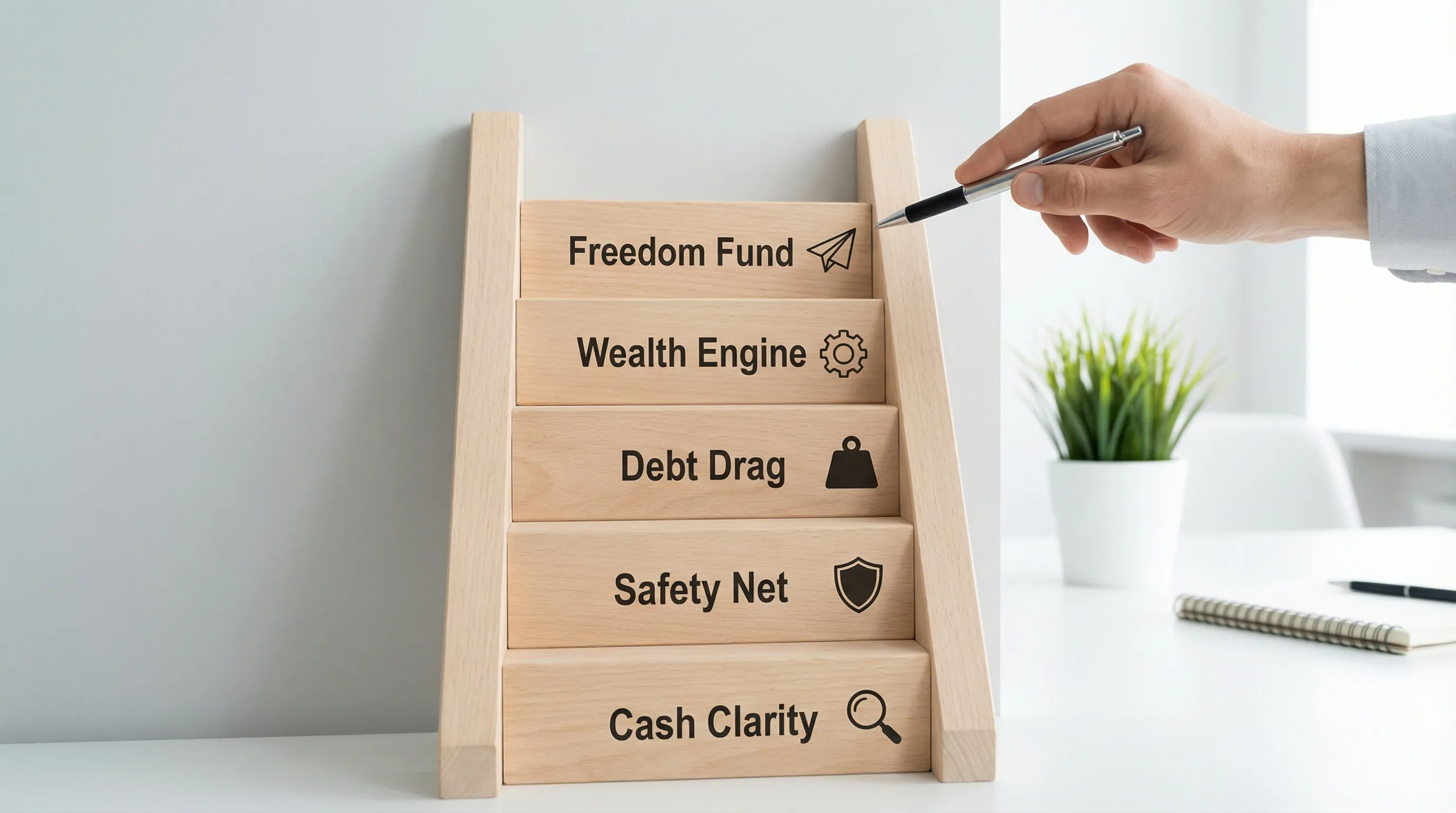
Level 1: Cash clarity (you can’t improve what you refuse to look at)
This is the foundation. If you do nothing else in January, do this.
Goal: Know, with annoying accuracy, where your money actually goes.Cash clarity is not just “I check my account sometimes.” It’s:
- Income tracked (including irregular income)
- Expenses tracked (including the little leaks)
- Subscriptions identified
- A usable “safe to spend” number
If you want to do FIRE math later, this is your raw material.
Level 2: Safety net (your emergency fund is your anti-panic device)
Goal: Build a buffer so normal life stops becoming a financial emergency.Without this, every surprise turns into debt, stress, or both.
Level 3: Debt drag (high APR debt is your financial parking boot)
Goal: Reduce the stuff that compounds against you.You don’t need to be debt-free to build wealth, but you do need to stop paying “convenience taxes” to credit card APR.
Level 4: Wealth engine (automate the boring, profitable part)
Goal: Make investing automatic, consistent, and emotionally boring.This is where compounding finally gets to do its job.
Level 5: Freedom fund (the point of money is options)
Goal: Save for a life upgrade you actually care about (sabbatical, move, business runway, Coast FIRE, Barista FIRE).A goal should buy you freedom, not just a higher score in the game of adulthood.
One-liner worth stealing: You don’t need more goals, you need goal order.
The scoreboard: track these 6 numbers (and ignore the rest)
If your financial app can’t clearly show these, it’s basically a calculator with a marketing budget.
| Metric | What it answers | Why it matters in 2026 |
|---|---|---|
| Net worth | “Am I actually building wealth?” | Keeps you focused on outcomes, not vibes |
| Savings rate | “How fast am I buying my freedom?” | Biggest lever for FIRE timelines |
| Fixed costs % | “How trapped is my monthly budget?” | High fixed costs make you fragile |
| Subscription total | “How much am I paying for autopilot life?” | Subscriptions are stealth fixed costs |
| High-interest debt balance | “What’s compounding against me?” | Your wealth engine can’t outpace bad APR forever |
| Safe-to-spend | “What can I spend without regret?” | Prevents accidental overspending |
FIYR is built for exactly this kind of scoreboard: income and expense tracking, subscription visibility, savings rate, net worth, and a clean “safe-to-spend” signal, without making you do manual gymnastics.
Rule #1 for 2026: pick 3 goals, not 13
The adult version of “new year, new me” is “new year, new spreadsheet.”
Don’t.
Choose three goals for 2026:- One stability goal (cash clarity, emergency fund, or debt)
- One wealth goal (investing, savings rate, net worth)
- One lifestyle goal (freedom fund, travel, down payment, runway)
Everything else becomes a supporting habit.
Quotable truth: If everything is a priority, nothing is.
Goal #1: Build an emergency fund that actually works
Emergency funds fail when they are vague. “I should save more” is not a plan. It’s a guilt loop.
Your 2026 emergency fund targets (choose one)
Pick based on your income stability and responsibilities.
| Situation | Starter goal | Strong goal |
|---|---|---|
| Stable W-2 income, no dependents | $1,000 to $2,000 | 3 months of core expenses |
| Family or high fixed costs | $2,000 to $5,000 | 6 months of core expenses |
| Freelancer or volatile income | $3,000+ | 6 to 12 months of core expenses |
The simple formula
Monthly emergency fund contribution = (Target buffer − Current buffer) ÷ MonthsYes, it’s basic. That’s the point.
The system (how people actually win)
- Open a separate high-yield savings account (buffer money should not share oxygen with your checking account).
- Automate the transfer the day after payday.
- Track it like a goal, not like a nice-to-have.
If you want the full build plan, FIYR has a deeper guide here: Building Your Emergency Fund: The Ultimate Safety Net.
One-liner: A good emergency fund turns “panic” into “annoying.”
Goal #2: Kill “debt drag” before you try to go full wealth wizard
A lot of people try to invest while carrying high-interest credit card debt. That’s like trying to fill a bathtub with the drain open. Bold. Artistic. Not effective.
If you have high APR debt, your 2026 goal is not “be perfect.” It’s make the trend line obey you.
The two strategies that actually work (pick your personality)
- Avalanche: Pay extra on the highest APR first. Best math.
- Snowball: Pay extra on the smallest balance first. Best momentum.
The best method is the one you will do when you are tired, busy, and one inconvenience away from ordering takeout.
If you want a head-to-head breakdown, use this: Debt Payoff Smackdown: Snowball vs. Avalanche.
The “debt drag” goal template
Define it like this:
- Target: Reduce high-interest debt by $X by Dec 31, 2026
- Method: Avalanche or snowball
- Funding: $X extra per month (automated)
- Guardrail: No new revolving debt balances (if that’s not realistic, set a “new charges must be paid weekly” rule)
The move that changes everything: track purchases cleanly
Debt payoff fails when your spending tracker lies. Credit card payments get double-counted, refunds get misread, categories get sloppy, and suddenly you are “doing great” while your balance climbs.
If you use credit cards, read this once and save yourself a year of confusion: Smarter Budgeting With Credit Cards.
One-liner: Debt is not a moral failing, it’s a math problem with feelings.
Goal #3: Boost your savings rate (the closest thing to a cheat code)
If you care about FIRE, early retirement, or even just not working forever out of spite, your savings rate is the main character.
Not your budget category for candles. Not your points strategy. Not your “side hustle era.” Your savings rate.
The two savings rate numbers you should know
- Cash-flow savings rate: (Take-home pay − Spending) ÷ Take-home pay
- FIRE savings rate (broader): How much of your gross income goes to long-term savings and investing
Pick one definition and stick to it so you are not accidentally grading your progress on a curve.
Benchmarks (realistic, not influencer-fiction):
- 5% to 10%: building stability
- 15% to 20%: strong “traditional retirement” pace
- 35%+: FIRE acceleration territory
Want a full breakdown and ladders by life stage? Use: What Is a Good Savings Rate? Real Benchmarks.
The 2026 savings rate system (simple, repeatable)
- Raise your “Future You” allocation first (automate it)
- Then live on the remainder (this is how adults stop negotiating with themselves)
- Capture raises with a rule (example: save 50% of any raise until it becomes normal)
FIYR makes this easier because you can track your savings rate alongside spending and net worth, then connect it to a FIRE timeline using the built-in FIRE date calculator. That’s not motivation, that’s feedback.
One-liner: A budget is restraint. A savings rate is velocity.
Bonus goal (the fun one): Build a Freedom Fund
Most money advice is just “be responsible.” Great. Riveting. That’s not why people quit.
People quit because it feels like all sacrifice and no meaning.
So set a goal that makes the plan worth doing.
A Freedom Fund is money set aside for a specific life option:
- 3-month sabbatical
- Move cities without panic
- Start a business with runway
- Coast FIRE timeline acceleration
- “We can say no” fund
How to size it
- Define the event
- Price it like you are planning a wedding (assume it will cost more than you think)
- Create a dedicated category or goal
Pro move: label transactions for the goal (example: “Sabbatical 2026”) so you can see the true total cost over time, not a fantasy estimate.
One-liner: Money is only motivating when it buys you options, not just restraint.
The execution plan: a weekly rhythm that beats willpower
You don’t need a 4-hour “money date.” You need a boring cadence.
Weekly (12 minutes): the Money Check-In
Same day, every week.
- Check safe-to-spend
- Scan the last 7 days for nonsense (fees, duplicate charges, “how did we spend that?”)
- Confirm subscriptions and recurring charges look right
- Make one tiny correction (move money, adjust a cap, cancel something)
This is the habit that keeps your goals from becoming a museum exhibit.
Monthly (30 minutes): the Money Close
Do this once per month.
- Reconcile categories (fix mislabels, clean up transfers)
- Review savings rate and fixed costs
- Update net worth (or just verify it is accurate)
- Adjust next month’s caps based on reality, not optimism
Quarterly (60 minutes): the Goal Reset
This is where 2026 gets interesting.
- Are your goals still the right goals?
- Did your fixed costs creep up?
- Did you accidentally subscribe to 14 forms of “productivity”?
- Do you need to rebalance priorities (debt vs investing vs buffer)?
If your budget keeps breaking, it is rarely because you are weak. It is because your system is brittle. This deeper playbook helps: Why Budgets Fail (And How to Fix Yours in 2026).
One-liner: Consistency is a calendar problem, not a personality trait.
Make FIYR do the annoying parts (so you can do the human parts)
Most people don’t fail at financial goals because they hate money. They fail because the maintenance is endless.
FIYR is designed to cut that maintenance:
- Use custom categories and category groups so your budget matches your life (not a template from 2009).
- Set automatic transaction rules so recurring merchants stop hijacking your time.
- Turn on subscription tracking so “mystery charges” stop being a monthly plot twist.
- Track net worth, savings rate, and goals in one place, so your FIRE plan is connected to real spending data.
- Use labels (like “New York Trip 2026”) to see the true cost of life events without wrecking your regular categories.
It’s not magic. It’s just what happens when your tools stop fighting you.
The one-page 2026 blueprint (copy this)
Pick three. Write them in this format.
Goal A (Stability): By- Metric: (emergency fund balance, debt balance, fixed cost %)
- Target:
- Monthly amount:
- Weekly action:
- Metric: (savings rate, invested contributions, net worth)
- Target:
- Monthly amount:
- Weekly action:
- Metric: (Freedom Fund balance)
- Target:
- Monthly amount:
- Weekly action:
Tape it somewhere visible. Or at least pin it somewhere your thumb will see it more than your brain.
The punchline
Financial goals for 2026 don’t need to be inspirational. They need to be executable.
Track the truth. Automate the wins. Review weekly. Adjust monthly. Stay human.
Because the best financial plan is not the one that looks impressive on January 1.
It’s the one you can still follow on October 17, when your car makes a new sound and your group chat is planning a weekend you “deserve.”