Identity-Based Financial Habits: Spend Like Who You Want to Be
Most budgets fail for the same reason New Year’s resolutions fail: they’re built on shame, not identity.
You can spreadsheet your way into a “perfect” plan and still blow it up the moment life offers you a combo meal of stress, convenience, and one-click checkout.
Here’s the better question: What kind of person are you practicing being every time you spend money?
Because spending isn’t just math. It’s a vote. And right now, a lot of us are accidentally voting for “chaotic raccoon with a credit limit.”
Your budget is a personality test (and your bank statement is the answer key)
If you’ve ever said:
- “I’m just not a money person.”
- “I deserve this.”
- “It was only $12.” (said 17 times)
…congrats. You’ve discovered the real battlefield: identity-based financial habits.
The U.S. money vibe lately has been, how do we put this delicately, a dumpster fire with great branding.
A few data points to sober up your dopamine spending:
- 60% of Americans are living paycheck to paycheck, according to a CNBC report.
- 70% are stressed about money.
- Only 45% report having emergency savings, and many of those have under $5,000.
- 61% have credit card debt, with an average balance of $5,875.
Source: CNBC
This isn’t here to scare you. It’s here to make the point: if your financial system relies on willpower, it’s already losing.
The fix is not “try harder.” The fix is “become someone different on purpose.”
Meet Alex, the world’s most expensive “identity”
Alex is a real archetype. You know Alex.
Alex makes decent money. Not yacht money, but “I can order guac without checking my account” money.
Alex also has:
- A premium gym membership he visits twice a month
- A “productive” app stack that costs more than his car insurance
- A closet full of aspirational outfits for the person he plans to become
- A credit card balance that quietly grows like mold
Alex tells himself he’s “investing in himself.”
But when we looked at his last 90 days of spending (the part we actually live in, not the fantasy future), the pattern was obvious:
He wasn’t buying results. He was buying the feeling of being the kind of guy who gets results.That’s identity spending in a nutshell.
Here’s the part nobody talks about: identity spending can either build your life or cosplay it.
Identity-based financial habits: why this works (and “budgets” don’t)
Identity-based habits show up in behavioral psychology and popular habit frameworks (James Clear’s “Atomic Habits” made this idea mainstream): behavior sticks when it aligns with how you see yourself.
Money is especially vulnerable to identity because spending is public, emotional, and constant:
- We buy convenience to feel like we have control.
- We buy “status” to feel safe.
- We buy little treats to feel like the day didn’t win.
So if you want your money habits to change, you need two things:
- A clear identity to aim at (who you want to be)
- A system that makes that identity the default (how you behave without thinking)
Your financial plan should not require daily moral heroism. You are not Frodo. You are a person with a phone.
The “Spend Like Who You Want to Be” framework (the non-cringey version)
This is the playbook. It’s simple, repeatable, and it doesn’t require you to become a minimalist monk.
Step 1: Choose 2 identities (not 12)
Pick two identity statements. One “stability” identity, one “growth” identity.
Good examples:
- “I’m the kind of person who pays future me first.”
- “I’m a calm adult with an emergency fund.”
- “I don’t finance fun with debt.”
- “I’m a CEO of my household, not an intern.”
Bad examples:
- “I will never buy coffee again.” (That’s a tantrum.)
- “I’m going to be rich.” (Great, how?)
Write your two identities down. If you can’t say them in one breath, it’s not an identity, it’s a manifesto.
Step 2: Translate identity into 3 rules (tiny, enforceable, annoying)
Identity is useless without rules.
You want three rules that are specific enough to follow on your worst Tuesday.
Use this template:
- Identity: I’m the kind of person who ______.
- Rule: So I always/never ______.
- Trigger: When ______ happens.
Example set:
- Identity: I’m a calm adult with an emergency fund.
- Rule: I save $150 every payday.
- Trigger: The day my paycheck hits.
- Identity: I don’t finance fun with debt.
- Rule: If I can’t pay the card in full this month, I don’t buy the thing.
- Trigger: Any non-essential purchase over $75.
- Identity: I’m the kind of person who spends on purpose.
- Rule: I keep a monthly “Freedom Fund” category and treat it like rent.
- Trigger: Month starts.
Rules should feel slightly restrictive. That’s how you know they’re real.
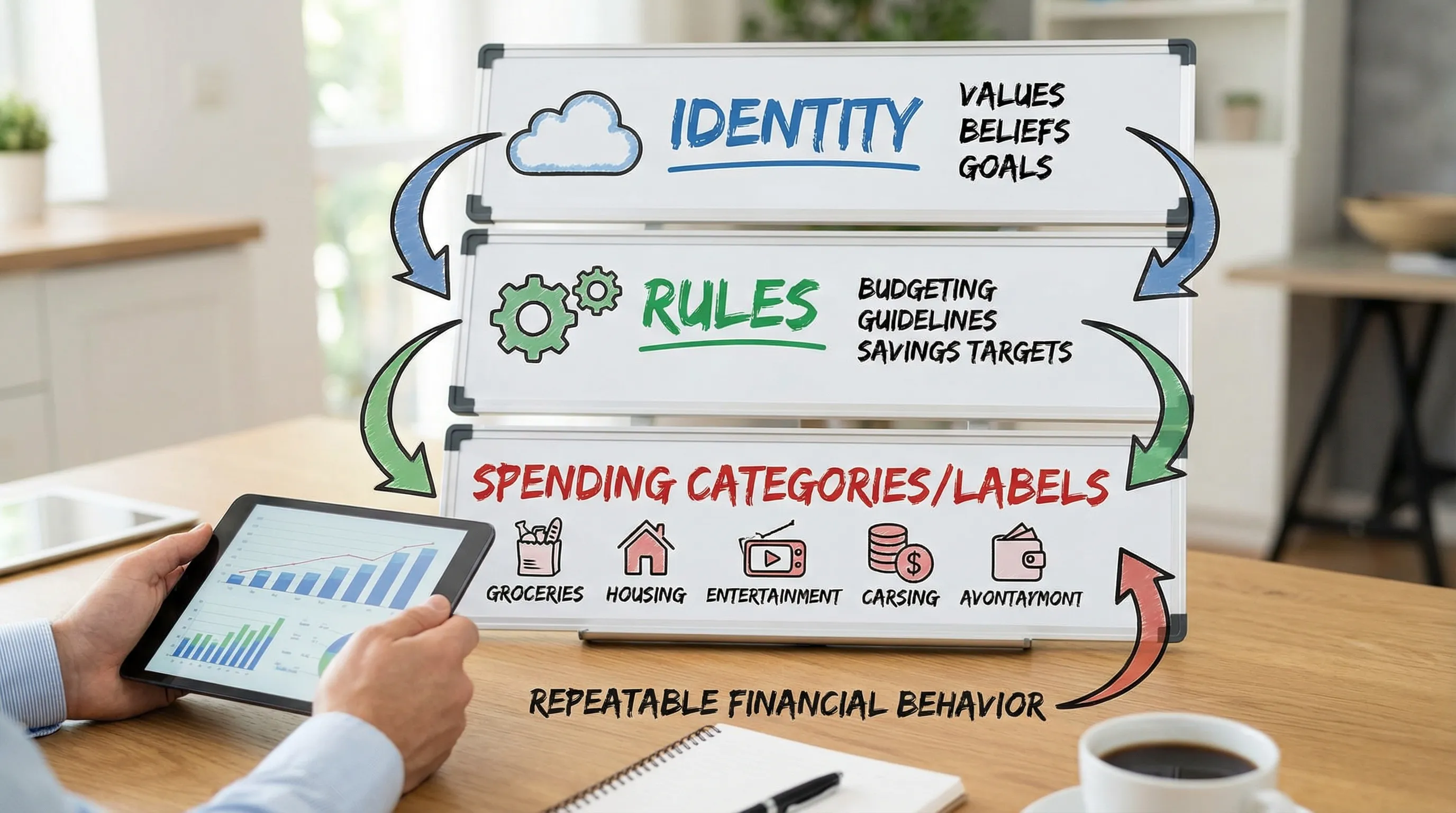
Step 3: Put identities into categories and labels (make your tracker do the heavy lifting)
This is where people mess up. They keep using generic categories like “Shopping” and “Misc” and then wonder why their money feels like fog.
Instead, build categories that reflect who you’re becoming.
Examples:
- “Strength Training” (instead of “Gym”)
- “Freedom Fund” (instead of “Savings”)
- “Date Night” (instead of “Restaurants”)
- “Career Moat” (courses, books, tools)
Then use labels to add context without exploding your category list:
- “New York Trip 2026”
- “Baby Prep”
- “Side Hustle Launch”
In FIYR, this is exactly the sweet spot: custom categories + label-based tracking lets you see whether your spending matches your identity, without turning your budget into a taxonomy dissertation.
Step 4: Build friction in the wrong direction (yes, on purpose)
Your future self does not need motivation. Your future self needs better defaults.
Friction is a weapon. Use it.
Add friction to “old you” spending:
- Remove saved cards from shopping apps
- Move impulse apps off your home screen
- Set a 24-hour delay rule for purchases over a number that actually matters
- Keep one “Chaos” category cap so overspending is visible, not hidden
Remove friction from “new you” actions:
- Auto-transfer savings on payday
- Auto-categorize recurring bills
- Use subscription tracking so you stop donating to companies you forgot existed
If you’re the type who wants to go even further, especially as a freelancer or small business owner, consider process automation beyond your budget. An AI agency that does audits and builds custom automations can help reduce the operational chaos that leaks money in the first place.
The goal is not discipline. The goal is design.
The Identity Spending Map (steal this)
Here’s a practical way to turn identity into a system you can actually run.
| Identity you want | What it looks like in real life | A simple rule | How to implement in FIYR |
|---|---|---|---|
| Calm adult | No “surprise” bills, fewer panic swipes | 1 sinking fund contribution every payday | Budget category for sinking funds + goal tracking |
| Future-you investor | Investing happens before lifestyle upgrades | Pay-yourself-first transfer on payday | Income tracking + goals + safe-to-spend visibility |
| Subscription assassin | No zombie charges, no “free trials” forever | One subscription review monthly | Subscription tracking + recurring detection |
| Debt-free operator | Credit cards are tools, not life support | Pay statement balance monthly | Track liabilities + categorize fees/interest cleanly |
| Values-based spender | More joy, less random dopamine | One “Yes” category, one “Nope” category | Custom categories + labels for experiments |
Identity isn’t fluffy. It’s a control system.
The “Identity Audit” (20 minutes, mildly humiliating, very effective)
This is the exercise that turns “I should” into “I do.”
Pull your last 30 days of transactions and do this:
1) Circle the top 10 non-bill purchases
Not your rent, not your insurance. The “choice” spending.
2) For each one, assign an identity
Ask: “What was I trying to feel or prove?”
Common answers:
- Comfort seeker
- Busy hero
- Status climber
- Treat myself survivor
- Future builder
3) Choose one identity to fire
Yes, fire it. Politely. With severance.
Script:
“I’m not the kind of person who buys relief with money I haven’t earned yet.”4) Replace it with one identity rule
Example:
Old identity: Busy hero (pays for convenience constantly) Replacement rule: “I cap delivery at $X per month, everything else is groceries.”In FIYR, you can make this easier by:
- Creating a “Delivery” category with a cap
- Adding a transaction rule that auto-categorizes DoorDash, Uber Eats, Postmates
- Watching your safe-to-spend shrink in real time when you violate your own identity (delightful)
This is how you stop “mystery overspending” and start getting clean cause-and-effect.
The scoreboard that makes identity real
Identity-based financial habits stick when you can see them.
Pick 3 metrics. Not 14. Three.
Suggested scoreboard:
- Savings rate (because it’s the loudest signal of “future me matters”)
- Subscription total (because modern life is a subscription-themed haunted house)
- Safe-to-spend (because you need a boundary, not vibes)
FIYR is built for this kind of tracking: you can see income, expenses, subscriptions, savings rate, net worth, and your path to FIRE without stitching together five apps and a prayer.
If you want to connect identity to the big picture, tie one identity directly to your timeline.
Example:
Identity: “I’m a person who buys time.”Translation: “I protect my savings rate so my FIRE date stops moving away like the horizon.”
For benchmarks on what a savings rate can do, you can cross-check your target against FIYR’s own guidance in What Is a Good Savings Rate? Real Benchmarks.
Common identity traps (so you don’t become a finance influencer in disguise)
Trap 1: The “I’m frugal” identity that quietly becomes deprivation
If your identity is “I never spend,” you eventually snap and buy a $900 jacket because you “earned it.”
Better identity: “I spend aggressively on what I value, and ruthlessly cut what I don’t.”
Trap 2: The “I’m successful” identity that’s actually just receipts
There is a difference between being wealthy and looking wealthy.
A painfully useful one-liner:
If it needs to be seen to feel real, it’s probably not real.Trap 3: The “I’ll fix it later” identity
Later is a magical land where you have more energy, fewer ads, and no subscriptions.
Later does not exist. Recurring charges do.
If subscription creep is your personal villain origin story, pair this article with Best Apps to Manage Subscription Renewals.
The 30-minute “Identity Budget” setup (do this once, then ride it)
You can set this up in one focused sprint.
Minute 1 to 10: Build the identity categories
Create 6 to 10 categories that reflect decisions, not accounting.
A clean starter set:
- Housing
- Utilities
- Groceries
- Transportation
- Health
- Fun (intentional)
- Subscriptions
- Freedom Fund (or investing)
- Sinking Funds
- Buffer (the “oops” category)
Minute 11 to 20: Add one label that matters this month
Pick one:
- “Rebuild Emergency Fund”
- “Debt Detox”
- “Side Hustle”
- “Wedding”
- “New Baby”
Labels keep your plan attached to reality, not generic advice.
Minute 21 to 30: Automate the boring stuff
Set up transaction rules for:
- Paycheck income
- Major merchants (Amazon, Target, Costco, the usual suspects)
- Subscriptions
- Transfers (so you don’t double-count)
Then schedule a weekly check-in.
Not a two-hour “life admin day.” A 12-minute scan.
Because consistency beats intensity, and intensity is how people end up rage-quitting budgeting apps.

The point (before you go buy another productivity app)
Identity-based financial habits are not about becoming “good with money.” That’s vague, moralistic, and honestly kind of boring.
They’re about becoming the kind of person whose money decisions make sense.
Spend like who you want to be, and your future stops being a motivational poster and starts being a calendar date.
And if your current identity is “financially anxious but trying,” don’t worry. That’s a real identity too.
Now give it a better system.