Automate Your Savings Without Feeling Broke
Most people don’t have a savings problem.
They have a timing problem.
Money comes in, life comes out. Rent. Daycare. The “quick” Target run that somehow costs $173. And then you try to save what’s left, like your checking account is going to spontaneously become a generous philanthropist.
Meanwhile, 60% of Americans say they’re living paycheck to paycheck. Only 45% say they have emergency savings. And 3 in 5 are in credit card debt. That’s not a personal failure, it’s a system failure.
So if you’ve tried to automate your savings and it made you feel broke, good news: you’re not weak. Your setup is.
Let’s fix it.
Why automating savings makes you feel broke (even when you’re doing “the right thing”)
Meet Sarah.
Sarah sets up an auto-transfer: $400 to savings on payday. She feels financially responsible and slightly superior.
Then day 9 happens.
Car insurance hits. A kid gets sick. Groceries are suddenly an Olympic sport. By day 12, she’s doing the classic checking-account squat: staring at the balance like it personally betrayed her.
So she transfers money back from savings. Again.
That’s not “lack of discipline.” That’s the autopay ambush: savings happens early, bills happen later, and your brain experiences it as scarcity.
Here’s what’s really going on:
- Cash flow timing is brutally literal. Savings on day 1, bills on day 17, and your checking account becomes a suspense thriller.
- You forgot your “true expenses.” Annual renewals, car repairs, birthdays, school fees, holiday travel, all the predictable chaos you didn’t monthly-ize.
- Your budget has no shock absorber. Without a buffer, every surprise becomes a withdrawal.
Automation isn’t the villain. Automation without structure is.
The “Not-Broke Automation” rule: automate what you can actually afford
You don’t automate a number.
You automate a sequence.
The right sequence prevents the most common savings failure: saving money that your future self will obviously need in 11 days.
Here’s the framework.
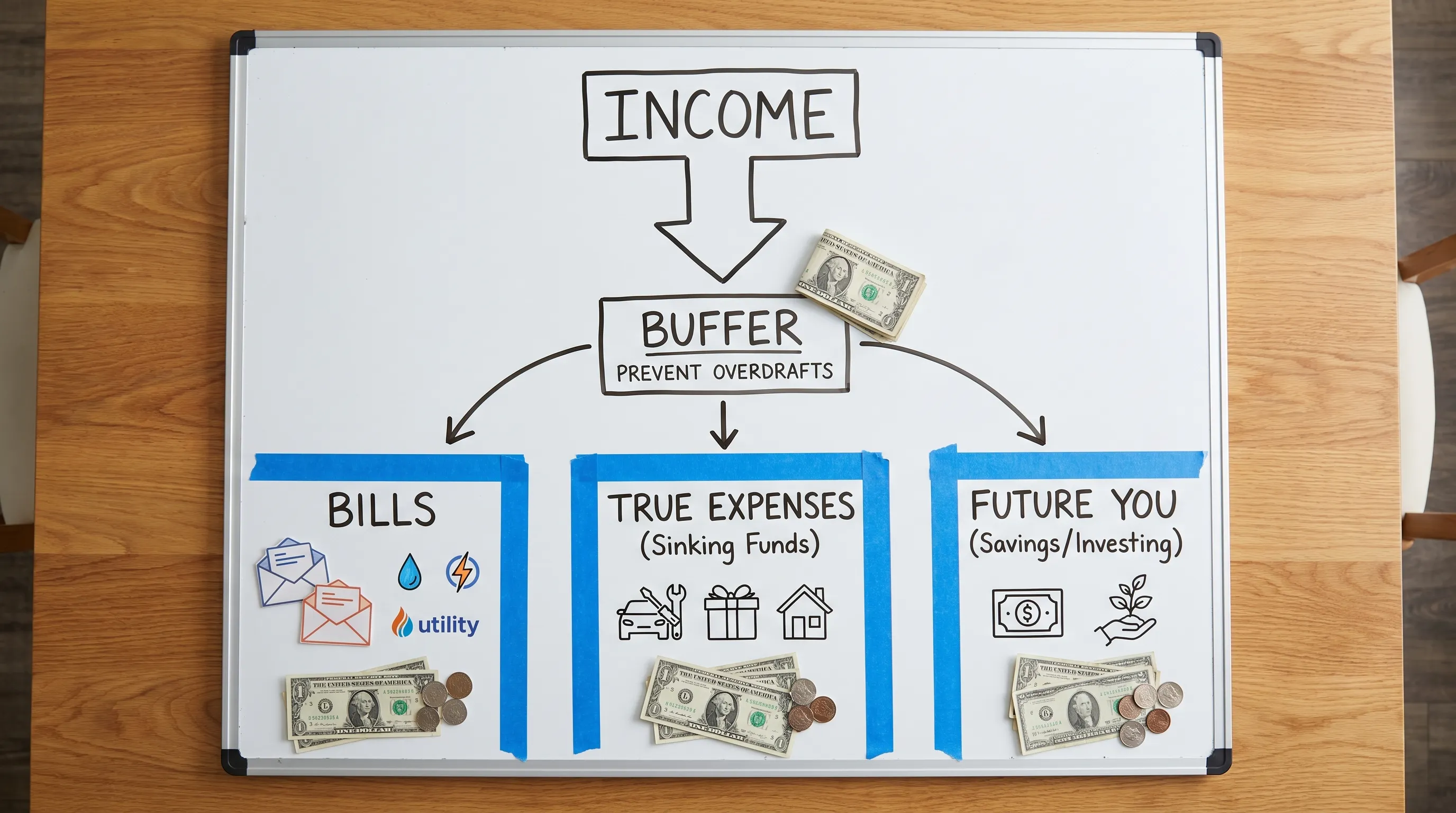
The Not-Broke Automation Stack (3 layers)
Layer 1: Protect cash flow (Buffer)This is your “I don’t panic when a tire explodes” money. Not your retirement. Not your vacation. Your sanity fund.
A simple starter target:
- $500 to $1,000 buffer if you’re in chaos mode
- 1 month of bare-bones expenses if you’re stabilizing
If you’re carrying high-interest credit card debt, you still need a small buffer. Without it, every surprise goes back on the card, and you’re stuck in the world’s most expensive hamster wheel.
Layer 2: Cover reality (Bills + true expenses)This is where most automation setups faceplant.
Your monthly budget is not just rent and groceries. It’s also:
- car registration
- annual subscriptions
- medical deductibles
- gifts
- travel
- home repairs
Predictable, irregular expenses need a monthly seat at the table. Otherwise, they show up as “unexpected” and wreck your savings.
Layer 3: Build Future You (Savings and investing)Only after layers 1 and 2 are handled do you automate long-term savings aggressively.
Because Future You is important, but Present You still needs groceries.
Quotable truth: Automation works best when it respects physics. Bills always win.
The simplest formula that prevents the broke feeling
If you want to automate your savings without feeling broke, you need a “safe-to-spend” number that isn’t fantasy.
Here’s a clean way to think about it:
Safe-to-spend = Current cash - upcoming bills - true-expense set-asides - minimum debt payments - bufferIf that number is negative, you don’t need more motivation. You need fewer obligations or more income, and probably fewer subscriptions hiding in the vents.
This is also where a modern tracker helps. In FIYR, you can track income, expenses, subscriptions, and goals, then use budgets and a safe-to-spend style setup to stop guessing. Guessing is expensive.
A practical system to automate savings in 45 minutes
No mystical mindset hacks. Just plumbing.
Step 1: Pick one “automation day” (and stop improvising)
Automation fails when you set it and forget it, but your cash flow is irregular.
Choose one day:
- Payday if you’re W-2 and consistent
- The day after payday if you have overdraft trauma and want a cushion
- Weekly if your spending is spiky and you need tighter feedback
Consistency beats perfection. Your bank account isn’t impressed by your intentions.
Step 2: Split your money into two jobs: Bills money and Life money
This can be done with separate accounts or just a clean tracking system, but the logic matters.
- Bills money: rent, utilities, insurance, debt minimums, subscriptions you actually keep
- Life money: groceries, gas, restaurants, fun, random kid-related chaos
When people feel broke after saving, it’s usually because bills and life are fighting inside the same checking account like roommates who hate each other.
Step 3: Monthly-ize your true expenses (so they stop jump-scaring you)
Take your irregular-but-predictable costs and convert them into monthly transfers.
Examples:
- $600 car insurance every 6 months = $100/month
- $240 annual Amazon Prime = $20/month
- $1,200 holiday spending = $100/month
This is the difference between “I had an emergency” and “I had a calendar.”
If you want a deeper dive, FIYR has a full guide to sinking funds.
Step 4: Choose an automation style that matches your life (not your fantasy self)
Here’s a quick scorecard.
| Automation method | Best for | How it works | Common fail point |
|---|---|---|---|
| Fixed transfer | Stable income, stable bills | Same dollar amount each payday/month | Too aggressive, causes mid-month clawbacks |
| Percentage-based transfer | Raises, commission, variable pay | Auto-save a % of each deposit | Needs a cap so big paydays don’t starve cash flow |
| Two-stage automation | People who feel “broke” easily | Small transfer now, larger transfer later | Requires you to know bill timing |
| “Save the raise” rule | Career climbers, lifestyle creep victims | Auto-route 50% to 100% of raises to savings | Forgetting taxes and benefits changes |
| Tiered floor + sweep | Irregular income, freelancers | Keep a minimum checking floor, sweep excess weekly | Needs consistent tracking or you’ll sweep bill money |
If you’ve failed before, don’t downgrade your goals. Upgrade your method.
Step 5: Add one guardrail so you don’t rage-quit
The goal is not “never touch savings.” The goal is “stop yo-yoing.”
Use one guardrail:
- Checking floor: never let checking fall below $X
- Flex cap: a weekly limit for dining, shopping, convenience spending
- Subscription ceiling: a hard monthly cap on recurring charges
Automation without guardrails is how people end up “accidentally” paying for three streaming services they don’t watch, a meditation app they resent, and a cloud storage plan for photos of receipts.
FIYR makes guardrails easier because you can set flexible budgets, track subscriptions, and use transaction rules to keep categories clean. Clean data is self-defense.
Three setups that work in the real world
Because not everyone gets paid the same way, and pretending otherwise is how advice gets people overdrafted.
Setup A: The W-2 “payday waterfall”
Use this order:
- Bills
- True expenses
- Emergency fund
- Investing
- Flex spending
If your paycheck hits twice a month, you can automate bills coverage on each paycheck, then automate savings after.
If you want a clean companion system, pair this with a spending tracker that shows income and expenses in one place, then track your savings rate over time. Seeing progress is rocket fuel.
Setup B: The irregular income “floor + sweep”
If your income is spiky, fixed transfers can be a trap.
Instead:
- Set a checking floor (example: one month of bare-bones expenses)
- Once per week, sweep any amount above the floor into savings or a tax account
The magic is psychological: you stop feeling broke because you always keep a known floor.
If this is you, the FIYR post on variable income budgeting is basically your operating manual.
Setup C: The debt-first “stop-the-bleeding” version
If you have high-interest credit card debt, the best savings automation is the one that prevents you from going deeper.
Start with:
- a small buffer ($500 to $1,000)
- automate minimum payments
- automate extra payments toward the highest APR (avalanche) or smallest balance (snowball)
Then, once the debt drag drops, redirect that payment to savings. Same cash flow, better outcome.
Your goal is to stop paying interest as a lifestyle.
How to make automation stick (the part nobody talks about)
Automation isn’t hard.
Sticking with it is hard.
The win is a tiny loop you repeat.
The 10-minute weekly “don’t feel broke” check-in
Once a week:
- Scan your upcoming bills
- Check your safe-to-spend
- Flag any weird transactions (refunds, duplicates, miscategorized transfers)
- Decide one move: cut one leak, cap one category, or increase savings by a tiny amount
This is where tools matter. If your tracker makes it painful to find what changed, you won’t do it.
FIYR is built for this kind of rhythm: spending tracking, subscription visibility, net worth and savings rate tracking, plus transaction rules so your data doesn’t rot.
Quotable truth: The best savings plan is the one that survives your worst week.
FAQ
How do I automate my savings if I’m living paycheck to paycheck? If cash flow is tight, start with a small buffer and automate tiny amounts ($10 to $50) to build the habit while you cut leaks (subscriptions, fees) and stabilize bills. Should I automate savings or pay off debt first? If you have high-interest debt, prioritize a starter buffer plus debt payoff. Then redirect the freed-up payment to savings once balances drop. What’s the best day to automate savings transfers? Usually payday or the day after. The right answer depends on bill timing. If big bills hit early, automate bills first, then savings later. How much should I automate each month? Start with an amount you can sustain for 3 months. Then increase in small steps (like 1% of income) until you feel mild friction, not panic. How do I automate savings with irregular income? Use a checking-floor system and sweep excess weekly. Fixed transfers can backfire when income dips.Build a savings machine that doesn’t make you miserable
If you’ve tried to automate your savings and ended up feeling broke, you don’t need more willpower. You need a system that understands your bills, your true expenses, and your real life.
That’s the whole point of FIYR: a modern, flexible alternative to Mint, Monarch Money, Copilot, Rocket Money, and Quicken that helps you track spending, build dynamic budgets, spot subscriptions, and measure the metrics that actually move the needle (like savings rate, net worth, and your path to FIRE).
If you want to stop guessing and start running your money like a grown-up with receipts, explore FIYR at blog.fiyr.app and build a setup you’ll still be using 90 days from now.