Personal Finance System Guide: Your Money, Finally Organized
Your money is already organized.
Just not by you.
It’s organized by rent, subscriptions, impulse buys, and that one “small” Target run that somehow costs the same as a respectable car payment.
And if you feel like you’re doing everything “right” but still treading water, you’re not broken. The system is.
According to a CNBC report, around 60% of Americans are living paycheck to paycheck, 70% are stressed about money, and 61% are in credit card debt (average balance: $5,875). That’s not a “personal failure” epidemic. That’s a “nobody taught us an operating system” problem.
This personal finance system guide is that operating system. Not a perfect-budget fantasy. A real-life system that survives busy weeks, weird expenses, and the occasional bad decision that arrives in a shiny Amazon box.
What a personal finance system actually is (and why budgets keep dying)
A budget is a plan.
A system is a loop.
A budget says, “I will only spend $400 on groceries.” A system says, “I will find out what groceries actually cost in my life, set a cap that doesn’t require sainthood, and review it weekly so it stays true.”
Most people try to win money with vibes:
- “I think I’m doing okay.”
- “I’ll start tracking next month.”
- “My bank balance looks… fine?”
That’s not a strategy. That’s just hoping your future self becomes a different person.
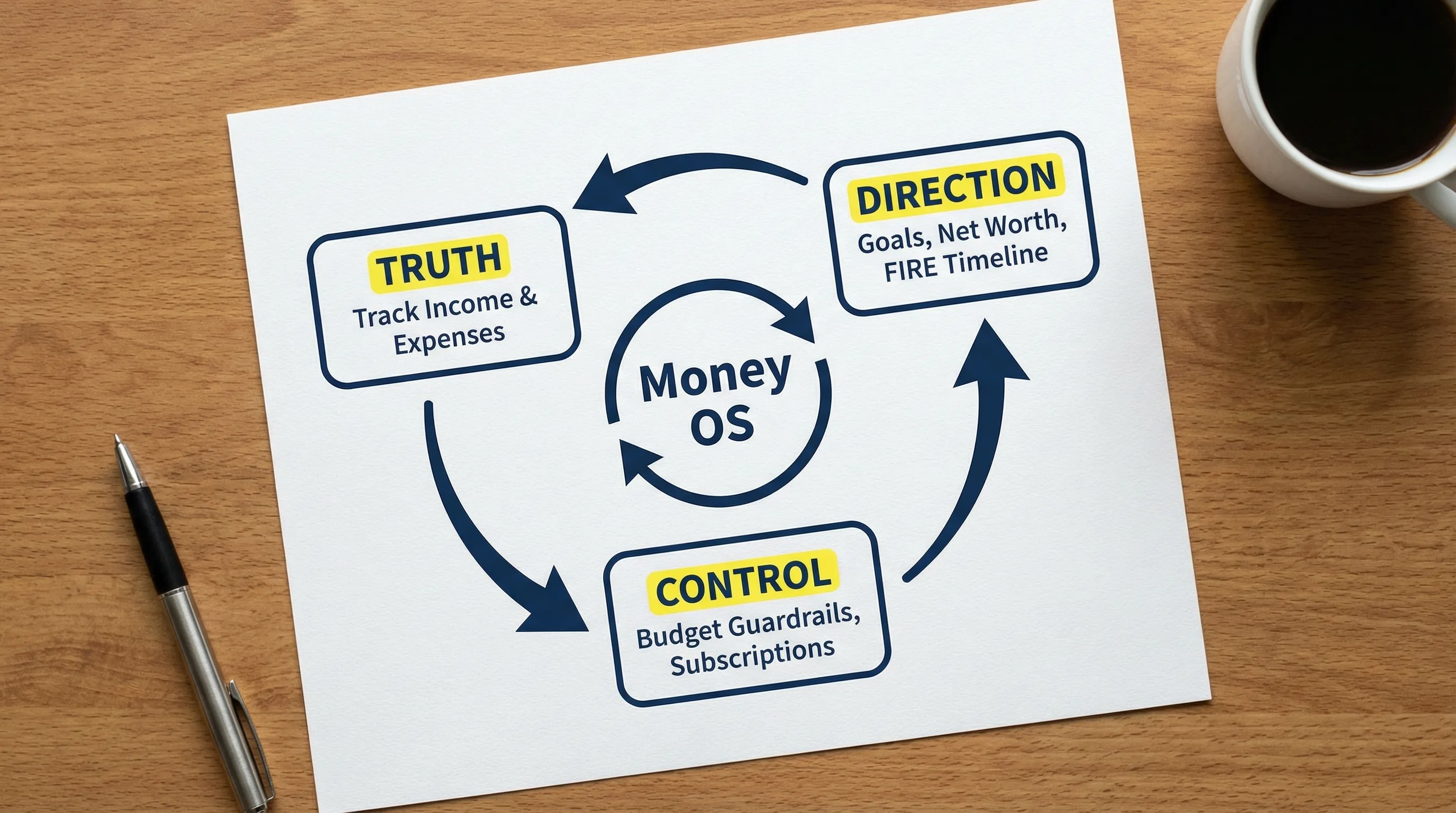
A personal finance system has three jobs:
- Tell the truth (tracking)
- Create control (budget + guardrails)
- Build momentum (goals + net worth + optionality)
If it does those three things, you stop “being good with money” and start running money like a grownup with a calendar.
The 5-number scoreboard (because complexity is where motivation goes to die)
Meet Sarah.
Sarah used Mint for years. Then Mint went away, and her financial plan became “I will not look.” She makes decent money, still feels broke, and has a recurring fear that her accounts are haunted.
What Sarah needed was not 47 charts. She needed five numbers, checked regularly.
Here’s the scoreboard that actually works:
| Metric | What it answers | How often to check | Why it matters |
|---|---|---|---|
| Safe-to-spend | “What can I spend without wrecking bills/goals?” | Weekly | Prevents accidental overspending |
| Savings rate | “How fast am I buying freedom?” | Monthly | Biggest lever for wealth and FIRE progress |
| Net worth | “Am I getting richer or just busy?” | Monthly | Tracks real momentum, not just income |
| Fixed cost % | “How trapped is my monthly life?” | Quarterly | High fixed costs crush flexibility |
| Subscription total | “What am I quietly paying for forever?” | Monthly | Subscription creep is financial termites |
The one-liner: If you can’t see it, you can’t steer it.
The Money OS: a simple personal finance system in 3 layers
Think of your finances like a phone.
You don’t need more apps. You need the operating system to stop crashing.
Layer 1: Truth (get clean data)
Truth is boring. Truth is powerful. Truth is also the part most people skip because it feels like admin.
Your mission: build a trustworthy picture of what’s happening.
That means tracking:
- Income (including irregular or side income)
- Expenses (accurately categorized)
- Subscriptions and recurring bills
- Assets and liabilities (for net worth)
This is where modern tools matter. Former Mint users already know the pain of messy categorization and mystery transactions.
FIYR is built to do the unsexy work well, tracking income, expenses, subscriptions, net worth, and savings rate in one place, with customizable categories and automation rules so your data gets cleaner over time.
Here’s the part nobody talks about: you don’t rise to the level of your goals, you fall to the level of your transaction hygiene.
Layer 2: Control (guardrails, not guilt)
Control is not “never buy coffee.” Control is “coffee is allowed, but it has a lane.”
A system needs guardrails:
- A spending plan that fits your life
- Caps on your most chaotic categories
- A way to handle irregular bills without panic
If you want a simple structure that works for most people, use three buckets:
- Floor: bills and essentials (housing, utilities, insurance, groceries)
- Flex: the fun and chaos (restaurants, shopping, hobbies)
- Future: savings, investing, debt payoff, sinking funds
This setup wins because it’s resilient. When life gets weird, you adjust Flex, not your entire identity.
Quotable truth: A budget that requires perfection is just a future breakup.
Layer 3: Direction (make your money point somewhere)
Direction is what turns budgeting from “restriction” into “power.”
This is where you connect the system to goals:
- Emergency fund target
- Debt payoff date
- Down payment plan
- FIRE number and a projected FI timeline
If you’re on the FIRE path, the goal is not to become a monk. The goal is to buy optionality.
FIYR includes FIRE-focused insights like a FIRE date calculator based on real user data, plus savings-rate and net worth tracking so your “financial independence plan” isn’t just a motivational poster.
One-liner: Goals without tracking are just expensive wishes.
The 60-minute setup sprint (do this once, then coast)
You do not need to “get good at budgeting.” You need one focused hour.
Step 1: Pick your win condition
Answer this in one sentence:
“My money system is working if __________.”
Examples:
- “I stop overdrafting and build a $5,000 emergency fund.”
- “I know what I can spend weekly without anxiety.”
- “I raise my savings rate from 8% to 20%.”
Step 2: Build a category skeleton (keep it boring)
Start with 8 to 12 categories. Yes, really.
If your categories look like a restaurant menu, you’re going to quit.
A clean starter set:
- Housing
- Utilities
- Groceries
- Transportation
- Insurance/Health
- Debt payments
- Dining and convenience
- Shopping
- Subscriptions
- Travel and fun
- Savings/investing
Step 3: Add two labels that make your life make sense
Categories explain “what.” Labels explain “why.”
Examples:
- “New York Trip 2025”
- “Baby Prep”
- “Kitchen Remodel (Regret)”
This is how you stop arguing with yourself about whether a purchase was “shopping” or “misc.” It was “Vacation,” and now you can see the total cost.
Step 4: Catch subscription creep immediately
Subscriptions are sneaky because they feel small.
$14.99 here, $9.99 there, $6.99 for an app you downloaded during a breakup and never opened again.
Set a monthly subscription cap and track recurring charges. If your tool does subscription tracking, this becomes a monthly cleanup instead of a yearly financial exorcism.
Step 5: Track net worth with brutal honesty
Net worth is just:
Assets − liabilities
Not vibes. Not “potential.” Not the resale value of your Peloton.
Track:
- Checking and savings
- Retirement and brokerage accounts
- Credit cards
- Student loans
- Auto loans
- Mortgage
The payoff: you stop judging your finances by your salary and start judging them by trajectory.
Step 6: Install one automation rule
One rule is enough to start.
Examples:
- “Any transaction with ‘Spotify’ goes to Subscriptions.”
- “Any ‘Payroll’ description gets categorized as Income.”
- “Anything from my landlord is Housing.”
The goal is to reduce manual work so your system survives your worst week.
Final one-liner: Automation is what turns good intentions into default behavior.
The weekly and monthly rituals (the glue that makes this stick)
If your system has no rhythm, it will slowly turn into financial junk drawer energy.
The 15-minute weekly money check-in
Do this once a week. Same day. Same vibe. Low drama.
- Review new transactions
- Fix anything miscategorized
- Check your safe-to-spend
- Flag upcoming bills
- Pick one small action (cancel something, adjust a cap, move money)
That’s it. You’re not writing a novel. You’re steering.
The 25-minute monthly close
Once per month:
- Confirm income totals
- Review category overshoots (no guilt, just data)
- Update net worth
- Calculate savings rate
- Decide one improvement for next month
The punchline: You don’t need motivation. You need a meeting.

The psychology piece: your money patterns are not special (sorry)
Most money chaos is just pattern repetition.
- Convenience spending spikes when you’re stressed.
- Subscriptions multiply when you’re busy.
- Shopping becomes therapy when your life feels out of control.
This is normal. Also, it’s trackable.
If you like self-awareness tools, you’ll appreciate the parallel: money patterns and relationship patterns behave the same way. You don’t fix them with shame, you fix them with visibility and better defaults. If you want a surprisingly insightful example of pattern detection outside finance, check out the DateSense dating pattern quiz and notice how quickly “random behavior” turns into something predictable when you actually measure it.
That’s the move. Measure, then steer.
How FIYR fits (without the cringe sales pitch)
You can build a personal finance system with a spreadsheet, a notes app, and sheer willpower.
You can also churn your own butter.
Tools matter because the hard part is consistency. FIYR is designed for the exact system you just read:
- Tracks spending, income, subscriptions, assets, liabilities, and net worth
- Uses customizable categories and category groups so your budget matches your life
- Supports automatic transaction rules to keep data clean
- Shows savings rate and FIRE-focused insights so progress is visible
- Includes goal tracking and a safe-to-spend style signal so you know what’s actually available
If you’re coming from Mint, or comparing Monarch Money, Copilot, Rocket Money, or Quicken, the real question is simple:
Will you still use it in 90 days?
Because that’s where the results live.
Frequently Asked Questions
What’s the difference between a budget and a personal finance system? A budget is a plan for spending, a personal finance system includes tracking, guardrails, goals, and a review rhythm that keeps the plan true over time.
How long does it take to set up a personal finance system? You can get a working version in about 60 minutes, then maintain it with a 15-minute weekly check-in and a short monthly close.
What should I track first if I’m overwhelmed? Start with safe-to-spend (or a simple checking balance buffer), total spending by category, and subscriptions. Once those are stable, add savings rate and net worth.
How many budget categories should I use? Most people do best with 8 to 12 categories. Too many categories creates friction and makes you quit.
Do I need to track net worth if I’m focused on budgeting? Yes, net worth shows whether your financial decisions are improving your balance sheet over time, especially if you’re paying down debt or building investments.
What if my income is irregular? Use a conservative monthly baseline (like a rolling average), build a buffer, and run the same weekly check-in. Your system should be stability-first, not forecast-perfect.
Your next step: build the loop, not the fantasy
If you take nothing else from this personal finance system guide, take this:
A “perfect month” is not the goal. A repeatable month is.
Set up your scoreboard. Run the weekly check-in. Do the monthly close. Make one improvement at a time.
And if you want the system in one place, with clean tracking, flexible budgeting, subscription visibility, net worth, savings rate, and FIRE-focused insights, FIYR exists for exactly this job.
Your money is not chaotic. Your system is missing. Fix the system, and the chaos gets bored and leaves.