New Year Financial Planning 2026: The No-Fluff Roadmap
January is the month we all pretend the calendar is a reset button.
Spoiler: it’s not.
Your bank account doesn’t care that you bought a new planner. Your credit card APR didn’t take a vow of silence. And your “one weird subscription” is still charging you $12.99 for something you signed up for during a 2 a.m. existential spiral.
So if you’re doing new year financial planning 2026, here’s the deal: the goal isn’t to become a monk. It’s to build a system that survives your real life, including takeout, toddlers, travel, and the occasional “treat yourself” incident.
The uncomfortable truth: most people aren’t failing at money, they’re flying blind
Meet Sarah.
Sarah is smart, employed, and has a password manager (already elite behavior). She also:
- “kind of” knows where her money goes
- has three streaming services for one household member who mostly watches TikTok
- keeps saying she’ll “get serious” once life calms down
Then Mint sunsets, her tracking falls apart, and suddenly her financial plan is vibes plus a checking account balance.
She’s not alone. According to a CNBC report, about 60% of Americans are living paycheck to paycheck, 70% are stressed about money, and emergency savings are shaky, with only 45% saying they have an emergency fund (and many of those under $5,000). Credit card debt is also widespread, with 61% carrying credit card debt and an average balance reported around $5,875. Source: CNBC.
Translation: if your finances feel chaotic, congratulations, you’re having a normal American experience.
But here’s the part nobody talks about: you don’t need motivation. You need a roadmap.
New Year Financial Planning 2026: The no-fluff roadmap
This roadmap is built for:
- ex-Mint users who want a modern replacement (without spreadsheet cosplay)
- FIRE-minded people tracking savings rate, net worth, and timelines
- couples and families who need something that won’t implode mid-February
- freelancers and variable-income humans living in “feast or famine” land
It’s six steps. Each step has a “why,” a “do this,” and a “make it stick.”
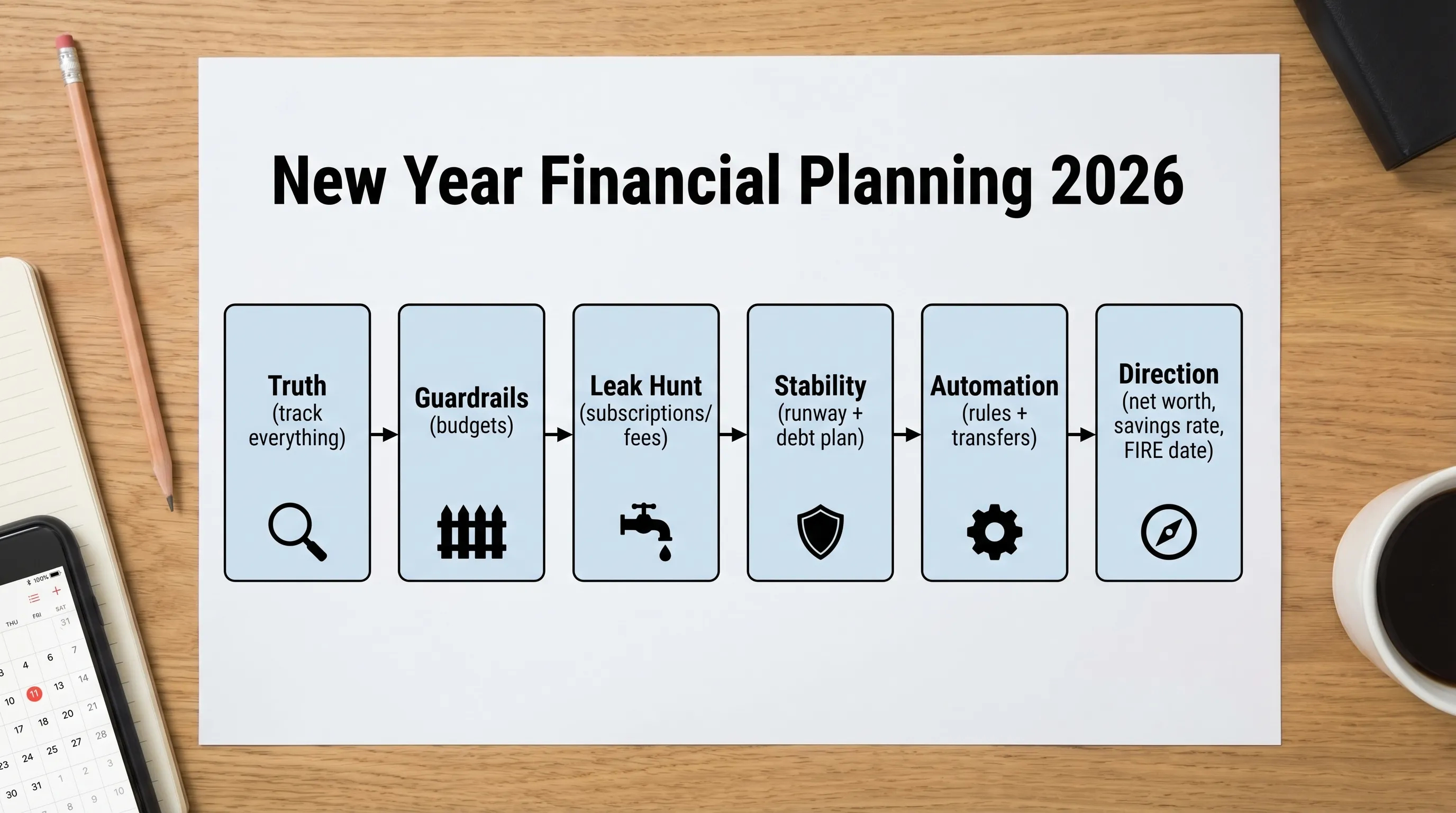
Step 1: Pick a win condition (or your plan will become interpretive dance)
Most “financial planning” fails because it’s vague. Vague goals are where discipline goes to die.
Your job: define a 2026 money win in one sentence.
Examples:
- “I will build a 3-month emergency fund by October.”
- “I will get out of credit card debt by December 31.”
- “I will raise my savings rate from 8% to 18% and keep it there.”
- “I will stop overdrafting like it’s a personality trait.”
If you’re pursuing FIRE, your win condition might be: “Increase my savings rate by 10 points and pull my FI date closer.”
Quotable truth: A plan you can measure beats a plan you can Pinterest.
Step 2: Get the truth (because “I think” is not a financial metric)
Before you optimize anything, you need a clean snapshot.
Do this in 45 minutes:
- Track the last 60 to 90 days of spending.
- Make sure income, bills, and transfers aren’t miscategorized (this is where budgets go to get haunted).
- Create a small, decision-friendly category set.
If you want a simple rule: 8 to 12 core categories is plenty. “More categories” usually means “more avoidance.”
If you’re using FIYR, this is where it shines: you can track income, expenses, subscriptions, and build custom categories and category groups that reflect your real life (not a generic template designed for someone who still pays for cable).
Quotable truth: You can’t out-budget bad data.
Step 3: Build guardrails, not handcuffs
Your budget should feel like guardrails on a mountain road, not a prison sentence.
A clean structure that works for most people:
- Floor: non-negotiables (housing, utilities, insurance, minimum debt payments)
- Flex: variable spending (food, fun, chaos)
- Future You: saving, investing, sinking funds, extra debt payoff
Now do the one thing most budgets forget: make Flex weekly.
If your Flex is $2,000/month, your brain hears “infinite.” If it’s $500/week, your brain hears “maybe don’t DoorDash smoothies twice today.”
In FIYR, you can pair this with dynamic budgets and a clear safe-to-spend signal, so you’re not doing mental math in the Trader Joe’s parking lot.
Quotable truth: A budget that only works on perfect weeks is a fantasy novel.
Step 4: Run the Leak Hunt (subscriptions, fees, and other tiny financial vampires)
The modern economy is basically:
- free trial
- forgot
- charge
And it adds up.
Do this 30-minute audit:
- Identify every recurring charge.
- Sort into: Keep, Pause, Replace, Cancel.
- Set one rule: one-in, one-out for new subscriptions.
Your goal is not “zero subscriptions.” Your goal is zero mystery subscriptions.
FIYR makes this easier with subscription tracking, so recurring charges stop hiding in plain sight.
Quotable truth: If you can’t remember buying it, you don’t own it. It owns you.
Step 5: Choose your stability strategy (runway first, then speed)
Financial planning in 2026 is two things:
- stability (so small surprises don’t become disasters)
- momentum (so you actually move forward)
That means you need two numbers:
- Cash runway (months): cash / essential monthly expenses
- High-interest debt drag: anything with an APR that could qualify as a controlled substance
Here’s a practical priority order that won’t start a comment war:
- If you have missed payments or can’t cover essentials, stabilize cash flow first.
- If you have credit card debt at high APR, attack it aggressively while building a small starter buffer.
- If you have no high-interest debt, build runway and invest consistently.
A quick scoreboard to make this real:
| Metric | What it tells you | Simple target (adjust for life) |
|---|---|---|
| Cash runway | How long you can survive if income drops | 1 month starter, then 3 to 6 months |
| Savings rate | How fast you’re building freedom | 10% baseline, 20% strong, 35% FIRE mode |
| Subscription total | How much “set it and forget it” costs | Keep it intentional, cap it |
| Debt drift | Whether balances are shrinking or creeping | Negative drift (down) every month |
| Net worth | Your actual financial gravity | Track monthly, focus on trend |
FIYR helps you track runway-adjacent reality by keeping income/expense tracking clean, showing net worth (assets + liabilities), and calculating savings rate so you’re not guessing.
Quotable truth: Stability is the cheat code that makes discipline optional.
Step 6: Automate like a lazy genius
If your plan relies on daily willpower, it’s already dead. Willpower is a limited resource, like airport Wi‑Fi and patience.
Automation moves that actually matter:
- Auto-transfer to savings/investing on payday (even small).
- Auto-pay minimums, ideally statement balance for credit cards if you can.
- Use transaction rules so your categories don’t degrade into “Misc” soup.
FIYR’s automatic transaction rules are the boring superpower here. You set the rules once, and your data stays clean without you playing accountant every Sunday night.
Quotable truth: Automate the boring, and you’ll finally have energy for the important.
The 2026 one-page plan (steal this)
You want financial planning to go viral in your own life? Make it stupid simple.
Copy this into a note, spreadsheet, or your finance app.
| Section | Fill this in | Example |
|---|---|---|
| Win condition | One measurable outcome | “Pay off $6,000 credit card debt by Nov” |
| Monthly “Floor” | Must-pay bills total | $3,200 |
| Weekly “Flex” cap | Weekly spending limit | $350 |
| Future You auto-move | Amount + cadence | $200 per paycheck |
| Leak rule | Subscription guardrail | “One-in, one-out” |
| Money ritual | When you review | Friday 15 minutes |
| Scoreboard | 3 to 5 metrics | Savings rate, runway, net worth |
This is the whole game: a plan you can run while tired.
For the self-employed: financial planning is also revenue planning
If you’re freelance, run a small business, or sell anything on the internet, your money plan can’t be only “cut expenses.” Sometimes the most rational move is earn more.
The trick is doing it with intent, not by randomly boosting posts like it’s 2017.
If you’re serious about growth and want a benchmark for what a data-driven approach looks like, check out this data-driven digital marketing agency and how they frame conversion and performance. Even if you don’t hire anyone, reading how professionals think about ROI can upgrade how you evaluate your own marketing spend.
Quotable truth: A budget can save you, but revenue can free you.
How FIYR fits (without turning this into a sales pitch)
This roadmap works with any tool. But tools change how long you stick with the plan.
FIYR is built for people who want clarity without chaos:
- full spending and income tracking
- customizable categories (so your budget matches your life)
- automatic transaction rules (so your data stays clean)
- subscription tracking (so leaks stop leaking)
- net worth tracking (assets + liabilities, not vibes)
- savings rate tracking and FIRE-focused insights
- goal tracking with a safe-to-spend balance
If you’re a former Mint user, the vibe shift is simple: less “pretty dashboard,” more “do the next right thing.”
Frequently Asked Questions
What is new year financial planning 2026, realistically? It’s a short, repeatable system for tracking money, setting guardrails, and automating progress, not a once-a-year budget makeover.
What should I do first in January 2026: budget or goals? Start with the truth: track the last 60 to 90 days so your goals and budget are built on real numbers, not optimism.
How many budgeting categories should I use? Most people do best with 8 to 12 core categories. Enough detail to make decisions, not so much detail that you stop using it.
How do I plan financially if my income is irregular? Use a conservative monthly income baseline, build a cash buffer, and automate transfers on high-income weeks. Track income streams separately so you can see patterns.
What metrics matter most for FIRE planning? Savings rate, annual spending (burn rate), net worth, and a projected FI timeline. If you can’t measure those, you’re basically speedrunning financial uncertainty.
Your next move (do this today, not “someday”)
Block 45 minutes this week. Do Step 2 (Truth). Then pick one:
- cut one recurring leak
- set one weekly Flex cap
- automate one transfer to Future You
If you want the process to be dramatically easier, use a tool that keeps your data clean and your plan visible. FIYR was built for exactly that.
Because the goal in 2026 isn’t to be perfect.
It’s to be impossible to derail.