High-Yield Savings Strategy: Earn More Interest Without Drama
If your savings is sitting in a checking account earning basically “thoughts and prayers” interest, you are doing charity work for your bank.
Meanwhile, 60% of Americans are still living paycheck to paycheck, and only 45% say they have an emergency fund. That is not a vibe, it’s a vulnerability. (Numbers via this CNBC roundup.)
A high-yield savings strategy is the simplest financial upgrade on Earth: same you, same money, more interest, less chaos. No crypto chart mood swings. No “I watched a TikTok and now I’m a day trader.” Just clean, boring, profitable.
And yes, we are going to do it without drama.
What a “high-yield savings strategy” actually is (and isn’t)
Let’s kill a myth: a high-yield savings strategy is not “open a HYSA and call it a day.” That’s like buying a treadmill and assuming you now have cardio.
A real strategy answers three questions:
- Where does your cash live, and why? (checking vs HYSA vs T-bills)
- How does money flow there automatically? (paydays, rules, buckets)
- What is this cash for? (emergency, taxes, sinking funds, opportunity)
Because the goal is not to earn an extra $18.42 in interest while your life is still held together with overdraft fees and optimism.
The goal is control, with interest as the cherry on top.
Meet Maya, who accidentally donated $1,100 to inflation
Maya is a real person in the sense that I have met Maya 400 times.
She’s responsible, employed, and has $25,000 “saved”… in a checking account. She tells herself it’s for emergencies.
Then three things happen:
- Her car needs new tires.
- Her friend’s wedding weekend turns into a $900 “memory.”
- She realizes she’s been paying for three streaming services to watch the same five comfort shows.
Her money was liquid, sure. It was also unguarded.
A high-yield savings strategy does not just pay you more, it adds friction and structure so “emergency fund” does not become “my lifestyle’s emotional support cash.”
Memorable takeaway: Your savings shouldn’t be one tap away from your bad ideas.
The boring truth about earning more interest
Interest is not magic. It is math. Here’s the kind of math you can do in your head while waiting for coffee.
Interest earned (roughly) = Balance × APYExample: $10,000 at 4% APY earns about $400 per year (before taxes). If your checking account pays 0% (or close to it), that’s a free $400 you are declining. Politely. Like an absolute maniac.
Two important fine-print items:
- Rates change. Today’s “high” might be next year’s “meh.”
- You do not need to rate-chase every 0.10%. That way lies madness.
Here’s the part nobody talks about: the biggest gains come from moving more money into the right place and keeping it there, not from obsessing over tiny APY differences.
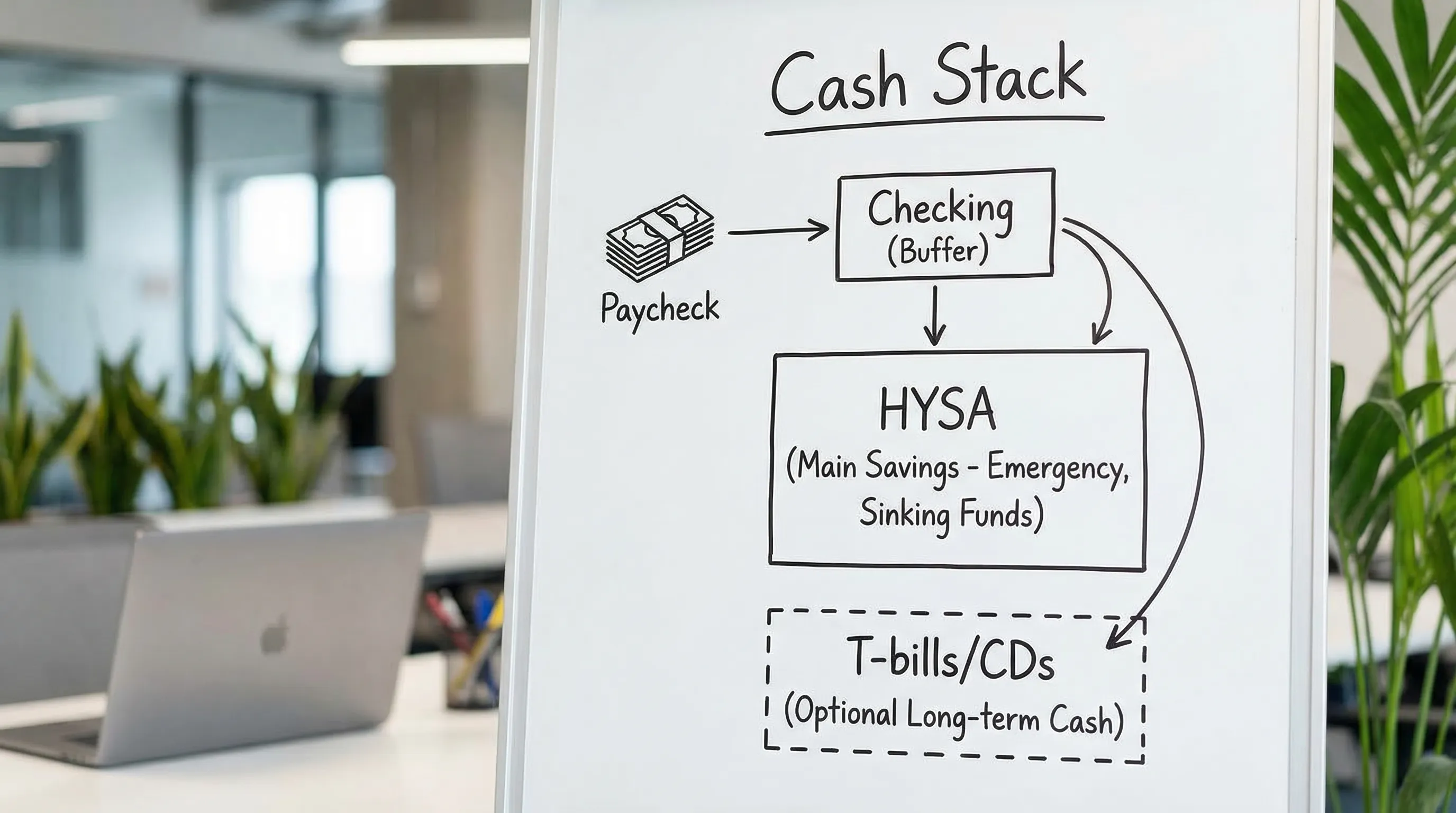
The Cash Stack: the no-drama system (3 layers)
Think of your cash like a three-layer “stack.” Each layer has a job. When each dollar has a job, it stops freelancing as impulse spending.
Layer 1: Checking (the transaction buffer)
This is your “life happens” zone.
Keep roughly 1 to 2 weeks of expenses here, enough to cover bills and normal spending without overdraft roulette.
Why not more?
Because checking accounts are where money goes to get bored and slowly lose purchasing power.
Layer 2: HYSA (your real savings engine)
This is the core of most high-yield savings strategies.
Use your HYSA for:
- Emergency fund (typically 3 to 6 months of essential expenses, more if your income is variable)
- Sinking funds (predictable, non-monthly costs like car repairs, insurance premiums, holidays)
- Near-term goals (house down payment, upcoming move, baby fund, “I want options” fund)
This layer should be FDIC insured (banks) or NCUA insured (credit unions). If you don’t know what that means, that’s okay, just know it’s the adult supervision of deposits.
You can verify coverage at the FDIC or NCUA sites.
Layer 3: “Still safe, slightly fussier” cash (optional)
If you have cash beyond your emergency fund and near-term goals, you can consider options that may yield more but require a touch more effort.
Common choices:
- Treasury bills (short-term US government debt)
- CDs (fixed term, usually a penalty if you cash out early)
- Money market funds (not FDIC insured, but often used for cash in brokerages)
This layer is for money you probably will not need tomorrow.
If you want to buy T-bills directly, start at TreasuryDirect. (Yes, it feels like it was designed in 2006. No, the government is not winning UX awards.)
Quick comparison: where your cash can live
| Option | What it’s best for | Access speed | Safety baseline | The catch |
|---|---|---|---|---|
| Checking | Bills and day-to-day spending | Instant | Bank dependent, usually FDIC | Typically low interest |
| HYSA | Emergency fund, sinking funds, near-term goals | Usually fast (ACH) | FDIC/NCUA (if insured) | Rates can change |
| Money market deposit account (bank) | Similar to HYSA | Fast | Often FDIC (confirm) | Terms vary, sometimes minimums |
| CDs | Cash you can lock for a term | Locked until maturity | Often FDIC (confirm) | Early withdrawal penalties |
| Treasury bills | Extra cash beyond HYSA layer | Term-based | Backed by US government | Slightly more setup/complexity |
| Money market fund (brokerage) | Cash parked in brokerage | Fast inside brokerage | Not FDIC | Fund risk and yield changes |
Memorable takeaway: Your cash should have a home address, not a couch to crash on.
How to pick a HYSA without getting emotionally manipulated by APY
Banks market APY the way fast food markets burgers: glossy, aggressive, and slightly dishonest.
Use this checklist to choose a HYSA like a grown-up.
HYSA checklist (no drama edition)
- Insurance: Confirm it’s FDIC (bank) or NCUA (credit union) insured.
- Fees: Avoid monthly fees, maintenance fees, and minimum balance “gotchas.”
- Transfer experience: ACH transfer times matter. If moving money feels like a hostage negotiation, you will stop doing it.
- Withdrawal rules: Some banks still enforce limits or friction. Know what you’re signing up for.
- Rate realism: Prefer consistent competitive rates over short-lived teaser promos.
- Account structure: Make sure it supports what you need (joint accounts, multiple savings buckets, etc.).
- Visibility: If you cannot easily see balances alongside the rest of your money, you will make decisions based on vibes.
Here’s the part nobody wants to admit: the “best” HYSA is the one you will actually use for the next 12 months.
The strategy that actually makes you money: automate the flow
Most people don’t fail at saving because they are dumb.
They fail because saving is a behavior, and behavior collapses under friction, stress, and “I’ll do it later.”
So do this once, then let the system run.
The Payday Split (simple, repeatable)
Pick a split that fits your life. If you want a starting point, try:
- Bills first (checking stays funded)
- Buffer next (emergency fund and sinking funds in HYSA)
- Goals last (extra savings, investing, debt payoff)
Then automate transfers so it happens the day after payday. Not when you “feel like it.”
Because you will never feel like it. That’s why DoorDash is a public company.
A clean “bucket” setup inside your HYSA
You can run a high-yield savings strategy with one account, but buckets make it stick.
Suggested buckets:
- Emergency Fund
- True Expenses (annual insurance, car maintenance, gifts)
- Near-Term Goal (travel, move, down payment)
- Taxes (if you are self-employed)
If your bank does not support buckets, you can still simulate them with separate accounts, or track them clearly in your money app.
Where FIYR fits (quietly, but powerfully)
A high-yield savings strategy gets messy when you can’t answer basic questions like:
- “How much do I actually spend per month?”
- “What’s my real savings rate?”
- “Do I have subscription leaks draining my cash flow?”
That’s where FIYR shines, not with hype, with clarity.
In FIYR you can:
- Track income, expenses, and cash balances in one place
- Use custom categories and labels to separate “Emergency Fund transfer” from “Vacation Fund transfer” (even if they go to the same HYSA)
- Add transaction rules so transfers get categorized consistently, automatically
- Monitor your savings rate and watch how cash decisions shift your FIRE timeline
- Track subscriptions so your HYSA stops subsidizing apps you forgot existed
It’s hard to build a calm cash system when your data is a junk drawer. FIYR helps you clean the drawer.
Memorable takeaway: High yield is nice. High clarity is richer.
The most common HYSA mistakes (so you can skip them)
Mistake 1: Rate chasing like it’s an Olympic sport
Switching banks for tiny APY bumps can backfire through:
- Lost time
- Transfer delays
- Broken automation
- Increased odds you give up and go back to checking-account purgatory
Rule: Only switch if the improvement is meaningful and the friction is low.
Mistake 2: Calling it an “emergency fund” but using it for vibes
If it’s truly an emergency fund, define emergencies.
A good definition: unexpected, necessary, urgent.
A bad definition: “this weekend got a little expensive and I deserve joy.”
Joy is valid. Joy should be budgeted.
Mistake 3: Forgetting taxes
If you are a freelancer, creator, or self-employed, taxes are not a surprise, they are a calendar event.
Treat taxes like a bill and route money into a dedicated HYSA bucket. Future You will send a thank-you note, written on paper made of relief.
Mistake 4: Keeping too much cash forever
Cash is for stability and near-term goals.
Long-term wealth building usually requires investing (with risk). A HYSA is not your retirement plan, it is your financial shock absorber.
If you are sitting on piles of cash with no plan, you might be overpaying for “safety” and underinvesting in your future.
A one-week high-yield savings sprint (do this, get paid)
No 47-step masterclass. Just a tight sprint.
Day 1: Decide your Layer 1 checking buffer
Pick a number (1 to 2 weeks of expenses). Set it. Stop thinking about it.
Day 2: Open or confirm your HYSA
Confirm FDIC/NCUA coverage, fees, and transfer speed.
Day 3: Create your buckets
Emergency Fund, True Expenses, Near-Term Goal, Taxes (if needed).
Day 4: Automate transfers
Route money automatically the day after payday.
Day 5: Clean your categories and rules
In FIYR (or your tracker), create consistent categories for:
- HYSA transfers
- Sinking fund transfers
- Interest income
Then add a rule so it stays clean.
Day 6: Run the “subscription leak” scan
Find the recurring charges you forgot. Cancel or downgrade one.
Day 7: Measure one metric
Pick one:
- Savings rate
- Emergency fund months (cash runway)
- Total interest earned this month
Track it monthly. What gets tracked gets better.
Memorable takeaway: Your financial life does not need more motivation, it needs fewer decisions.
Frequently Asked Questions
What is the best high-yield savings strategy for beginners? Start with the Cash Stack: keep 1 to 2 weeks in checking, put your emergency fund and sinking funds in a FDIC/NCUA-insured HYSA, then automate transfers right after payday. Are high-yield savings accounts safe? Generally, yes, if the institution is FDIC insured (banks) or NCUA insured (credit unions) and you stay within coverage limits. Always verify coverage on the provider’s site and the regulator’s site. Should I put my emergency fund in T-bills instead of a HYSA? T-bills can be great for money you are unlikely to need immediately, but they are term-based. Many people keep their core emergency fund in a HYSA for speed, then use T-bills for extra cash beyond that. How often should I switch HYSAs to chase a higher APY? Not often. Switch only when the difference is meaningful and the friction is low. A strategy you stick with beats an optimal strategy you abandon. Is HYSA interest taxable? Usually, yes. Interest from savings accounts is generally taxable income (federal, and possibly state). If you are unsure how it affects you, ask a tax pro. Should I pay off credit card debt before building a HYSA? If you have high-APR credit card debt, prioritize that. A HYSA yield rarely beats credit card interest. Keep a small starter buffer for emergencies, then attack the debt.Make your savings earn, then make it obvious
A high-yield savings strategy is not a flex. It’s a seatbelt.
You stop donating interest to your bank. You stop funding surprises with credit cards. You buy yourself time, options, and a little swagger.
If you want to make this system easier to run, FIYR helps you see the full picture: spending, transfers, savings rate, subscriptions, and net worth, all in one place, with rules that keep your data clean.
Build the stack, automate the flow, then let your money do its job.
Because adulting is hard enough, your savings should not be a side quest.