 FIYR
FIYR Barista FIRE: Pros, Cons, and How to Start the Transition
Here is the uncomfortable truth about early retirement, the fastest way to get your time back is not to stop working forever, it is to stop needing a full paycheck. That is the entire point of Barista FIRE.
What Barista FIRE Really Means (in plain English)
Barista FIRE is partial financial independence. You cover a chunk of your expenses with investment withdrawals and a chunk with flexible, lower-stress part-time work. The portfolio does not need to fund 100 percent of your lifestyle yet, which means you can exit the 9 to 5 years earlier.
- Simple formula: Barista FI number equals 25 times the annual gap, annual gap equals expenses minus part-time income.
- Example: Spend 60,000 dollars per year, plan to earn 30,000 dollars part-time, your Barista FI number is 30,000 times 25 equals 750,000 dollars. Full FI would have been 1,500,000 dollars.
How it differs from Coast FIRE: Coast FIRE means you stop contributing because your current nest egg will grow to full retirement needs by a traditional retirement age. You still need your job for living expenses today. Barista FIRE means you leave or downshift now, you fund part of your lifestyle from investments today, and part from part-time work.
Who Barista FIRE is best for:
- Burned out high performers who have a decent nest egg but not the seven-figure number.
- Parents who want time flexibility while kids are young.
- Creators, early-stage entrepreneurs, and freelancers who want a longer runway without corporate handcuffs.
- Anyone who values autonomy more than status, and is willing to trade a title for time.
Here is the part nobody talks about, you do not need a latte to do Barista FIRE, but health insurance is the secret ingredient.
The Stealth Superpower, Healthcare and Lower Taxes
Health insurance is the biggest fear in any early retirement plan. Barista FIRE tackles it two ways.
1) Employer coverage from part-time work. Some employers offer health insurance at part-time hours thresholds, typically in the 20 to 30 hours per week range. Policies change, read the fine print and verify eligibility before you bank on it.
2) ACA Marketplace with subsidies. If you do not get employer coverage, you can purchase an Affordable Care Act plan on the Marketplace. Premium tax credits scale with income, so lower work income can mean dramatically lower premiums. The Inflation Reduction Act extended enhanced subsidies through 2025, which kept many premiums more affordable for middle-income households. See the Marketplace and check your state’s numbers at HealthCare.gov. For policy context, review Kaiser Family Foundation’s explainer on enhanced ACA subsidies and eligibility rules at KFF.
Tax advantages in Barista years:
- Your taxable income is often lower, which can enable 0 percent long-term capital gains up to the top of the 12 percent bracket, check the current thresholds at the IRS.
- More room for Roth conversions at modest tax rates.
- Potential HSA eligibility if you choose a qualifying high deductible plan, triple tax advantage for future healthcare costs.
Translation, Barista FIRE converts a single giant problem, healthcare, into a manageable premium plus a few forms, and it can make your tax bill play nice too.

Pros and Cons, no sugarcoating
Pros
- Time freedom arrives years earlier, even if full FI is still ahead.
- Lower portfolio withdrawal rate early on, which reduces sequence of returns risk.
- Built-in safety valve against boredom and identity shock, you still work, just on your terms.
- Healthcare is often easier to secure through part-time employment or ACA subsidies.
- Space to build a business, go back to school, travel slow, or parent without calendar Tetris.
Cons
- You still need to show up for shifts or contracts, flexibility is real but not infinite.
- Income is variable, hours can be cut, you need a bigger emergency buffer than you think.
- Benefits can change, employer policies, subsidy rules, and premiums move.
- Social pressure, people will ask if you are “really retired”, build your own definition and move on.
One-liner to remember, Barista FIRE trades a bigger nest egg for a better life now, if you plan it like a pro, not like a daydream.
The Math That Makes Barista FIRE Work
The old rule of thumb still applies, the 4 percent rule, popularized by the Trinity Study, suggests a 25 times annual expenses target for full FI. Barista FIRE shrinks the target by replacing some expenses with part-time income.
- Full FI number equals 25 times annual expenses.
- Barista FI number equals 25 times annual gap, annual gap equals expenses minus part-time income.
Here are three realistic sample scenarios. We assume a 5 percent real return, a constant annual contribution while you are still full time, and no change in taxes or inflation beyond that 5 percent assumption. It is a model, not a promise.
| Household | Annual Spend | Part-time Income | Portfolio Covers | Barista FI Number | Starting Portfolio | Annual Contribution While Full Time | Years to Barista FI | Years to Full FI |
|---|---|---|---|---|---|---|---|---|
| Solo renter | 40,000 | 22,000 | 18,000 | 450,000 | 120,000 | 24,000 | ~9 years | ~18.5 years |
| Couple | 60,000 | 30,000 | 30,000 | 750,000 | 200,000 | 36,000 | ~9.6 years | ~18.0 years |
| Family with one child | 85,000 | 45,000 | 40,000 | 1,000,000 | 300,000 | 40,000 | ~10.1 years | ~20.0 years |
Why this matters, shaving 9 to 10 years off your 9 to 5 changes your life trajectory. That is not marginal, that is a new story.
If you prefer the savings-rate lens, remember the classic shorthand from the FIRE community, at a 50 percent savings rate, financial independence arrives in roughly 17 years, closer to 10 years at 65 percent, and about 7 years at 75 percent, see the original framing from Mr. Money Mustache’s “Shocking Simple Math” for intuition at MMM. Barista FIRE lowers the target, which can turn a 17-year path into a 9 to 10 year path with the same habits.
Data punch for context, money stress is real. Around 60 percent of Americans live paycheck to paycheck and a majority report money stress, according to CNBC’s reporting on recent surveys, see CNBC. A partial exit plus a plan beats a full meltdown plus wishful thinking.
Healthcare, Budget Lines, and Realistic Cash Flow
Your new monthly budget needs three things dialed in.
- Healthcare line item: price employer plan options, then model ACA Marketplace premiums using your estimated Barista-year income. Adjust for HSA contributions if available.
- Variable income buffer: aim for 6 to 12 months of essential expenses in cash. Hour cuts happen. Side gigs go quiet. You want optionality, not anxiety.
- Withdrawal discipline: set a monthly transfer from your portfolio equal to the gap, not more. Treat overspending as a problem to solve with hours or cuts, not higher withdrawals.
Example cash flow for the couple scenario above after transition:
- Part-time take-home: 2,400 dollars per month.
- Portfolio draw (4 percent on 750,000 dollars, paid monthly): about 2,500 dollars per month.
- Total monthly income: about 4,900 dollars.
- Essentials target: 4,500 dollars, which includes housing, utilities, groceries, insurance, transport, and healthcare premiums.
- Safe-to-spend buffer: about 400 dollars, fun money plus a little wiggle room.
If you can live on the Barista budget for three months straight before you pull the ripcord, you are ready.
A 7-Step Transition Plan
1) Get your numbers honest. Track 3 to 6 months of spending by category. Identify your true baseline and your non-negotiables. If you do not know your monthly burn, you are not ready.
2) Define your Barista target. Choose a realistic part-time income number, then calculate the gap and the Barista FI number. Use 25 times the gap as your portfolio goal. Review our 4 percent rule explainer for context at Unlocking the 4 percent Rule.
3) Model healthcare. Price employer part-time options and pull Marketplace quotes at HealthCare.gov. Decide whether an HSA-eligible plan makes sense.
4) Build a bigger buffer. Stack 6 to 12 months of essential expenses in your emergency fund. If you are self-employed or have kids, aim high. Our guide can help at Emergency Fund, The Ultimate Safety Net.
5) De-risk your lifestyle. Kill subscriptions you no longer use, eliminate high-interest debt, and fix the big three, housing, transport, food. Each 100 dollars cut is 2,500 dollars less needed in your portfolio.
6) Warm-start your part-time income. Line up the job or the first three clients while you are still employed. Negotiate minimum hours, predictable shifts, and any benefits in writing. Use simple scripts like, “I am excited about the role. Can we confirm the weekly hours range and health coverage eligibility so I can plan accordingly?”
7) Set a date and communicate. Give notice respectfully, lock your schedule, and celebrate the new chapter with a zero-based Barista budget.
Quote to pin to your fridge, If it is not on the calendar and in the budget, it is not a plan, it is a Pinterest board.
The 30-Day Barista FIRE Crash Test (prove it before you pivot)
- Week 1, run the math. Calculate your Barista FI number and a draft monthly budget. Price healthcare and taxes. If the spreadsheet makes you sweat, adjust the plan, not the assumptions.
- Week 2, live the hours. Work your current job at 80 percent time or simulate by blocking out two afternoons as “off limits” and practice a part-time rhythm. Use the time for rest, errands, and a small paid project.
- Week 3, live the money. Cap spending at the Barista budget for 7 days. If you blow the cap, identify the exact category and fix it.
- Week 4, fix the leaks. Cancel at least three subscriptions, renegotiate one bill, and sell something you would not buy again. Small wins multiply.
Optional bonus, take one unpaid day to test healthcare logistics, schedule a preventive visit, estimate out-of-pocket costs, and make sure your doctors are in-network.
How FIYR Makes This Easier
Oh, and by the way, all of this is much easier if your money system is doing the heavy lifting.
- Track income and expenses automatically, then slice by custom labels like “Barista Pilot Q1” to see the full cost of your test month.
- Build a Barista budget with category caps and a safe-to-spend number that updates as transactions post.
- See your savings rate and projected FIRE timeline in one place, then toggle scenarios as you model part-time income.
- Apply automatic transaction rules so you do not spend your new freedom categorizing lattes as groceries.
- Monitor net worth and your gap draw, assets plus liabilities, so you stay disciplined on withdrawals.
- Track recurring charges with subscription tracking, because Barista FIRE dies by a thousand 9.99 charges.
FIYR was built for people who want not just a budget, but mastery. If you are migrating from Mint or shopping Monarch and Copilot, FIYR is the flexible, FIRE-first alternative.
For deeper background as you plan, see our guides on Boosting Your Savings Rate, Index Fund Investing for Beginners, and What Is the FIRE Movement.
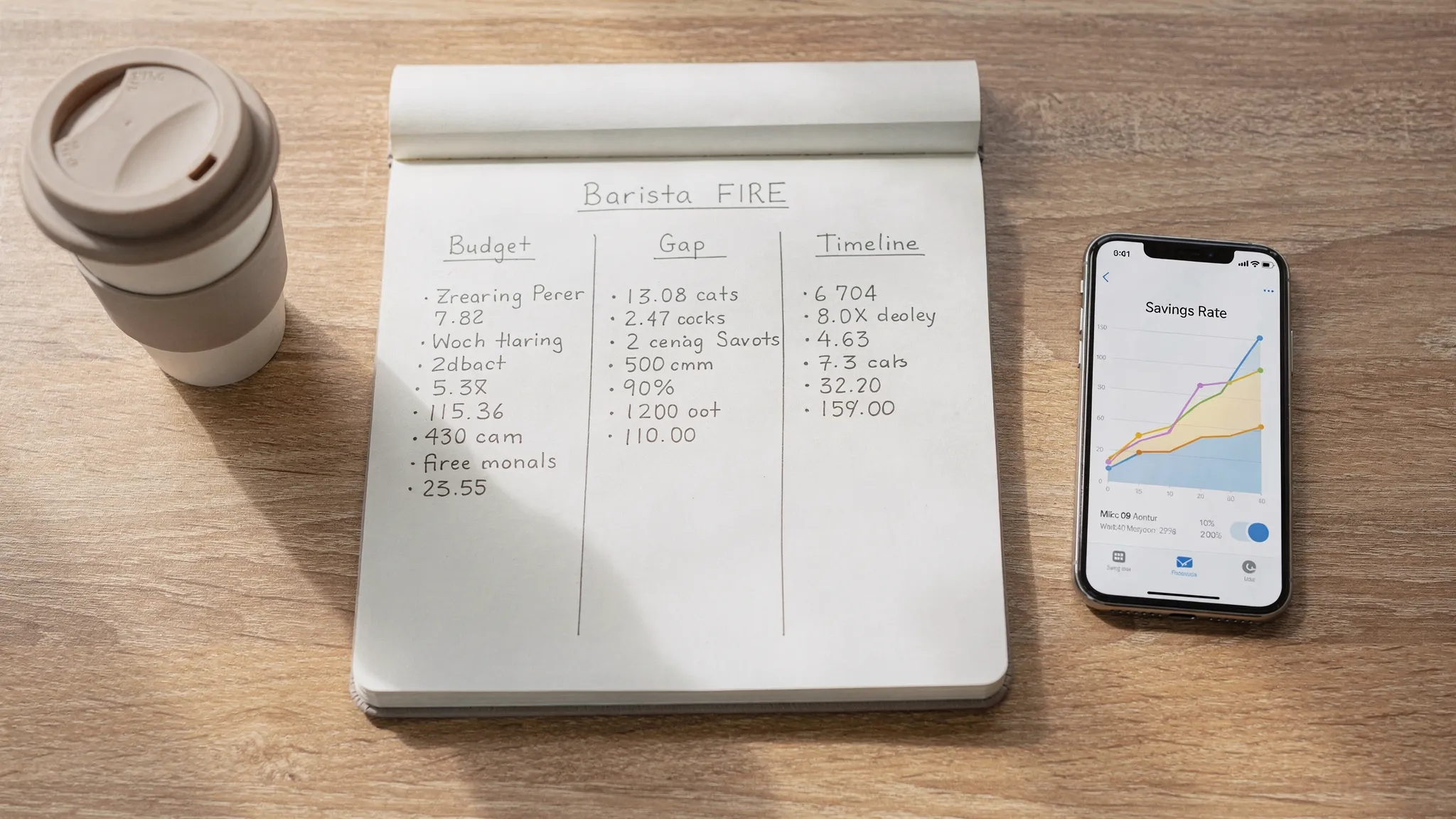
Example Budgets You Can Steal
These are monthly targets that map to the three scenarios. Replace with your real numbers.
Solo renter, 40,000 dollars per year spend target, about 3,333 dollars per month
- Housing 1,400, utilities 200, groceries 350, transport 300, healthcare premiums 250, out-of-pocket 75, phone and internet 120, fun 250, travel 200, misc 188.
- Part-time take-home around 1,833, portfolio draw around 1,500.
Couple, 60,000 dollars per year spend target, about 5,000 dollars per month
- Housing 2,100, utilities 250, groceries 650, transport 500, healthcare premiums 500, out-of-pocket 150, phone and internet 150, child-free fun 350, travel 250, misc 300.
- Part-time take-home around 2,500, portfolio draw around 2,500.
Family with one child, 85,000 dollars per year spend target, about 7,083 dollars per month
- Housing 2,600, utilities 300, groceries 900, transport 700, childcare or school 1,200, healthcare premiums 700, out-of-pocket 200, phone and internet 170, family fun 400, travel 400, misc 513.
- Part-time take-home around 3,750, portfolio draw around 3,333.
If your real numbers come in higher, adjust two levers, spend less or earn a bit more part-time. Five hours a week or one big fixed cost is often the difference between stress and glide path.
Common Pitfalls to Avoid
- Counting on max hours that never materialize. Underwrite to the low end of your likely schedule.
- Underestimating healthcare costs. Budget premiums plus out-of-pocket plus dental and vision.
- Lifestyle inflation the moment you breathe again. Put travel and fun in the plan, then keep the total cap.
- Pulling from the portfolio for upgrades that should be earned with hours. Barista means bridge income, not all-access ATM.
Spicy take, your budget is not broken, your system is. Fix the system, the numbers follow.
FAQs
What is Barista FIRE? Barista FIRE is partial financial independence where you cover part of your spending with investment withdrawals and the rest with flexible part-time work. The goal is freedom years earlier than full FI while keeping healthcare and cash flow stable. How is Barista FIRE different from Coast FIRE? Coast FIRE means your current nest egg will grow to support full retirement at a later age, but you still need to work for your living expenses now. Barista FIRE means you downshift now and use your portfolio today for part of your costs, with part-time work covering the rest. How much do I need for Barista FIRE? Use 25 times the annual gap between expenses and planned part-time income. If you spend 60,000 dollars and will earn 30,000 dollars part-time, your Barista FI number is 750,000 dollars. What about health insurance? If your part-time employer offers coverage, great. If not, the ACA Marketplace provides income-based subsidies that can lower premiums, see HealthCare.gov. Lower taxable income in Barista years can also unlock favorable tax brackets for capital gains and Roth conversions, check the IRS. Should I keep investing after I switch to Barista FIRE? Ideally yes, even small contributions help and reduce the future gap. At minimum, avoid selling more than your planned withdrawal to fund lifestyle creep. What returns should I assume? We modeled 5 percent real returns for simplicity. Markets are volatile. Stress test your plan with lower returns and a higher healthcare line item. Is Barista FIRE only for coffee shop jobs? No. The name comes from famous part-time employers, but any flexible income counts, retail, seasonal work, contract gigs, teaching, consulting, creative services, delivery, you name it. ---Bottom line, you do not have to wait for a perfect number to start living a better life. Design the gap, buy your time back with part-time income, and let compounding do the rest. If you want to make the transition with fewer surprises, track everything in one place and pressure test your plan with real numbers. FIYR can help you do exactly that, from spending and subscriptions to savings rate, net worth, and a FIRE date calculator that reflects your Barista income. Then go live the calendar you actually want.